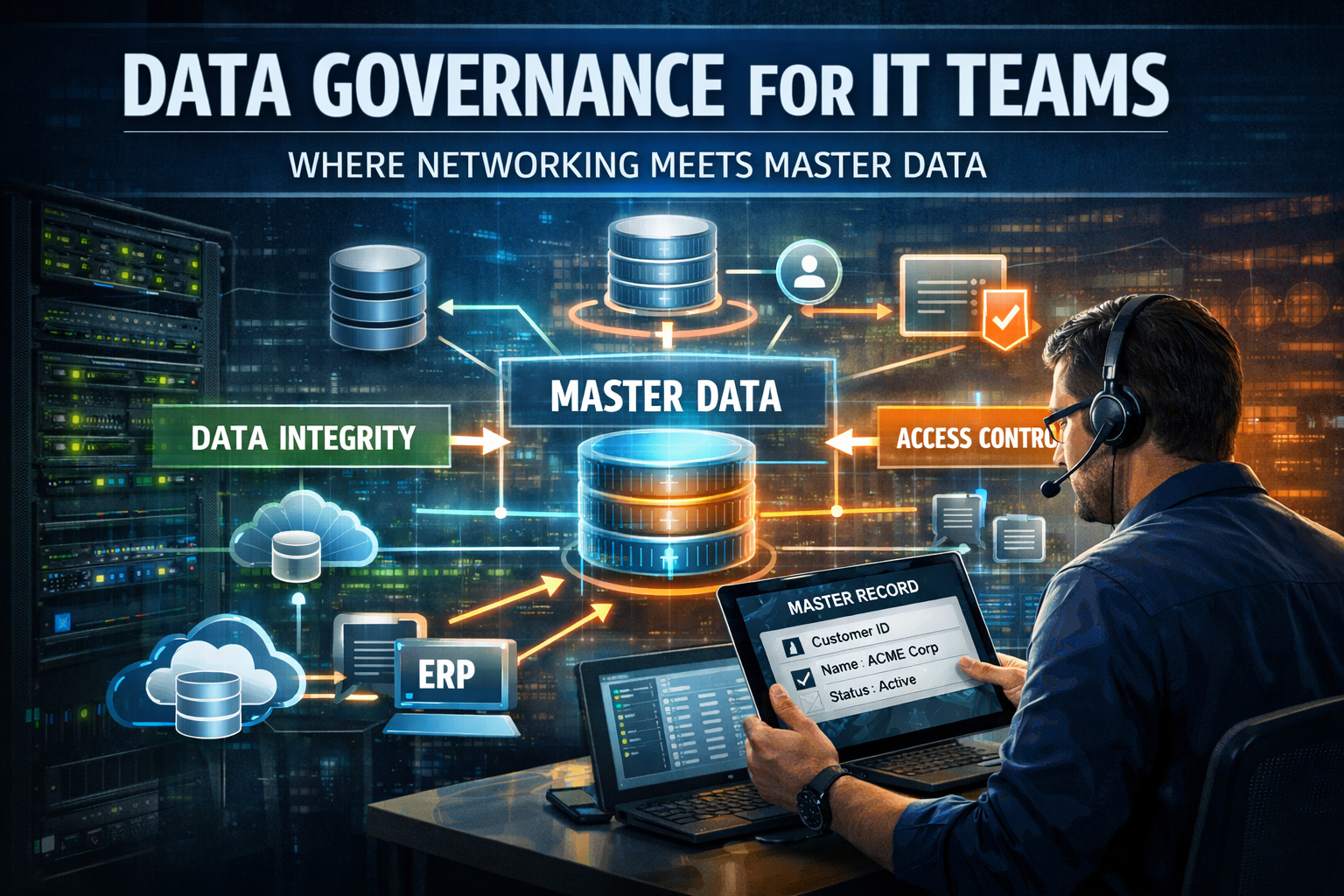
Ask a network engineer about data governance and you will often get a shrug. It sounds like a compliance team’s problem, filed next to policy documents nobody reads.The people who work with Information Technology and networking are usually the ones who have to deal with the problems caused by management. This can be things like duplicate records for customers that stop an integration from working or identifiers for devices that’re not consistent and make it hard to track assets. It can also be fields that do not match and turn a contract for an Application Programming Interface into a support ticket that someone has to deal with at 2 in the morning. If you are in charge of the systems that move Information Technology data then you have a big interest, in making sure that Information Technology data is reliable.
Two disciplines that are quietly converging
Networking is really about getting packets from point A to point B without any issues. Data governance is about making sure the information that gets to point B is correct and means the same thing every time it is used. For a time these two things were thought of as separate. That is not the case anymore.
As companies start connecting systems like cloud platforms and SaaS tools and databases and Internet of Things devices and other machines it gets harder to tell the difference between just moving data around and actually managing it. The people who work on making all these systems talk to each other are now the ones who notice when something is off like when the Customer ID in one system does not match the Customer ID in another system.. When two systems do not agree on what some information means. Networking and data governance are closely related to data and data is a part of what these systems are all, about so people who work with data and Networking and data governance are really important. Network and platform teams have become, by default, the first line of defence for data integrity.
Master data: an addressing scheme for your business entities
Here is a framing that lands with networking teams. DNS gives every host a single authoritative name so the rest of the network does not have to argue about where to send traffic. Master data does the job for business things like customers, products, suppliers, locations and employees. It gives each of these business things a record that every system can use.
This single record is very important. Without it every time we connect two systems we need to translate the data.. Every time we translate data we can make mistakes. If we have systems connected we can make a lot of mistakes. It is like a map with directions. Things can still move,. We are not sure if they are going to the right place. The main idea of data governance and master data management is to create a record for each important business thing. We need to decide who is responsible for making sure the record is correct. We also need to make rules to keep the record consistent when it is used by systems. Master data management is about making sure we have master data for customers, products, suppliers, locations and employees. Master data is important for business entities, like customers, products, suppliers, locations and employees. Think of it as pairing an authoritative source of truth with the access and change-control policies that keep it clean – the data-layer equivalent of disciplined IP address management plus change control.
Why IT teams should care, in concrete terms
Fewer incidents
A large share of integration failures and data-sync bugs trace back to inconsistent master data, not broken code. When two systems disagree about a record, the symptom shows up as a failed job or a corrupted feed – and the on-call engineer pays for it. Governance attacks the root cause instead of the symptom.
Security and access alignment
Governance defines who can read and change sensitive records. That sits directly adjacent to the identity and access controls networking and security teams already manage. Done well, governance and IAM reinforce each other rather than duplicating effort.
Reliable automation
The automated workflows IT increasingly owns only work if the underlying records are consistent. Feed an automation messy data and you have simply automated the production of errors at scale – faster, and harder to trace.
Audit and compliance
When an auditor asks where a data point originated and who changed it, governance is what lets you answer in minutes rather than launching a forensic investigation. Lineage and ownership turn a dreaded request into a routine one.
A practical starting point for IT teams
- Identify the two or three entities that cause the most pain across systems – usually customers, products, or assets.
- Document where each is currently mastered, and where duplicates or conflicts arise.
- Decide which system should be authoritative for each entity, and how others should sync from it.
- Assign ownership: a named person accountable for each entity’s quality, not a committee.
- Put change-control around it – the same discipline you would never skip on a production routing config.
You do not need to boil the ocean. One well-governed entity – say, a clean, authoritative customer record that every system resolves against – removes a surprising amount of recurring pain and proves the value before you expand.
A worked example: the duplicate customer record
Picture a customer who exists three times across your systems – once in the CRM as Acme Corp, once in billing as Acme Corporation, and once in support as ACME. Each system is internally consistent, so nothing looks broken. Then an integration tries to sync billing status into the CRM, cannot match the records cleanly, and either fails or – worse – updates the wrong one. The support team sees a paid customer flagged as overdue, the automation that should have paused only that account misfires, and an engineer spends an afternoon tracing a bug that was never in the code. It was in the data. A single golden record, with one system authoritative and the others syncing from it, removes the entire class of problem.
Tooling, and where to draw the line
You do not need an enterprise master-data platform on day one. Many teams start with disciplined process – a documented system of record per entity, validation rules at the point of entry, and a reconciliation job that flags mismatches – before investing in dedicated MDM tooling. The principle matters more than the product: decide what is authoritative, control who can change it, and make divergence visible. Buy tooling when manual reconciliation stops scaling, not before.
The takeaway
Framed this way, governance is not paperwork. It is reliability engineering for data. When you think about it, the people who know about networks and data are really important. They are the ones who will keep the business running. You see, data governance is not something from networking work. It is actually a part of the same job. The teams that understand both networks and data will be the ones who really know what they are doing. Data governance and networking work are becoming more connected all the time.