At some point, almost every growing software company asks the same question:
Where should we build our team?
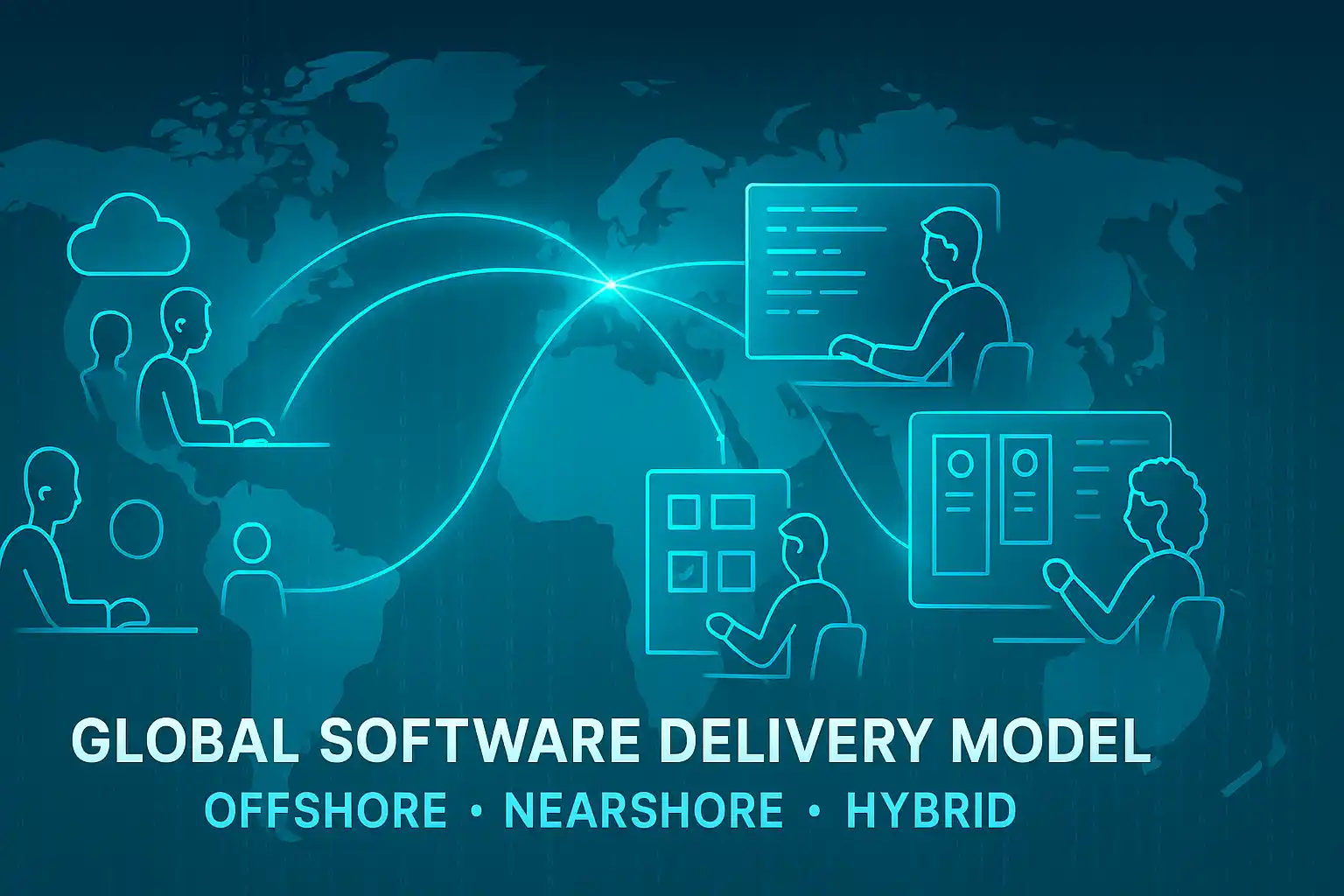
Not just who to hire, but where to place capability. In-house only? Nearshore partners? A fully offshore structure? Some kind of hybrid model?
The answer isn’t ideological. It’s structural.
And the companies that make this decision based on slogans (“offshore is cheap” or “nearshore is easier”) usually end up revisiting it within two years.
Let’s unpack what actually matters.
The Old Debate: Cost vs Communication
For years, the conversation was framed too simply.
- Offshore = lower cost
- Nearshore = easier collaboration
- In-house = more control
That framing made sense when distributed collaboration was clunky and tooling immature. Time zone differences created friction. Video calls were unreliable. Documentation lagged.
But today? Slack, Git workflows, CI/CD pipelines, AI-assisted documentation, and async culture have changed the operational reality.
The debate is no longer just cost versus communication. It’s about structure, ownership, and integration maturity.
What Offshore Really Means Today
Offshore doesn’t automatically mean outsourcing projects to the lowest bidder anymore.
In mature organizations, offshore often means building long-term engineering capacity outside the company’s home market. It can involve stable teams, shared processes, and deep integration into product roadmaps.
Many global technology firms establish an offshore development centre in India, particularly in Bangalore, where decades of engineering investment have created a dense ecosystem of software talent, technical universities, and product-focused experience. The model works not because it’s “cheap,” but because it’s scalable.
The difference between transactional outsourcing and a structured offshore development centre is commitment. One is project-based. The other is strategic.
Nearshore: The Collaboration Comfort Zone
Nearshore models often appeal to companies that value time zone overlap and cultural proximity.
When teams operate within one to three hours of each other, real-time collaboration becomes easier. Meetings are simpler to schedule. Travel is shorter. Regulatory alignment may be more straightforward.
But nearshore is not automatically more efficient.
If processes are unclear, if ownership is weak, or if integration is poor, proximity won’t fix structural issues. Geography reduces friction, it doesn’t eliminate misalignment.
Hybrid Models: Where Most Companies Eventually Land
Interestingly, many organizations that start with a strong preference, offshore or nearshore, eventually move toward hybrid structures.
Why?
Because different layers of the product require different proximity levels.
- Core product leadership may remain in-house.
- Architecture oversight might sit close to executive teams.
- Scalable development capacity may operate offshore.
- Specialized teams might be nearshore for collaboration-intensive work.
Hybrid models acknowledge a simple truth: not all work requires the same collaboration density.
Talent Density vs Talent Location
Here’s a question leaders don’t ask often enough:
Are we optimizing for geography, or for talent density?
Certain global hubs offer concentrated expertise. Bangalore, for example, isn’t just a low-cost destination, it’s one of the largest engineering ecosystems in the world. That matters.
Talent density affects:
- Hiring speed
- Replacement cycles
- Domain specialization
- Long-term scalability
When companies choose locations purely based on hourly rates, they often miss the bigger picture. Access to mature engineering ecosystems can determine whether a model succeeds long term.
Governance: The Hidden Variable
Regardless of offshore, nearshore, or hybrid, governance determines success.
Clear ownership. Defined review standards. Shared tooling. Transparent communication protocols. These matter more than physical distance.
Companies that fail with offshore often blame geography. In reality, they lacked integration maturity.
Companies that succeed offshore invest heavily in:
- Process alignment
- Documentation discipline
- Stable team structures
- Long-term relationship models
Without those, any model will eventually fracture.
When Offshore Makes Strategic Sense
Offshore models tend to work well when:
- The company has clear product ownership internally
- Architecture is defined
- Work can be structured into stable team pods
- There is a long-term commitment, not short-term project outsourcing
It works less well when leadership expects instant integration without investing in onboarding, culture alignment, and governance.
Scaling across borders is not about cost reduction. It’s about system design.
The Wrong Question to Ask
Leaders often ask:
Which model is best?
The better question is:
Which model aligns with how our organization actually operates?
If your internal structure is chaotic, offshore will amplify that chaos.
If your internal structure is disciplined, offshore or hybrid models can extend it efficiently.
Delivery models don’t fix strategy. They amplify it.
Conclusion: Geography Is a Tool, Not a Strategy
Choosing between offshore, nearshore, or hybrid isn’t a moral decision. It’s an operational one.
The right answer depends on product complexity, leadership maturity, talent access, and integration capability. Companies that treat global delivery as a structural design choice, not a cost shortcut, build more resilient systems.
In the end, geography matters less than alignment.
And alignment is never accidental.
FAQs
What does offshore software delivery really mean today?
Offshore software delivery involves building long-term, integrated engineering teams in distant high-talent locations such as Bangalore, India. It focuses on scalability, deep product ownership, and shared processes rather than pure cost cutting. Modern collaboration tools have removed most friction, but success demands strong governance, documentation, and cultural alignment. Without these, even the best offshore setup will amplify internal chaos.
How does nearshore software delivery differ from offshore?
Nearshore software delivery places teams in locations with only 1–3 hour time-zone overlap and cultural similarity, making real-time meetings, travel, and regulatory alignment far easier. While it reduces daily friction compared to offshore, it does not automatically solve weak processes or unclear ownership. Nearshore is ideal for collaboration-intensive work, yet still requires the same level of internal discipline as any other model.
When is a hybrid global software delivery model the smartest choice?
A hybrid global software delivery model is best when different parts of your product need different proximity levels — core leadership and architecture stay close or in-house, heavy scalable coding moves offshore, and high-collaboration tasks use nearshore. Most mature companies naturally evolve to hybrid because it delivers resilience, cost efficiency, and speed simultaneously. It optimizes every layer instead of forcing one-size-fits-all geography.
What are the key factors when choosing a global software delivery model?
Key factors include product complexity, leadership maturity, talent access speed, and your organization’s integration capability. Strong governance makes offshore or hybrid thrive; weak governance makes any model fail. Focus on long-term structural design rather than short-term rates. Geography is merely a tool — the real decision is how well the chosen model aligns with your operational maturity and growth ambitions.