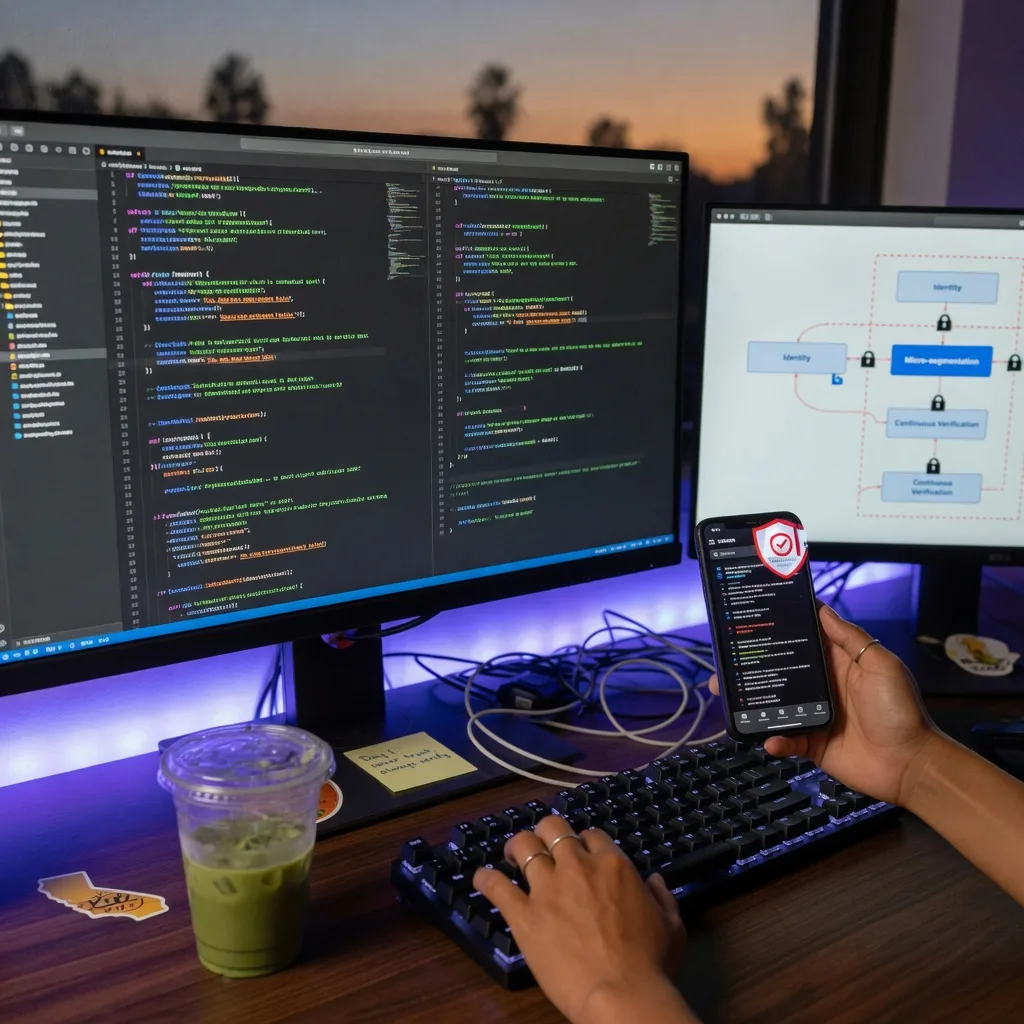
Anyone who has shipped a mobile app against a hard deadline knows the quiet way security dies. Someone raises it in the kickoff meeting, everyone nods, and it turns into a ticket.
That ticket picks up a label, waits for a sprint with room to spare, and keeps sliding to the next one, because there is always a login screen to finish or an investor demo that cannot move.
Launch day arrives, the app works, users pour in, and somewhere a tired voice in the back of your head asks who is actually hitting the backend right now and whether those requests even came from your real app. Most teams cannot answer that with a straight face.
That slow death is the habit California app development experts have decided to break. Instead of bolting protection on after launch, when it costs more, and half the codebase already assumes everyone is friendly, they put it into the first diagram on the whiteboard, before anyone designs a single screen.
The model they reach for goes by a name that sounds colder than it feels in practice. A phone never earns the benefit of the doubt. Neither does the network it rides on, the token sitting in its memory, or the person tapping the screen.
It sounds exhausting. Done early, it turns out to be the thing that lets a small team actually sleep.
Why bolting security on later never works
“It will get hardened before launch” is one of the great lies of product development, and most engineers know it while they are saying it.
The reason is simple… trust assumptions get baked into the foundation. If the app was built assuming the backend can rely on whatever the client sends, you cannot patch your way out of that later without tearing things apart.
None of this is theoretical, and the numbers stopped being polite a while ago. One study took apart a sample of roughly 156,000 iOS apps and found more than 815,000 secrets hardcoded straight into them, the kind of keys that hand an attacker a clean way in.
Every one of those started life as a developer who needed to ship and promised to move the key somewhere safe later. Later rarely comes.
Free tools that anyone can download will lift a static key out of an app binary in seconds. The flood of new Android malware keeps climbing, too, up more than 25 percent in a single recent quarter.
What zero trust actually means on a phone
Strip away the conference talk, and the idea is plain. Verify everything, every time, and assume the environment is already hostile. The old model treated the network like a castle. Cross the wall once, and you are trusted inside forever.
Mobile killed that years ago, because your app runs on hardware you do not own, across networks you cannot see, in the hands of users you cannot vouch for.
John Kindervag, who created the Zero Trust model at Forrester and now serves as chief evangelist at Illumio, built the whole approach on one uncomfortable idea. In his words, trust is “a vulnerability.”
The United States government eventually came around to the same view. NIST now describes zero trust as designing security as though the system has already been breached and no safe perimeter survives, which sits a long way from the old castle thinking.
Strip away the conference talk, and the idea is plain. Verify everything, every time, and assume the environment is already hostile. The old model treated the network like a castle. Cross the wall once, and you were trusted inside forever.
Mobile blew that apart years ago. Your app lives on a phone you will never touch, talks over networks you cannot see, and sits in the pocket of someone you have no reason to trust.
John Kindervag put a name to all of this back in 2009, while he was an analyst at Forrester, and he has spent the years since hammering it home, these days as chief evangelist at Illumio. His entire framework rests on one line that still makes engineers shift in their seats. Trust, he says, is “a vulnerability.”
The United States government eventually came around to the same view. NIST now describes zero trust as designing security as though the system has already been breached and no safe perimeter survives, which sits a long way from the old castle thinking.
So the better teams stop settling for the one easy question, whether the user is logged in, and start asking harder ones every time a request comes through.
Is this really your app talking, or a convincing copy of it? Has the phone underneath been left alone, or did someone pry it open first? And does the move this person is making actually fit who they claimed to be at the door? Those checks run on every request.
Every request has to earn its access
This is where the work shows up in the codebase. Long-lived sessions get swapped for short-lived tokens that expire in minutes, so a stolen credential rots fast. OAuth 2.0 with PKCE handles the flow instead of a static secret anyone can rip out of the binary.
Access gets checked again when a user does something sensitive, like moving money or changing a password, rather than trusting a session opened hours ago.
The backend stops believing the client. Validation that actually matters happens server-side, because anything running on the phone can be bypassed by someone willing to modify the app. Rate limits get applied per user and per device.
Certificate pinning locks the app to the servers it should be talking to, which closes off a whole category of interception attacks when it is built with care rather than copied from a tutorial.
The device in someone’s hand is not on your side
The hardest mental shift is accepting that the user’s own phone might be working against you. It might be rooted or jailbroken. There could be an instrumentation tool quietly hooking into the app while it runs.
The hardest mental shift is accepting that the user’s own phone might be working against you. It might be rooted or jailbroken. There could be an instrumentation tool quietly hooking into the app while it runs.
That is the job the device attestation quietly does. Tools like Play Integrity on Android and App Attest on iOS let your backend check that the request came from a real, unmodified build of your app. Knowing who the user is no longer earns a free pass, because now the app itself has to show its papers as well.
Secrets and payment logic stay on the server where nobody can reach them, and the handful of keys that truly have to live on the device get locked into hardware-backed storage like the Secure Enclave or StrongBox, well clear of the source code, where a quick teardown would otherwise turn them up by lunch.
California gives teams a second reason to care
The technical case is strong enough on its own. In California, there is a legal one stacked on top.
Updated CCPA and CPRA rules that took effect at the start of 2026 push businesses to honor Global Privacy Control signals, show clear confirmation once an opt-out has been processed, and put the privacy policy directly inside an app’s settings, which counts as a hard requirement now.
The state also expects security measures matched to how sensitive the data is, with cybersecurity audits part of the picture.
Regulators have shown they will collect. The state settled with one health information company for $1.55 million over how it handled user data, the largest CCPA penalty on record at the time.
Teams like the one at 8ration treat that first architecture meeting as the moment to get this right, because retrofitting privacy controls after an audit notice lands is a miserable way to spend a quarter.
The honest cost, and why it still pays
None of this is free. Zero trust adds friction while you build, more moving parts, more edge cases, and more arguments about whether a feature is worth the attack surface it opens up.
Spending on zero trust across the industry runs into the tens of billions of dollars, and yet barely a sliver of that has gone toward the mobile layer, which is where most users now actually live.
That gap is the opening, and the smart teams are walking through it. A breach charges you for far more than the engineering hours you skipped.
The bill arrives as downtime, as the trust you spent years earning, and as the quiet churn of users who close the app one day and never open it again.
Wiring verification from day one will never be the part of the job anyone brags about at a meetup, yet that dull, stubborn work is exactly what keeps a product breathing long enough to be worth building.
California app development experts have simply decided to treat that work as the floor they stand on, not a coat of polish they will get around to once there is time, because that someday almost never arrives.