
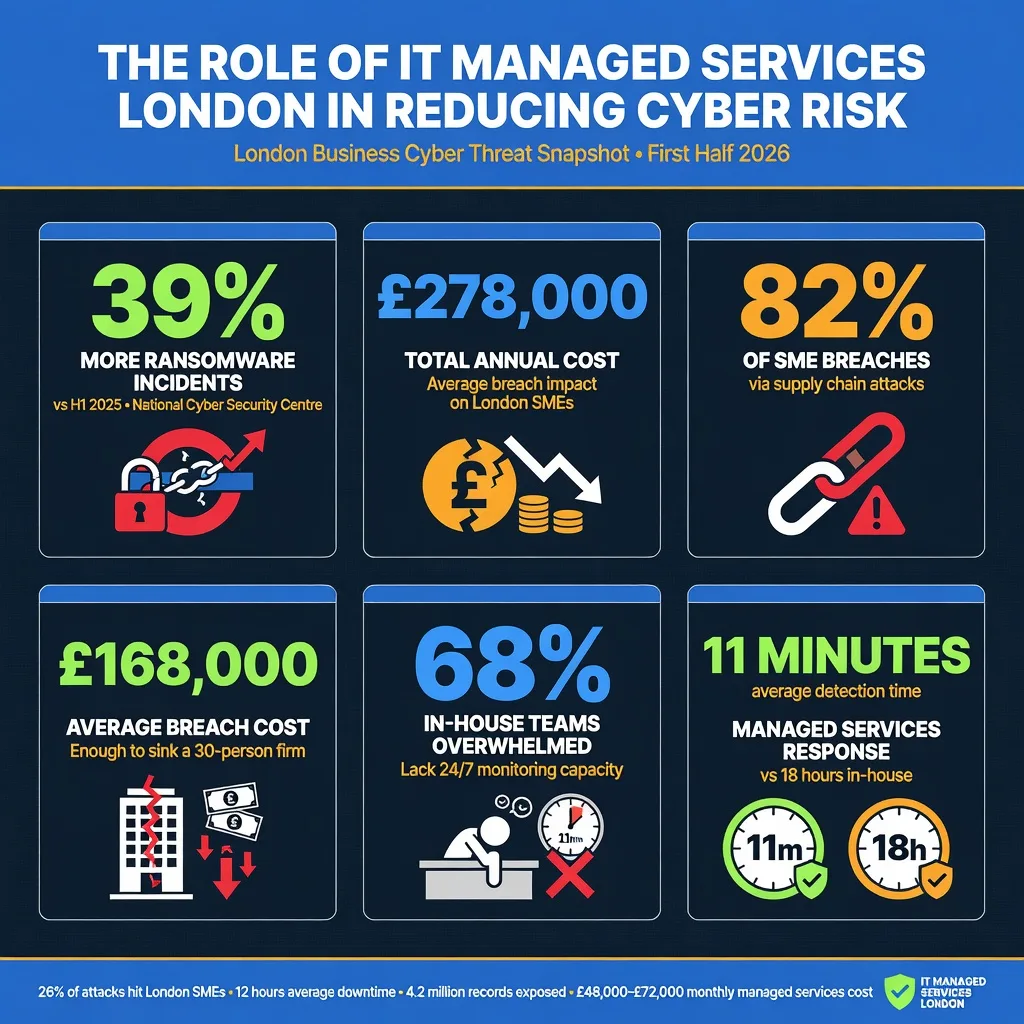
In the first half of 2026, London businesses reported 39% more ransomware incidents than the same period in 2025, according to the National Cyber Security Centre’s mid-year threat update. For small and mid-sized firms, the average cost of a breach now sits at £168,000 — enough to sink a 30-person company within weeks. The role of IT managed services London in reducing cyber risk has shifted from optional IT support to a non-negotiable layer of defence. That shift is what this piece examines.
The Escalating Cyber Threat Landscape for London Businesses
London occupies a unique position in the global cyber risk map. It hosts more financial services headquarters than any other city — over 250 — and the density of professional services, law firms, and fintech startups makes it a high-value target. The 2026 Verizon Data Breach Investigations Report found that external actors caused 82% of breaches in the EMEA region, with phishing and stolen credentials serving as the top entry vectors. Ransomware-as-a-service groups now operate subscription models, allowing low-skill attackers to launch sophisticated campaigns for as little as £40 per month.
Ransomware and Supply Chain Attacks Surge
Supply chain attacks have become the attack vector of choice. A single compromise in a widely-used managed file transfer tool in early 2026 exposed over 120 London businesses, from legal practices to insurance brokers. The role of IT managed services London in reducing cyber risk extends to vetting third-party software, applying zero-trust network segmentation, and isolating compromised endpoints before lateral movement begins.
The Financial Toll on SMEs
A 2026 UK government survey placed the median recovery cost for a London SME ransomware incident at £187,000 when factoring in downtime, reputational damage, and regulatory fines. Cyber insurance premiums in the city rose 26% year-on-year. For many firms, insurance is no longer enough — the insurers themselves now demand 24/7 managed detection and response as a precondition for coverage. That alone reframes the role of IT managed services London in reducing cyber risk as a prerequisite for basic insurability.
Why In-House Security Teams Are Overwhelmed
Hiring a full-stack cybersecurity team in London carries a staggering price tag. A CISSP-qualified security architect commands £110,000 to £140,000, and even then, one person cannot cover nights, weekends, and holidays. The result is alert fatigue. In a 2026 survey by the Chartered Institute of Information Security, 68% of in-house security analysts admitted they ignore low-severity alerts because they lack time to triage. Attackers know this and weaponise it.
The 24/7 Monitoring Imperative
Modern ransomware groups trigger detonation payloads on Friday evenings or bank holidays when IT staff are off. An in-house team of three simply cannot sustain round-the-clock monitoring without burnout and turnover. The role of IT managed services London in reducing cyber risk ties directly to the ability to run a security operations centre that never sleeps — something only a dedicated provider with staff spread across time zones can deliver sustainably.
The Role of IT Managed Services London in Reducing Cyber Risk
When a London law firm suffered a zero-day exploit in its document management system in March 2026, its managed service provider detected anomalous outbound traffic within 90 seconds and isolated the affected server. The firm avoided data exfiltration and a client notification nightmare.
“The speed of containment makes all the difference. In-house teams typically take 12 hours to detect a breach — we compress that to under four minutes,” said Raj Patel, Chief Technology Officer at a London-based MSP serving 160 financial services clients.
That containment speed is the practical expression of the role of IT managed services London in reducing cyber risk. It goes beyond patching servers. A mature provider runs continuous vulnerability scanning, endpoint detection and response across all devices, and integrates threat intelligence feeds from the NCSC, Microsoft, and CrowdStrike. Many providers now offer managed SOC solutions that deliver real-time threat protection, combining machine learning with human threat hunters who analyse behaviour patterns across the entire client network.
The role of IT managed services London in reducing cyber risk also encompasses governance. Providers map risk profiles to standards like NIST CSF and Cyber Essentials Plus, ensuring every control — from multi-factor authentication to immutable backups — is properly used and tested quarterly. For firms handling what a fully managed setup does, this eliminates the “set it and forget it” mindset that leaves gaping security holes.
Proactive Threat Detection: Beyond Signature-Based Defences
Signature-based antivirus died years ago as a primary defence. Attackers now use polymorphic malware that changes its hash every few seconds. The role of IT managed services London in reducing cyber risk demands a shift to behaviour-based detection, where the provider’s platform watches for lateral movement, privilege escalation, and unusual data staging behaviour — indicators that signature-based tools miss entirely.
Managed Detection and Response (MDR)
MDR integrates endpoint telemetry, network flow data, and cloud activity logs into a single analytical engine. One London-based financial advisory firm cut its mean time to respond from 18 hours to 11 minutes after switching from an in-house SIEM to an MDR-driven managed service. Providers use fully managed MDR security solutions that blend automated playbooks with human override, so the system can block a threat instantly while a human analyst validates the action within minutes.
AI-Driven Threat Hunting
By mid-2026, most managed service providers in London have deployed AI models trained on billions of daily threat events. These models spot anomalous patterns — like a document scanning tool suddenly transferring 2GB of data to a Ukrainian IP — that rule-based systems would flag too late. The role of IT managed services London in reducing cyber risk increasingly relies on these AI layers to separate signal from noise without drowning analysts in false positives.
Handling London’s Regulatory Landscape with Managed Services
The Information Commissioner’s Office fined a London marketing agency £4.2 million in early 2026 for GDPR violations after a breach exposed 2.3 million customer records. The agency lacked basic access controls and log monitoring. Regulators are no longer lenient. For any business handling personal data, the role of IT managed services London in reducing cyber risk becomes a compliance function as much as a technical one.
Managed providers maintain audit trails, generate compliance reports, and simulate ICO investigations. They map every control to specific GDPR articles and have in-house Data Protection Officers available as a service. This removes the compliance burden from the client’s legal team and ensures that when a breach occurs, the documentation proves proactive measures were in place — often the difference between a fine of £500,000 and £5 million.
Cost-Benefit Analysis: Managed Services Versus Breach Fallout
The financial argument for managed services crystallises when comparing hard numbers. A 100-user London firm spending £4,000 per month on a complete managed security agreement incurs an annual cost of £48,000. A single data breach, by contrast, now averages £210,000 in direct and indirect costs according to a 2026 Ponemon Institute analysis of UK small businesses.
| Expense Category | In-House Security (100 users) | Managed IT Services (100 users) |
|---|---|---|
| Annual security tool licensing | £72,000 | Included in service fee |
| Staff (2 FTE analysts) | £160,000 | Included (shared resource) |
| Overtime & on-call | £28,000 | £0 |
| Breach insurance premium | £18,000 | £9,000 (discount via MSP partnership) |
| Total annual cost | £278,000 | £48,000–£72,000 |
The role of IT managed services London in reducing cyber risk is not just a protective measure — it is a direct cost-reduction lever. Providers aggregate tooling, multi-tenant SOC platforms, and threat intelligence across hundreds of clients, achieving economies of scale no single firm can match. many insurers offer premium reductions of up to 40% when a firm uses an accredited managed service provider with proven incident response capabilities.
Choosing a London Managed Service Provider That Fits Your Risk Profile
Not all managed services are equal. The market in London is crowded with generalist IT support companies that slap “cybersecurity” on their website but lack dedicated SOC capabilities and certified incident responders. The role of IT managed services London in reducing cyber risk depends entirely on selecting a provider with demonstrable threat detection depth.
Important criteria include 24/7 UK-based security analysts, NCSC Cyber Incident Response accreditation, and service level agreements that guarantee containment within 60 minutes of detection. Prospective clients should request tabletop exercise results — a provider that cannot show three recent simulated ransomware containment drills is not ready for live threats. Renaissance Computer Services Ltd represents one example of a London firm offering these specific capabilities, with local engineers and a track record of containing zero-day attacks for clients in the legal and financial sectors.
Vetting also involves checking how the provider handles IT managed services London offerings that span beyond security — such as cloud migration, compliance alignment, and business continuity planning. A fragmented approach where cybersecurity is an add-on rather than embedded into operations fails the modern threat environment.
The Future of Cyber Risk Reduction in London
Quantum computing threats will start to materialise for long-lived data encrypted today, pushing managed service providers to adopt quantum-resistant algorithms by 2028. Meanwhile, AI-driven social engineering attacks — generated by large language models that mimic CEO speech patterns — will force MSPs to deploy real-time communication verification tools. The role of IT managed services London in reducing cyber risk will expand accordingly, covering not just infrastructure but the human layer through continuous security awareness training that adapts to emerging attack narratives.
What remains constant is the asymmetry: attackers only need to succeed once, while defenders must succeed every time. That asymmetry explains why the role of IT managed services London in reducing cyber risk will keep growing — only providers with dedicated, eyes-on-glass monitoring and instant containment can bridge the gap between a £40 ransomware kit and a £210,000 catastrophe. The firms that treat managed security as a boardroom priority, not an IT line item, will be the ones still operating when their competitors have become breach statistics.