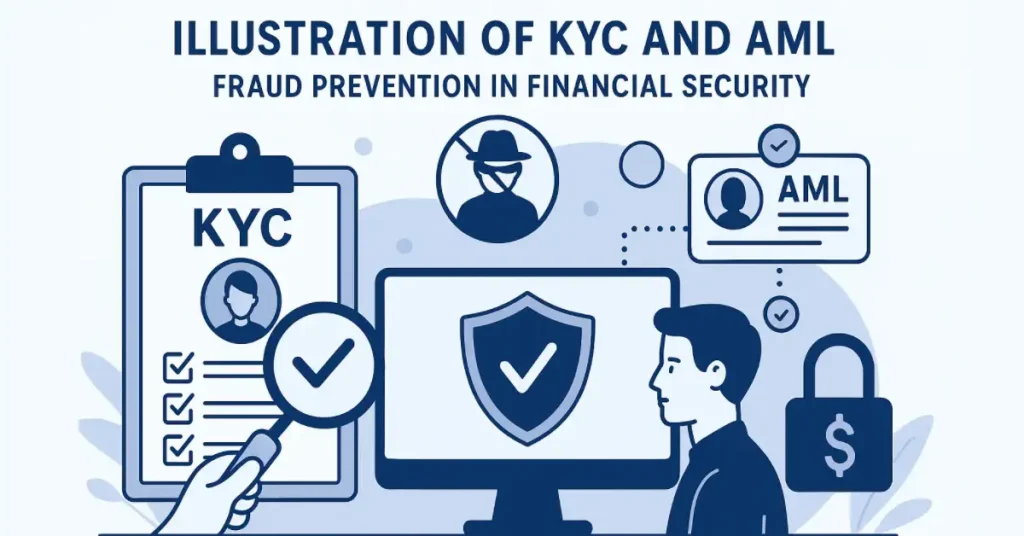

Breaking barriers and making the world a global village is all good and delightful until you face the kind of frauds that you are not familiar with. Therefore, businesses are incorporating KYC/AML compliance to verify their clients. Online sellers that fail to comply with KYC have to pay penalties for this negligence. According to a report, between 2010 and 2016, banks paid more than $160 billion in penalties to the US government for not following compliance checks.
In the fast-paced digital economy of 2025, these figures have escalated dramatically. Recent data from Napier AI’s 2025-2026 AML Index reveals that money laundering now costs the global economy up to $5.5 trillion annually, with only a fraction—around 0.1%—of illicit funds recovered. This statistic represents 2-5% of global GDP, emphasizing the need to establish robust KYC/AML frameworks.
Regulatory groups like the Financial Action Task Force (FATF) are paying closer attention, with new rules focusing on using AI for monitoring and checking transactions in real-time to fight advanced threats like AI-created fraud and decentralized finance (DeFi) schemes. Fines in 2025 alone have surpassed $50 million in the securities sector, as reported by ComplyAdvantage, highlighting the financial and reputational risks of non-compliance.
Online sellers are increasingly operating at the international level, making them more susceptible to various online frauds. In this case, certain authorities are working to save businesses from such scams. They are trying to do their part by making certain laws and regulations for them to abide by. To eliminate online frauds, businesses are pressured to exercise robust customer due diligence. These regulations are called Know Your Customer (KYC).
KYC serves as the pivot point for organizations to ensure that vendors comply with regulatory requirements. Know Your Customers’ compliance varies from region to region, but their overall perspective remains the same. The main purpose is to eliminate the fraud risk for online sellers. All these regulations from different regions come under the Financial Action Task Force (FATF).
Financial institutions specifically are requiring KYC/AML regulations because this is the sector that encounters the majority of online frauds. The customers are identified by authenticating their provided information, verifying their documents, the source of their wealth, and their transaction behavior, and monitoring their activities regularly.
Evolving Landscape of KYC/AML in 2025
As we navigate 2025, KYC/AML compliance has evolved beyond traditional methods to address emerging risks. According to Moody’s 2025 insights, financial crime now costs up to $2 trillion annually, driven by advancements in AI fraud and global payment rails like crypto. Important trends are the use of smart AI to find problems early, tougher rules for revealing who really owns companies, and the growth of digital identity systems.
For instance, the EU’s AML Package, fully implemented in 2025, mandates enhanced due diligence for high-risk sectors, including real-time monitoring of cross-border transactions. In the US, the Bank Secrecy Act amendments emphasize AI integration in AML programs, while Asia-Pacific regions like Singapore enforce biometric verification for fintech operations. These updates aim to close gaps where 90% of money laundering goes undetected, as per Shufti Pro’s 2025 statistics.
Businesses must adapt by integrating these trends into their compliance strategies. For example, fintech firms are now required to screen against expanded sanctions lists, including those related to terrorist financing, as highlighted in FATF’s 2025 report on evolving risks. This not only mitigates threats but also fosters trust in an increasingly interconnected global market.
KYC Verification Process
Just like the traditional verification process, the online identity verification process is completed in the following steps:
Collecting the information:
First of all, the customer is required to submit all their basic information, like name, date of birth, and address, at the time of account registration.
Providing a shred of evidence:
The website then asks the customer to provide any secondary evidence for identity proof. This assists the system in verifying that the information provided by the customer is authentic.
Verifying the information:
Once the user uploads the document as secondary evidence, its validation is performed by checking the template and investigating whether the document is forged or photoshopped. After confirming the document validation, the information is fetched through Optical Character Recognition (OCR). The software then verifies the customer’s information.
Customer Verification
Verification is mandatory to check the individual to ensure that they are who they claim to be. It begins by identifying the individual, authenticating their ID documents, and verifying if they are a threat to your business. The conventional methods of identity verification required the customer to visit the branch to get their verification done. This was a tedious process for both the customer and the staff member assigned for the task. It also had chances of human error and was a time-consuming process. On the other hand, online verification processes proved to be helpful for both the client and the merchant in reducing their physical labor and completing the process faster.
AI and biometric technologies revolutionized customer verification in 2025. Tools like facial recognition and liveness detection, integrated into platforms such as those from Sumsub, can complete verifications in seconds with 99% accuracy, reducing false positives by up to 50%. This is crucial amid rising AI fraud, where deepfakes pose new challenges. Regulatory updates, such as those from the FATF, now require ongoing biometric checks for high-value transactions, ensuring compliance in volatile sectors like crypto exchanges.
Customer Due Diligence (CDD)
Customer Due Diligence (CDD) is further verification employed by financial institutions to identify their consumers to reduce the risks of financial crimes like money laundering and terrorist financing. At the time of account opening, certain checks are required to authenticate the customer. One such control is verifying the client against sanction lists and Politically Exposed Persons (PEP).
Expanding on CDD in 2025, institutions must adopt a risk-based approach, prioritizing high-risk clients with enhanced scrutiny. LexisNexis Risk Solutions’ 2025 trends report notes seven key areas, including AI-powered perpetual KYC (pKYC), which continuously updates customer profiles. This helps detect anomalies in real-time, such as unusual transaction patterns linked to DeFi or metaverse activities. Global regulations, like the UK’s updated Money Laundering Regulations, mandate CDD for virtual asset service providers, adding layers of UBO verification to prevent shell company abuses.
AML Screening
One-time identification of the individual is not enough. Rather, an ongoing process of verifying the client is necessary to get the customer’s online behavior, thus predicting their future activities. The process also helps the merchants know if the monitored customer is ever a threat to their business.
AML screening in 2025 leverages AI for predictive analytics, as per McKinsey’s insights on agentic AI. This technology automates end-to-end processes, from transaction monitoring to alert triage, boosting efficiency by 40-60%. With global threats like ransomware payments laundered through crypto, screening now includes network analysis to trace illicit flows. Encompass Corporation’s June 2025 pulse highlights evolving regulations, urging firms to integrate AI to stay compliant and avoid fines exceeding millions.
Integrating AI into KYC/AML Workflows
A significant opportunity for 2025 updates is the integration of AI, which addresses traditional bottlenecks. AI-driven tools from providers like Hawk AI automate KYC for banks, reducing manual reviews by 70%. Challenges include data privacy under GDPR and bias mitigation, but benefits like real-time fraud detection outweigh them. Case studies from ThetaRay show mid-sized banks using AI to transform AML, detecting 95% more suspicious activities than legacy systems.
Methods to perform Remote ID Verification
KYC can be performed through a lot of measures that add to strengthen the process:
- Databases
These are the saved information of the customer that once was collected at the time of registering a customer. Databases help in the recurring processes, the customer information is checked against the one that is present against that certain ID document.
- ID documents
Various techniques like AI, HI, and facial recognition are used to prove if the government-issued ID document is valid or not. The documents like ID documents, passports, driving licenses are used to verify the individual.
- 2 Factor Authentication
This method requires users to provide personal identification often called a token at the time of account set up. The 2FA can be an alphabet or number and is particularly useful for creating accounts and password resetting.
Building on these, 2025 methods include blockchain-based digital IDs and AI-enhanced 2FA with behavioral biometrics. For databases, federated learning allows secure data sharing across institutions without privacy breaches. Idenfo’s 2025 regulatory updates stress these for UBO checks, especially in cross-border trade.
Advanced Remote Verification Techniques for 2025
To remain competitive, incorporate emerging tools like zero-knowledge proofs for privacy-preserving verification and machine learning for anomaly detection. A table below compares traditional vs. 2025 methods:
| Method | Traditional Approach | 2025 Enhanced Approach | Benefits |
|---|---|---|---|
| Databases | Manual checks | AI cross-referencing with global sanctions | Faster, 80% accuracy boost |
| ID Documents | Visual inspection | AI + biometrics | Reduces forgery by 90% |
| 2FA | SMS codes | Behavioral + device fingerprinting | Mitigates SIM swap attacks |
This expansion ensures compliance amid rising threats, such as AI fraud in KYC processes noted by KYC-Chain’s top trends.
Case Studies and Best Practices
Real-world examples illustrate success: A major EU bank in 2025 reduced onboarding time from days to minutes using AI KYC, complying with the new AML directives. Best practices include regular audits, employee training, and partnerships with tech providers like Duane Morris for AI AML strategies.
Conclusion
With the increased financial activities, the chances of online fraud in financial institutions are also increasing. Regulatory authorities addressing laws thus came forward with the solution to keep the fraudsters in check. KYC and AML compliance make the process easy for businesses to verify their clients in seconds. The compliance also helps to have ongoing monitoring of clients to keep their records secure online, preventing sellers from having to encounter any criminal activity.
In 2025, embracing AI and real-time tools in KYC/AML ensures regulatory adherence and builds resilient businesses against $5.5 trillion in global laundering threats. By prioritizing these updates, organizations can enhance security, reduce costs, and foster trust. Explore top KYC AML compliance solutions today to stay ahead in a digital-first world—keywords like “KYC AML compliance 2025” and “AI in AML verification” can guide your search for optimal strategies.
FAQs
What are the key KYC/AML updates in 2025?
2025 brings stricter UBO disclosures, AI-driven real-time monitoring, and digital identity frameworks under FATF guidelines. EU’s AML package mandates enhanced CDD for crypto, helping detect 90% undetected laundering amid $2-5.5 trillion in global costs.
How does AI improve KYC/AML compliance?
AI automates verification, reduces false positives by 50%, and enables predictive screening. Tools like agentic AI from McKinsey make customer due diligence and transaction monitoring easier, help manage AI fraud risks, and ensure compliance with GDPR for better and faster fraud prevention.
Why is CDD essential for financial institutions?
CDD verifies customers against PEP and sanctions lists, reducing money laundering risks. Perpetual KYC, which updates profiles continuously in 2025, is crucial for DeFi sectors, as they launder 2-5% of GDP ($2 trillion), thereby preventing fines and reputational damage.
What penalties face noncompliant businesses in 2025?
Non-compliance can lead to fines over $50 million in securities, as per ComplyAdvantage. With global laundering at $5.5 trillion, regulators like FATF enforce hefty penalties, license revocations, and audits for failing KYC/AML checks.
How to implement remote ID verification effectively?
Use AI biometrics, databases, and 2FA with behavioral analysis. 2025 trends emphasize blockchain IDs for privacy, cutting onboarding time by 70% while complying with cross-border rules to combat evolving threats like metaverse fraud.
Disclaimer: This article offers general insights into KYC/AML compliance and is not intended as legal, financial, or professional advice. Consult qualified experts for tailored guidance on regulations and implementation. The author and NetworkUstad.com assume no liability for decisions based on this content.