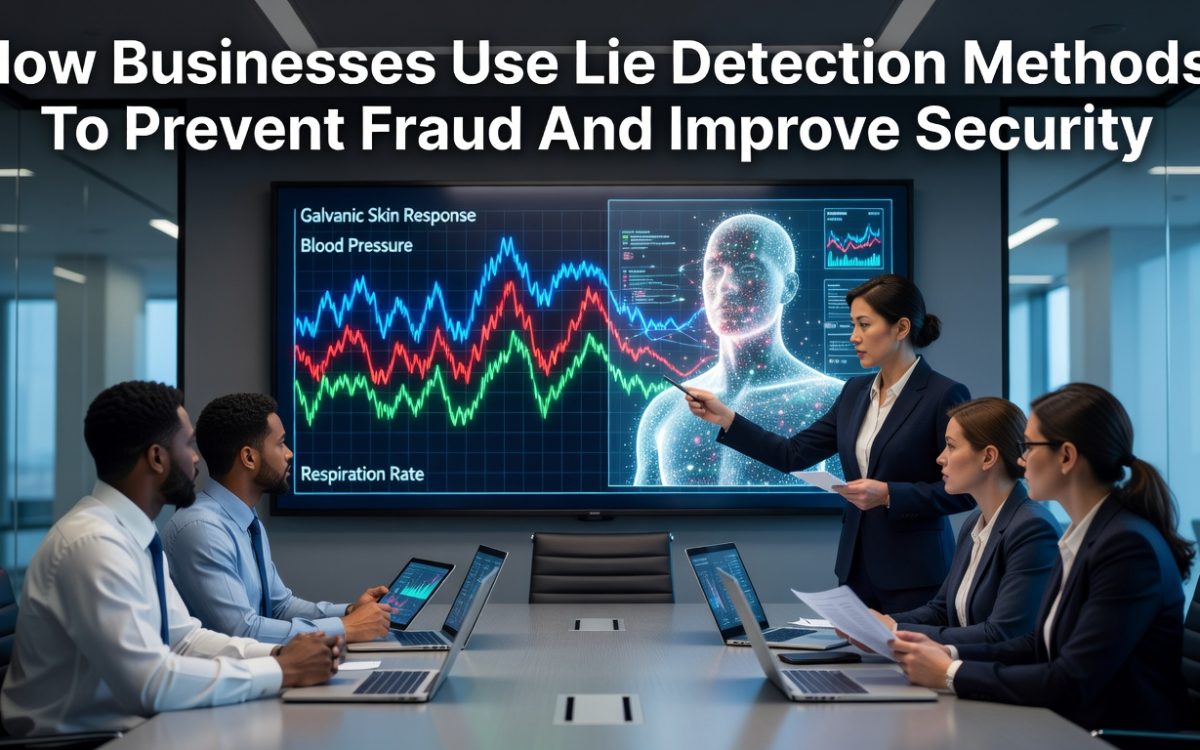
Fraud may not necessarily be a dramatic event. It more frequently occurs through small gaps, such as unmonitored claims, divergent statements, or internal activities that are overlooked. In the long run, such gaps develop into severe risks. Because of this, you might not be able to determine the point of origin of the problem.
Meanwhile, conventional methods of control, including audits, surveillance, and compliance check-ups, primarily focus on outcomes as opposed to intent. As a result, they may overlook the warning signs. In cases where the decisions made are based on partial or false information, the implications on finances, reputation, and operations are monumental.
Hence, companies are moving towards systematic approaches that extend beyond the surface level verification. One of such methods is lie detection, which provides quantifiable information about human behavior.
In this article, you will learn how businesses use these techniques to prevent fraud and strengthen security.
1. Strengthen Pre-Employment Screening
Recruitment choices have a direct effect on the risk exposure of your organization. Although resumes, interviews, and background checks provide useful information, they do not always reveal intentional deception. Therefore, using either of these approaches alone may result in gaps in your hiring process.
This is where a lie detector becomes relevant in high-risk positions. With the help of structured polygraph testing, you can test the physiological response to certain job-related questions, although in the United States, private non-government employers must comply with the Employee Polygraph Protection Act (EPPA), which significantly limits such use. These reactions are used to detect discrepancies, which can be signs of undisclosed behavior or integrity issues.
These tests are commonly administered by qualified and trained professionals following standard procedures. Consequently, consistency, accuracy, and professional integrity are maintained throughout the process.
Furthermore, this method is especially useful for jobs that entail financial management, confidential information, or operational control. Rather than responding to issues in the future, you can actively minimize hiring risks.
Moreover, the availability of such screening also serves as a filter. Applicants who have intentions of hiding important details are less likely to move forward. Consequently, not only do you enhance the quality of hiring, but you also instill a culture of responsibility earlier on.
2. Detect Internal Fraud and Misconduct
Internal fraud presents a unique challenge. Employees are familiar with your systems, workflow, and controls. Thus, they can more effectively take advantage of vulnerabilities without being noticed.
When discrepancies arise, traditional investigations tend to rely on documentation and interviews. Nevertheless, such techniques may fail to pinpoint the origin of deception. Consequently, the investigation process may become lengthy and ineffective.
Lie detection techniques offer a structured substitute. By analyzing physiological responses during targeted questioning, you are able to detect patterns that may indicate truthfulness or lies. Consequently, this process targets consistent response behavior, rather than isolated responses.
Consequently, you can:
- Narrow down suspects more efficiently
- Eliminate irrelevant leads
- Consider resources on valid findings
This method transforms internal investigations from an assumed process into a structured evaluation that enhances speed and accuracy.
3. Support Workplace Investigations
Workplace conflicts usually entail contradictory narratives. Whether it is a case of harassment, policy violation, or misconduct, each party may have a convincing story. This brings confusion and postpones decision-making.
In these situations, lie detection techniques add an extra dimension of transparency. You can use physiological response analysis as part of the investigation process instead of relying solely on subjective interpretation.
For example, in structured questioning, certain subjects are covered in a systematic way. This enables you to observe how people react in a controlled environment. Consequently, discrepancies can be detected with ease.
Moreover, the approach does not substitute but enhances the existing procedures. You continue to use evidence, documentation, and policy guidelines. Nevertheless, lie detection offers reinforcing behavioral information that helps reinforce your judgments.
As a result, you are able to solve conflicts more effectively while maintaining fairness and transparency. This will not only secure your organization but will also help build trust among employees.
4. Enhance Corporate Security Protocols
The contemporary business space needs a multi-layered approach to security. It is no longer confined to physical access; instead, it incorporates digital systems, intellectual property, and operational processes.
Trust is not enough in high-security conditions. Thus, companies should introduce routine verification actions in order to maintain compliance. One such measure is the lie detection methods.
For example, structured evaluations can be conducted for employees in sensitive positions at specific intervals. This assists in ensuring compliance with policies and determining the possible risk ahead of time.
This method, further, functions as a preventive and remedial control. On one hand, it deters misconduct by raising the perceived risk of detection. On the other hand, it helps identify issues before they escalate.
Consequently, you enhance your general security structure while minimizing vulnerability to insider threats.
Conclusion
In today’s risk landscape, relying on assumptions is no longer sufficient. Fraud, misconduct, and security breaches tend to arise in areas that have poor verification. As such, it becomes imperative to reinforce your method of evaluating truth.
Lie detection techniques provide a systematic, data-driven means of coping with this problem. When you combine these methods in the hiring process, investigations, and security measures, you shift from reactive problem-solving to proactive risk management.
Meanwhile, you establish an environment where responsibility is clearly established. The employees are aware that integrity is not optional but quantifiable. As a result, trust in your organization is enhanced and more enduring.
Finally, trust combined with verification can better equip businesses to avoid fraud, secure assets, and transact with confidence.