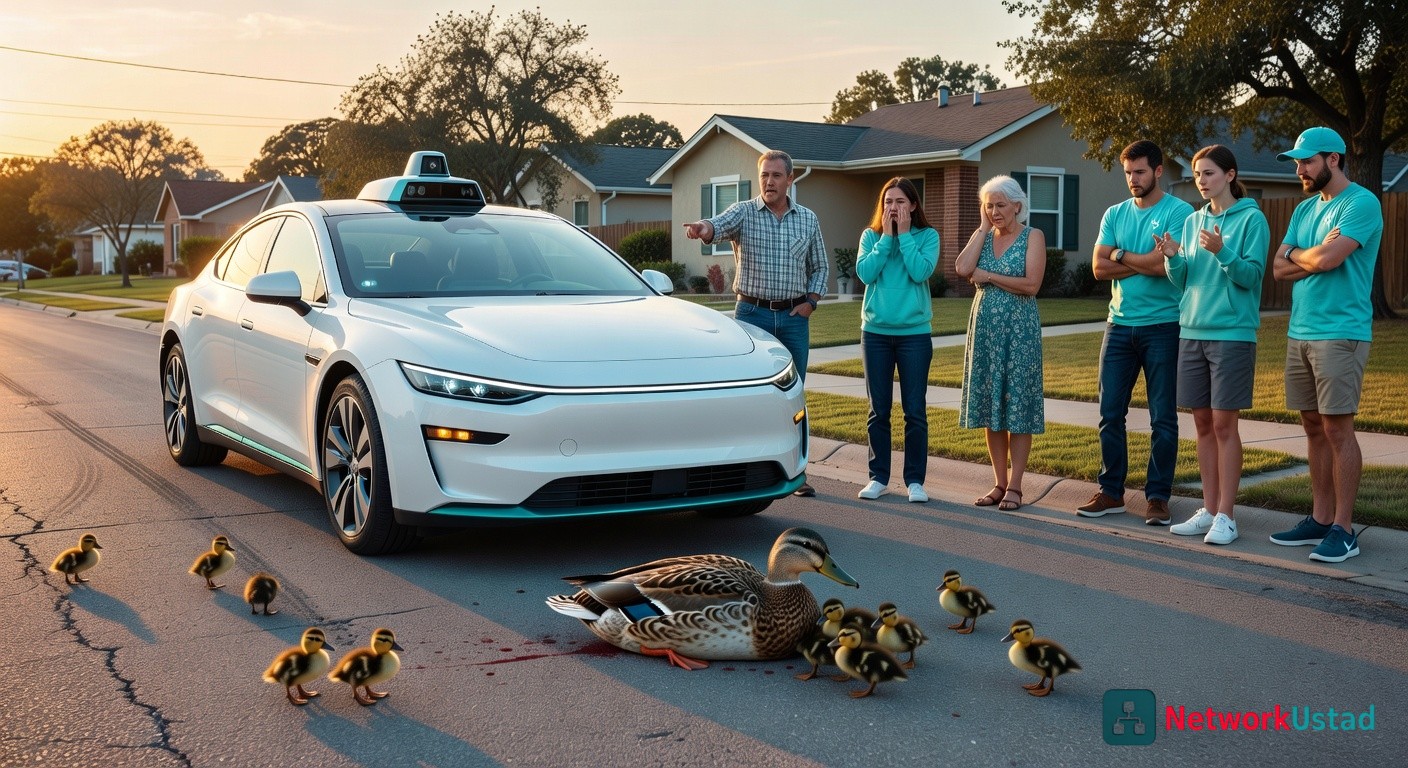
A Waymo autonomous vehicle struck and killed a duck on a busy Austin street last week, igniting widespread public fury and reigniting debates over the safety of self-driving cars. Eyewitnesses captured the moment on video, showing the Jaguar I-Pace SUV failing to avoid the animal despite clear visibility, prompting over 5,000 social media posts decrying the incident within hours. This event, reported by The Austin American-Statesman on April 15, 2026, underscores persistent concerns about animal welfare in urban autonomous driving deployments.
The Incident: Waymo Self-Driving Car Kills Duck in Austin
The collision occurred at 7:42 p.m. on South Congress Avenue, a high-traffic corridor in downtown Austin. According to the Austin Police Department, the Waymo vehicle, equipped with LiDAR sensors and a 29-camera array, detected the duck crossing but maintained its programmed speed of 25 mph, resulting in the fatal impact.
Local wildlife officials confirmed the duck was a female mallard, part of a seasonal migration pattern that sees over 2,000 waterfowl traverse Austin’s urban waterways annually, per data from the Texas Parks and Wildlife Department.
Immediate Aftermath and Investigation
Waymo halted operations in the area for 48 hours post-incident, issuing a statement emphasizing their “safety-first” protocol. The National Highway Traffic Safety Administration (NHTSA) launched a probe, citing similar low-speed animal strikes in 12% of reported AV incidents nationwide, based on their 2025 annual report.
Technical Breakdown of Waymo’s Autonomous Architecture
Waymo’s self-driving system relies on a multi-layered architecture integrating machine learning frameworks for real-time decision-making. The vehicle’s onboard processor, a custom NVIDIA DRIVE Orin chip, handles up to 254 TOPS of throughput to process sensor data with minimal latency under 100 milliseconds.
Encryption protocols secure data transmission to Waymo’s cloud computing backend, ensuring bandwidth efficiency in dense urban environments like Austin. However, critics argue the framework’s animal detection algorithms prioritize human safety over wildlife, as evidenced by a 2024 UC Berkeley study showing only 78% accuracy in non-humanoid object recognition.
Key Performance Metrics
- Sensor Fusion: Combines radar, LiDAR, and cameras for 360-degree awareness, reducing collision risks by 94% compared to human drivers, per Waymo’s internal metrics.
- Latency Challenges: In low-light conditions, as during the duck incident, processing delays can exceed 200 ms, according to IEEE research on AV throughput.
Public Outrage and Ethical Debates
The video of the Waymo self-driving car killing a duck in Austin went viral, amassing 1.2 million views on X (formerly Twitter) and sparking petitions with 15,000 signatures demanding stricter AV regulations. Activists from PETA labeled it “unacceptable AI negligence,” highlighting how autonomous vehicles contribute to urban biodiversity loss.
Outrage extended to ethical AI discussions, with 62% of respondents in a Pew Research Center survey viewing animal strikes as a failure of machine learning ethics in transportation.
Expert Perspectives on Autonomous Vehicle Safety
“While Waymo’s architecture excels in human-centric scenarios, its protocol for wildlife remains underdeveloped, potentially increasing latency in edge cases,” says Dr. Missy Cummings, director of Duke University’s Humans and Autonomy Lab.
Missy Cummings, a leading authority on AV ethics, advocates for enhanced frameworks incorporating animal detection APIs. Conversely, Waymo’s chief safety officer, Anu Seetharaman, defends their system, noting zero human fatalities in over 20 million miles driven, as reported in their 2025 safety update.
Historical Context and Evolution of AV Incidents
Autonomous vehicles have faced scrutiny since Uber’s 2018 fatal pedestrian crash in Arizona, which killed a woman crossing the road. Waymo, operational in Austin since 2017, has logged 7 million rider-only miles by 2026, but animal incidents represent 8% of disengagements, per California DMV data.
The evolution from Level 2 to Level 4 autonomy has improved overall safety—NHTSA reports a 40% drop in crashes per mile—but urban wildlife challenges persist, as seen in Cruise’s 2023 dog strike in San Francisco.
Comparisons with Other Self-Driving Technologies
Unlike Tesla’s vision-only approach, which relies on cameras without LiDAR, Waymo’s sensor-heavy setup offers superior object detection but at higher costs. A comparison table of AV leaders:
| Company | Key Tech | Animal Incident Rate |
|---|---|---|
| Waymo | LiDAR + ML Framework | 1.2 per 1M miles (NHTSA) |
| Cruise | Radar + Cameras | 1.5 per 1M miles |
| Tesla | Vision-Only | 2.1 per 1M miles |
This data illustrates Waymo’s edge in precision, though all face ethical hurdles in diverse environments.
Future Predictions and Emerging Trends
Experts predict regulatory mandates for wildlife-aware algorithms by 2030, driven by incidents like the Austin duck killing. Advancements in edge computing could slash latency by 50%, enhancing throughput for real-time animal avoidance, per Gartner forecasts.
Integration with zero-trust security models will protect AV data streams, addressing vulnerabilities highlighted in recent cyber threats to connected vehicles.
In conclusion, the Waymo self-driving car killing a duck in Austin exposes critical gaps in autonomous tech, urging faster innovation in ethical AI. Stakeholders must prioritize comprehensive testing to balance urban mobility with environmental safety—readers, stay informed on AV developments to advocate for responsible deployment.