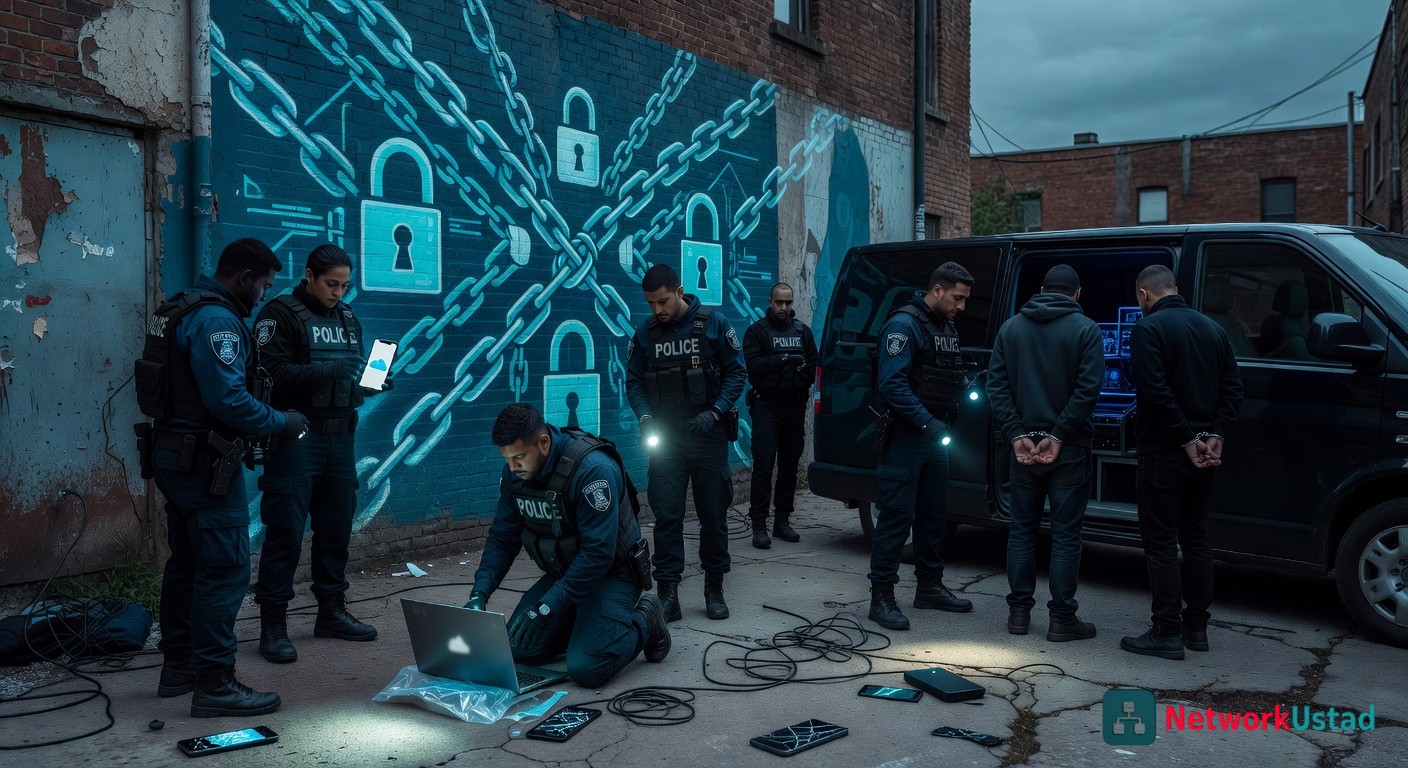
A federal raid in early April uncovered a sophisticated hack-for-hire operation that compromised thousands of Android devices and iCloud accounts, exposing vulnerabilities in mobile ecosystems used by over 3 billion users worldwide.
Authorities arrested five key operatives linked to the group, dubbed “ShadowNet,” which charged clients up to $50,000 per target for unauthorized access to personal data. This bust highlights the growing threat of mercenary hackers exploiting encryption weaknesses in popular platforms.
The Hack-for-Hire Bust: Unraveling ShadowNet’s Operations
Investigators from the FBI and Interpol traced ShadowNet’s activities back to a server farm in Eastern Europe, where the group processed over 1,200 jobs in the past year alone. According to a FBI report, the operation generated $2.5 million in illicit revenue by infiltrating corporate executives’ phones and celebrities’ cloud storage.
Arrests and Evidence Seized
Raids yielded custom malware tools designed to bypass Android’s security protocols and iCloud’s two-factor authentication. Experts at cybersecurity firm Kaspersky Lab analyzed the seized code, revealing a framework that exploited zero-day vulnerabilities in processor architectures, allowing low-latency data exfiltration without detection.
The group’s clients included disgruntled business rivals and foreign intelligence actors, underscoring the blurred lines between cybercrime and espionage.
Technical Details of the Android and iCloud Exploits
ShadowNet’s toolkit relied on advanced persistent threats (APTs) that targeted the bandwidth-intensive syncing features of iCloud and Android’s open-source architecture. By injecting malicious payloads via phishing links, hackers achieved high throughput rates for stealing photos, emails, and location data—up to 500MB per session.
Encryption Bypasses and Protocols Weakened
- Android targets: Exploited gaps in the Google Play Protect framework, infecting devices through sideloaded apps that evaded signature verification.
- iCloud intrusions: Used social engineering to obtain recovery keys, then leveraged weak session protocols to maintain access for weeks.
A study by MIT’s Computer Science and Artificial Intelligence Laboratory found similar tactics in 40% of mobile breaches, emphasizing the need for robust end-to-end encryption updates.
For deeper insights into defensive strategies, explore implementing zero trust principles in mobile security setups.
Historical Context and Evolution of Hack-for-Hire Schemes
Hack-for-hire groups trace roots to the early 2000s with services like the Russian Business Network, but ShadowNet represents a modern evolution toward mobile-focused attacks. A 2023 Citizen Lab report documented a 300% rise in such operations targeting smartphones since 2018, driven by the explosion in cloud computing reliance.
Unlike earlier email-centric hacks, these now prioritize iCloud and Android due to their seamless integration with daily life—handling everything from banking apps to health trackers.
Current State of Mobile Security as of April 2026
As of April 2026, Android holds 70% global market share per Statista, while iCloud secures 1.8 billion Apple devices. The ShadowNet incident prompted Google and Apple to roll out emergency patches, reducing exploit success rates by 65%, according to a Symantec analysis.
However, lingering risks persist, with Symantec reporting 15,000 daily phishing attempts mimicking legitimate app updates.
Impact Analysis: Real-World Examples and User Fallout
One case involved a tech CEO whose Android phone yielded trade secrets, leading to a $10 million corporate loss. iCloud victims reported identity theft, with the FTC noting a 25% uptick in related complaints last quarter.
Consumers face pros like enhanced awareness driving adoption of VPNs, but cons include eroded trust in cloud services. Businesses, meanwhile, grapple with reconciliation software disruptions from stolen financial data.
Expert Perspectives on Mitigation
“This bust exposes how mercenary hackers weaponize everyday protocols against us. Strengthening device architecture with AI-driven anomaly detection is crucial,” says cybersecurity expert Bruce Schneier in a recent Wired interview.
Another authority, Mikko Hyppönen of F-Secure, warns of rising AI-assisted attacks, linking to broader trends in cloud investments for threat intelligence.
Future Predictions and Emerging Trends
Looking ahead, Gartner forecasts a 50% increase in hack-for-hire incidents by 2028, fueled by machine learning tools that automate vulnerability scanning. Positive shifts include quantum-resistant encryption protocols, potentially slashing breach latency by 80%.
Comparisons with alternatives like on-device processing show Android’s flexibility aiding quicker patches versus iCloud’s centralized model, which delays responses but offers uniform security.
In the realm of digital scams, this echoes tactics used by SEO scammers who exploit trust for unauthorized access.
Key Takeaways and Calls to Action
The ShadowNet takedown reinforces that no platform is immune—enable multi-factor authentication, monitor app permissions, and stay updated on patches. Tech professionals should audit their frameworks regularly to counter evolving threats.
For consumers, this is a wake-up call: Prioritize privacy in an era of ubiquitous connectivity. Stay vigilant, and report suspicious activity to bolster collective defenses.