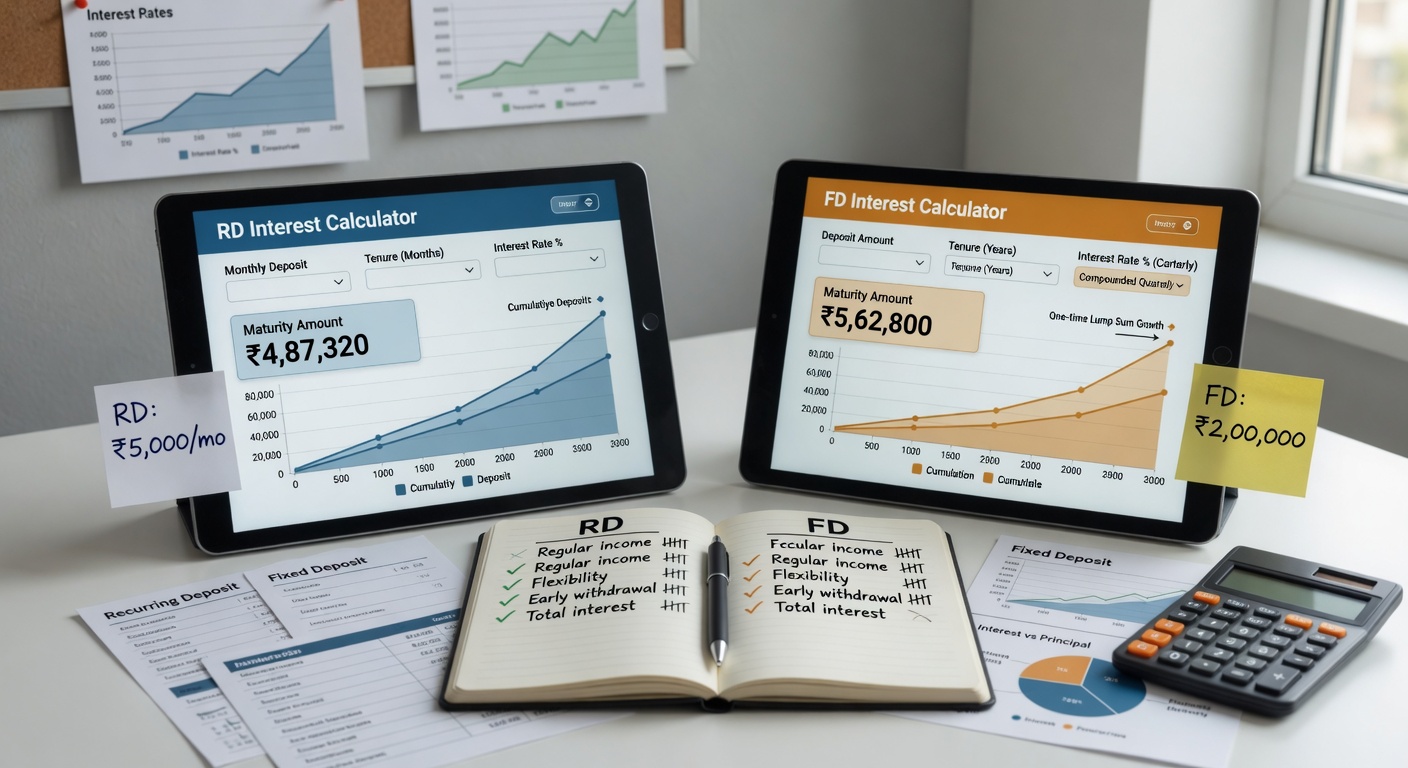
First salary. First savings question. FD or RD?
My cousin called to ask. I asked her one thing back: lump sum available or just monthly income?
Monthly income only.
One question, one answer. But the math behind it surprised her. Same rate at the same bank. Noticeably different outcomes. That gap is what an RD interest calculator and an FD calculator make visible before you commit to either.
The Basic Difference
An FD is a one-time deposit. You put in a lump sum, it sits for a fixed period, it earns interest, and you get the maturity amount.
An RD is a monthly commitment. You deposit a fixed amount every month for a chosen tenure. Each instalment earns interest from the date it goes in.
Same bank. Same interest rate. Completely different compounding dynamics.
In an FD, the entire principal starts compounding from day one. In an RD, each monthly instalment only starts compounding from the month it is deposited. So the first instalment earns interest for the full tenure. The last instalment earns interest for just one month.
This is why an RD always returns less than an FD with the equivalent total principal, even at the same interest rate.
What Each Calculator Shows You
An FD calculator takes three inputs. Principal amount, interest rate, and tenure. It shows the maturity value and the total interest earned.
Simple and direct. You know exactly what a fixed deposit will return before you open it.
An RD interest calculator works a bit differently. You enter the monthly instalment amount, the interest rate, and the tenure in months. It calculates the maturity value using a slightly more complex formula because each monthly deposit compounds for a different period.
The output tells you the total amount deposited, the total interest earned, and the maturity value.
Side by side, these two calculators reveal a gap that surprises most people when they see it for the first time.
The Numbers Side by Side
Say you have ₹60,000 available. Two options.
Option A: Put the full ₹60,000 in an FD for 12 months at 7% interest.
Option B: Put ₹5,000 per month in an RD for 12 months at 7% interest.
Run both through their respective calculators.
| FD | RD | |
|---|---|---|
| Total Amount Invested | ₹60,000 | ₹60,000 |
| Interest Rate | 7% | 7% |
| Tenure | 12 months | 12 months |
| Interest Earned | Approx ₹4,200 | Approx ₹2,278 |
| Maturity Value | Approx ₹64,200 | Approx ₹62,278 |
Almost ₹2,000 difference. Same principal. Same rate. Same bank.
The FD wins on returns when you have the full amount upfront. But if you do not have ₹60,000 sitting in your account right now, the FD option does not exist for you. The RD does.
That is the scenario where the RD interest calculator stops being a comparison tool and becomes a planning tool.
When the FD Calculator Is More Useful
You received a bonus. Or sold something. Or got a maturity payout from another investment. You have a lump sum and you want it to work while you decide what to do with it long term.
FD is the right call. Quick, safe, predictable.
Use the FD calculator to compare tenures. The FD calculator also helps with decisions most people make by gut feel. Quarterly payout or cumulative, depending on whether you need the interest income now or later. The calculator shows the difference in the final value between the two. Usually, cumulative wins if you do not need the money in between.
For senior citizens, there is an extra reason to run the numbers. The 0.25% to 0.50% rate advantage they get sounds small, but over two or three years on a decent principal, it is real money.
When the RD Interest Calculator Is More Useful
Every month, ₹5,000 or ₹10,000 can go towards savings. You want discipline. You want to build a corpus over 12 to 24 months for a specific goal, a trip, a laptop, a course fee, or an emergency fund.
The RD interest calculator helps you work backwards. Enter your goal amount and tenure, and figure out how much to deposit monthly. Or enter what you can afford monthly and see what you will accumulate.
For first-time earners, young professionals, and anyone building savings habits, an RD is often the most practical starting point. The calculator makes it concrete.
Tax Treatment: Worth Knowing
Neither FD nor RD is tax-free.
Interest earned on both is added to your income and taxed at your applicable slab rate. If your total FD or RD interest in a financial year crosses ₹40,000 or ₹50,000 for senior citizens, the bank deducts TDS at 10%.
This does not change which calculator you use. But it does change the net return you actually take home. Run the post-tax number through your head before deciding how much to invest.
Scenarios at a Glance
| Situation | Better Option | Calculator to Use |
|---|---|---|
| Have a lump sum, want steady returns | FD | FD calculator |
| Monthly saver, building a corpus | RD | RD interest calculator |
| Senior citizen with savings | FD | FD calculator |
| First salary, want to save small amounts | RD | RD interest calculator |
| Short-term goal in 6 to 12 months | Either, compare both | Both calculators |
| Need monthly income from savings | FD with monthly payout | FD calculator |
Last Word
My cousin opened an RD. ₹5,000 a month. She used the RD interest calculator to figure out she would have just over ₹62,000 at the end of a year, enough for the solo trip she had been planning.
Six months later her company paid a performance bonus. She put that in an FD. Used the FD calculator to pick between a 9-month and 12-month tenure.
Both tools. Different goals.
That is really how it works. The question is never which calculator is better. The question is which one fits what you are actually doing with your money right now.