iFi GO Link 2 Review: Portable DAC Excellence
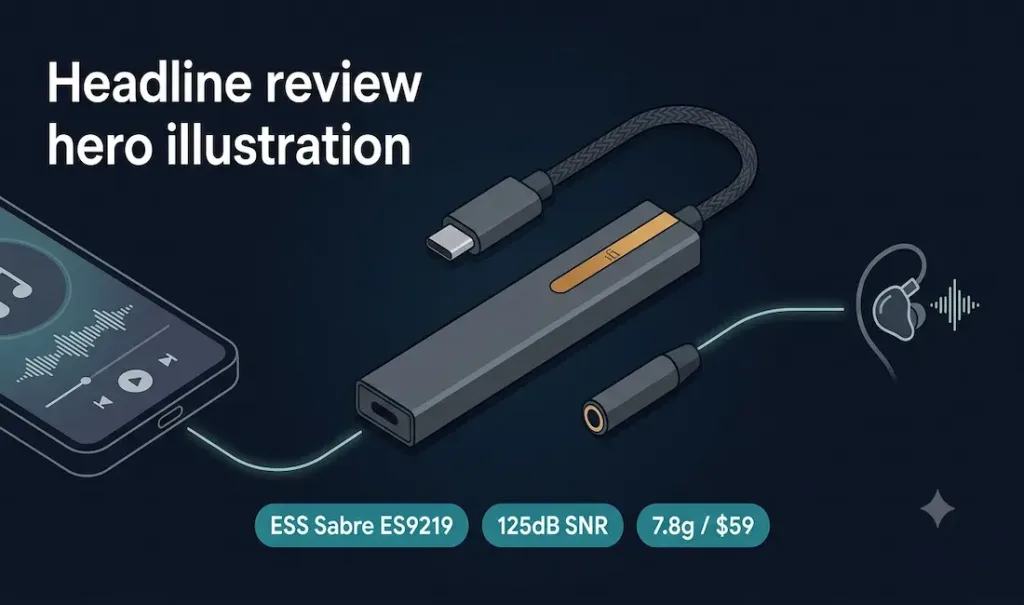
The iFi GO Link 2 is a precision-engineered dongle DAC that transforms smartphone and laptop audio into a genuinely high-fidelity experience. At $59, it delivers lower distortion, a wider dynamic range, and a lower noise floor than almost anything in its price bracket — in a package lighter than a coin. The lack of a 4.4mm balanced output and relatively modest power output are its only meaningful limitations.
Popular Comparison Scores
| Competitor | Price | Overall Score | vs GO Link 2 |
|---|---|---|---|
| iFi GO Link 2 | $59 | ⭐⭐⭐⭐½ 4.5 | — |
| Apple USB-C Dongle | $9 | ⭐⭐½ 2.5 | GO Link 2 wins decisively |
| FiiO KA1 | $25 | ⭐⭐⭐ 3.0 | GO Link 2 wins on noise floor and dynamics |
| FiiO KA13 | $50 | ⭐⭐⭐⭐ 4.0 | GO Link 2 wins on build; KA13 wins on power |
| Moondrop Dawn Pro | $50 | ⭐⭐⭐⭐ 4.0 | Very close; Dawn Pro has 4.4mm balanced |
| AudioQuest DragonFly Black | $99 | ⭐⭐⭐⭐ 4.0 | GO Link 2 wins on value; DragonFly on legacy support |
| AudioQuest DragonFly Cobalt | $299 | ⭐⭐⭐⭐½ 4.5 | Tied overall; Cobalt wins on refinement, GO Link 2 on portability |
| Chord Mojo 2 | $549 | ⭐⭐⭐⭐⭐ 5.0 | Mojo 2 wins on power and audiophile ceiling |
| iFi GO Link 2 Max | $85 | ⭐⭐⭐⭐½ 4.5 | Max wins on power; standard wins on price |
Product Overview
| Specification | Detail |
|---|---|
| Brand | iFi Audio |
| Model | GO Link 2 |
| DAC Chip | ESS Sabre ES9219 SoC |
| Output Power | 79mW @ 32Ω / 14mW @ 300Ω |
| Output Voltage | ≥1.59V @ 32Ω / ≥2.0V @ 300Ω |
| Output Impedance | <0.4Ω |
| THD+N | ≤0.0015% (1.27V @ 32Ω) |
| SNR | ≥125dB(A) |
| Dynamic Range | ≥125dB(A) |
| PCM Support | Up to 384kHz / 32-bit |
| DSD Support | DSD256 (native) |
| MQA | Not supported |
| Frequency Response | 10Hz–80kHz (-0.5dB) |
| Output | S-Balanced 3.5mm |
| Connection | USB-C (fixed cable) |
| App | iFi Nexis (Android only; iOS not compatible) |
| Dimensions | 137 × 12 × 7.6mm |
| Weight | 7.8g |
| Price | $59 / £59 / €69 |
| Warranty | 12 months (24 months EU) |
| In the Box | GO Link 2, Lightning adapter, USB-A adapter |
Announced: February 26, 2026 | Official product page
What Is the iFi GO Link 2?
The iFi GO Link 2 is a second-generation USB-C dongle DAC (digital-to-analog converter) from British audio specialist iFi Audio. It plugs into any USB-C port on a smartphone, tablet, or laptop, bypasses the device’s internal audio circuitry, and delivers higher-quality audio to wired headphones or IEMs through its 3.5mm output.
It is the successor to the original GO Link — announced in February 2026 and now available at the same $59 price point — and represents a meaningful upgrade in several technical areas: 8% smaller and 29% lighter than its predecessor, with THD compensation that reduces distortion by up to 62% compared to the original GO Link, a wider dynamic range, and support for iFi’s new Nexis app for filter selection and over-the-air firmware updates.
The GO Link 2 is aimed at commuters, mobile audiophiles, content creators, and anyone whose laptop or smartphone ships with an underwhelming internal DAC. It is not a battery-powered amplifier, not a balanced-output device, and not the right tool for driving full-size planar or high-impedance headphones from a portable source.
Key Features Explained
ESS Sabre ES9219 SoC
The GO Link 2 uses an ESS Sabre ES9219 SoC — not the Cirrus Logic chip found in the original GO Link. The ES9219 is a well-regarded DAC and amplifier system-on-chip used in a number of respected portable audio products. It unlocks 32-bit/384kHz PCM and native DSD256 playback, and iFi’s implementation adds THD compensation at the chip level — adjusting correction factors for the second and third harmonics — reducing measured distortion by up to 62% versus the original GO Link.
Note on MQA: The iFi GO Link 2 does not support MQA rendering or decoding. Some earlier marketing materials and third-party listings have incorrectly listed MQA as a feature. MQA Ltd. also entered administration in August 2023, making the format’s long-term future uncertain. Tidal’s lossless FLAC tier and Apple Music’s Lossless and Hi-Res Lossless formats do not require MQA and are fully supported at their native sample rates.
S-Balanced Output
The GO Link 2 uses iFi’s proprietary S-Balanced circuit on its 3.5mm output. This is not the same as a true balanced output requiring a 4.4mm Pentaconn connector — it is a single-ended 3.5mm output with circuit-level balancing designed to reduce channel crosstalk by 50%. For most users with standard 3.5mm IEMs or headphones, this provides cleaner stereo separation without requiring new cables.
Dynamic Range Enhancement (DRE)
DRE is an iFi processing feature that widens the gap between the quietest and loudest moments in a recording. The practical result is greater perceived contrast between passages — subtle details in quiet sections become more audible without the loudest peaks becoming harsh. It is a relatively subtle effect, most noticeable with well-mastered recordings in quiet listening environments.
iFi Nexis App
The GO Link 2 is the first GO Link model to support iFi’s Nexis app, enabling two features:
- Digital filter selection — two filters derived from the ES9219 chip are available, switchable within the app.
- Over-the-air firmware updates — no need to download files or connect to a computer.
Important compatibility note: The Nexis app is compatible with Android only. iOS compatibility is confirmed as not supported as of June 2026. Windows and macOS users can update firmware via computer.
Plug-and-Play Across Platforms
The GO Link 2 requires no drivers on Android, macOS, iPadOS, or Linux. Windows 10 and Windows 11 also support it natively via USB Audio Class 2. Sample rates switch automatically when the source material changes — no manual intervention required. USB-C adapters for Lightning (iOS devices) and USB-A (older laptops) are included in the box.
Sound Quality
Low Noise Floor
The GO Link 2’s most immediately impressive characteristic is its noise floor. With sensitive IEMs — including multi-driver IEMs with sensitivities above 110dB/mW — background silence is genuinely black. There is no detectable hiss during quiet passages, no interference from cellular radio, and no channel noise that commonly plagues budget laptop headphone outputs. The measured SNR of ≥125dB(A) is among the best in the sub-$100 dongle DAC category.
Soundstage and Imaging
Soundstage is a genuine strength. The GO Link 2 presents instruments and vocals with clear positional definition — center channel stays anchored, stereo elements have identifiable width, and layering between close and distant elements is well-resolved for a dongle DAC at this price. Compared to smartphone internal DACs, the improvement in spatial presentation is immediately apparent.
Tonal Character
The GO Link 2 leans toward a neutral-to-slightly-lean sonic signature. Bass has good note definition and distinction but does not add warmth or weight — if your headphones or IEMs are already bass-light, the GO Link 2 will not compensate. The midrange is clean and smooth. High frequencies have good extension without harshness. It is not a tonally colored device — it will reflect the character of your headphones rather than imposing its own.
This neutrality makes it a strong pairing for warm, musical IEMs and headphones (Meze 99 Classics, Final Audio A-series, Campfire Satsuma). It also works well with more reference-oriented gear without adding fatigue.
Power Output — Know the Limits
The GO Link 2 produces 79mW at 32Ω and 14mW at 300Ω. This is sufficient for:
- All IEMs (virtually any IEM will reach loud listening levels with headroom)
- Efficient portable headphones (sensitivity above 95dB/mW)
- Most closed-back headphones at moderate listening levels
It is not sufficient for:
- Power-hungry planar magnetic headphones (HiFiMAN HE400se, Audeze LCD series)
- High-impedance dynamic headphones at reference levels (Sennheiser HD800S at 300Ω, Beyerdynamic DT990 Pro at 250Ω)
- Open-back headphones in loud environments where significant volume is needed
If your headphones fall into the demanding category, evaluate the iFi GO Link 2 Max ($85, 241mW at 32Ω) or a battery-powered amplifier instead.
Design and Build
At 7.8g and 137 × 12 × 7.6mm, the GO Link 2 is iFi’s most compact DAC to date — 8% smaller and 29% lighter than the original GO Link. The aluminum body feels premium, resists fingerprints, and is rigid without flex.
The fixed USB-C to 3.5mm cable is 55mm long, braided, and rated for daily use. The short fixed cable is a deliberate design choice — it eliminates a loose connection point and keeps the unit low-profile when plugged in. The trade-off is a slight tendency to kink if coiled tightly in a pocket. Keeping it straight or loosely coiled prevents this.
No physical controls are present. Volume is controlled by the source device. This simplicity is appropriate for a product of this scope — it adds nothing that would benefit from buttons and removes nothing users need access to.
The included accessories are practical: a Lightning adapter for older iPhones and iPads, and a USB-A adapter for laptops without USB-C. Both are metal and feel equally well-made to the main unit.
Compatibility Guide
| Device Type | Compatible | Notes |
|---|---|---|
| Android (USB-C) | ✅ Yes | Plug-and-play; Nexis app available |
| iPhone 15+ (USB-C) | ✅ Yes | Plug-and-play; Nexis app not compatible |
| iPad Pro / Air (USB-C) | ✅ Yes | Plug-and-play |
| iPhone 14 and earlier (Lightning) | ✅ Yes | Use included Lightning adapter |
| MacBook / Mac (USB-C) | ✅ Yes | No drivers required |
| Windows 10 / 11 (USB-C) | ✅ Yes | Native USB Audio Class 2, no drivers |
| Linux | ✅ Yes | Native support |
| PS5 / Xbox Series X | ⚠️ Limited | Console USB audio support varies |
| Bluetooth-only source | ❌ No | USB-C connection required |
Compared to Popular Rivals
vs Apple USB-C Dongle ($9)
The Apple dongle is adequate for calls and casual listening. The GO Link 2 delivers 10× the output power, full hi-res support, and a dramatically lower noise floor. If you care about music, the $50 difference is justified within a week of use.
vs FiiO KA1 ($25)
The KA1 is a capable entry-level dongle at a lower price point. The GO Link 2 edges it on measured noise floor, dynamic range, and build quality. The KA1 is the right choice if budget is the primary constraint. The GO Link 2 is worth the extra $34 if sound quality matters more than price.
vs Moondrop Dawn Pro ($50)
The Dawn Pro is the GO Link 2’s closest genuine competitor. It offers a 4.4mm balanced output that the GO Link 2 lacks, which is meaningful if you have 4.4mm-terminated IEMs. Sound quality is broadly comparable. The GO Link 2 edges it on noise floor and dynamic range by measurement; the Dawn Pro wins on output option variety.
vs AudioQuest DragonFly Black ($99)
The DragonFly Black uses an older ESS chip at a higher price. The GO Link 2 measures better across the board at lower cost. The DragonFly’s advantage is its established ecosystem, broad legacy compatibility, and strong retail support network. On pure audio performance per dollar, the GO Link 2 wins.
vs Chord Mojo 2 ($549)
The Mojo 2 is a different class of device — a battery-powered desktop/portable DAC/amp with significantly more power (600mW), a more refined sonic presentation, and a price nearly 10× higher. The GO Link 2 is not competing with it. If you need the Mojo 2’s capability, you already know it.
Who Should Buy the iFi GO Link 2?
Buy it if:
- You stream lossless audio (Tidal, Apple Music, Qobuz, Amazon Music HD) on a smartphone or laptop and want to hear it properly
- You use IEMs — the low noise floor makes it an exceptional IEM partner
- You want plug-and-play simplicity across multiple devices without carrying adapters beyond what’s in the box
- You are an Android user who wants app-based filter switching and OTA firmware updates
- Your laptop’s headphone output has audible hiss, channel imbalance, or interference
Skip it if:
- You need balanced 4.4mm output — look at the Moondrop Dawn Pro ($50) or iFi GO Link 2 Max ($85)
- You drive power-hungry planar or high-impedance headphones — the 79mW output will not satisfy them
- You are an iOS user who wants the iFi Nexis app — it is not compatible with iOS as of mid-2026
- You already own the original GO Link and are happy with its sound — the improvement is incremental, not transformational
Final Verdict
The iFi GO Link 2 earns its 4.5/5 overall rating as one of the best-engineered dongle DACs available at its price point in 2026. Its combination of a measured noise floor that outclasses most similarly priced competitors, genuine plug-and-play simplicity across every major platform, and a build quality that feels premium rather than disposable makes it the default recommendation for anyone upgrading from smartphone or laptop audio to wired IEMs or efficient headphones.
The limitations are real but clearly defined: it will not satisfy high-impedance headphone users, it lacks balanced output, and iOS users cannot access the Nexis app. For users within its intended scope, those limitations do not affect the day-to-day experience.
At $59, the GO Link 2 represents exactly the kind of value that makes the dongle DAC category compelling — genuinely audible improvement in a package small enough to forget you’re carrying it, at a price that requires no justification.
Recommended for: mobile audiophiles, IEM users, commuters, content creators, Android users. Not for: high-impedance headphone users, balanced cable users, iOS users requiring app features.
Buy the iFi GO Link 2 from the official product page | Street price: $59
Frequently Asked Questions
What DAC chip does the iFi GO Link 2 use?
The iFi GO Link 2 uses an ESS Sabre ES9219 SoC. This is a change from the original GO Link, which used a Cirrus Logic CS43131 chip. The ES9219 is a combined DAC and amplifier system-on-chip that supports 32-bit/384kHz PCM and native DSD256 audio.
iFi has implemented THD compensation at the chip level by adjusting correction factors for the second and third harmonics, reducing measured distortion by up to 62% compared to the original GO Link. Some third-party listings and earlier reviews have incorrectly listed the Cirrus Logic CS43131 as the GO Link 2’s chip — this is inaccurate. The ES9219 is the correct chip for the second-generation model.
Does the iFi GO Link 2 support MQA?
No. The iFi GO Link 2 does not support MQA rendering or decoding. Some earlier promotional materials and third-party listings incorrectly listed MQA as a feature — the Headfonics review and the Music for the Masses review both confirmed that MQA is not supported on the GO Link 2. MQA Ltd. entered administration in August 2023, making the format’s long-term future uncertain. For streaming services, this is largely irrelevant: Tidal now offers lossless FLAC streaming, and Apple Music Lossless and Hi-Res Lossless operate natively at their sample rates without MQA. The GO Link 2 plays all of these formats correctly at full resolution.
Is the iFi GO Link 2 compatible with iPhone?
Yes — with an important distinction. The GO Link 2 connects directly to iPhone 15, iPhone 15 Pro, iPhone 16 series, and any other iPhone with a USB-C port. For older iPhones with Lightning connectors (iPhone 14 and earlier), the included Lightning adapter allows connection.
The device is plug-and-play on iOS with no drivers required. However, iFi’s Nexis app — which provides digital filter selection and over-the-air firmware updates — is Android-only as of mid-2026 and is not compatible with iOS. iPhone users can use the GO Link 2 fully for audio playback, but cannot access app-based features.
How much power does the GO Link 2 produce and what headphones can it drive?
The GO Link 2 produces 79mW at 32Ω and 14mW at 300Ω. This is sufficient for virtually all IEMs, most efficient portable over-ear headphones (sensitivity above 95dB/mW), and closed-back headphones at moderate listening levels. It is not adequate for planar magnetic headphones (which typically require 200mW or more at 32Ω), high-impedance audiophile headphones like the Sennheiser HD800S (300Ω) at reference levels, or any headphone being driven in loud environments where significant volume overhead is needed. For more demanding headphones, evaluate the iFi GO Link 2 Max ($85, 241mW at 32Ω) or a battery-powered portable amplifier.
What is the difference between the iFi GO Link 2 and the GO Link 2 Max?
The GO Link 2 Max ($85) is a higher-output sibling released alongside the GO Link 2. Key differences: the Max uses dual ESS Sabre DAC chips rather than one, producing significantly more output power (241mW at 32Ω vs 79mW), adds a hardware volume control knob, and includes both a 3.5mm and 4.4mm Pentaconn balanced output.
The standard GO Link 2 ($59) is smaller, lighter, and simpler — one output, no physical controls, and lower power for IEM and efficient headphone use. The Max is the right choice for users with demanding headphones or who require a balanced output; the standard GO Link 2 is the right choice for IEM-focused mobile listeners who want the smallest possible form factor.
+Pros
- Exceptionally low noise floor — genuinely black background with sensitive IEMs
- ESS Sabre ES9219 with THD compensation delivering ≤0.0015% THD+N
- 125dB(A) SNR and dynamic range — class-leading at this price
- Plug-and-play on Android, iOS, macOS, Windows, Linux — no drivers
- 8% smaller and 29% lighter than the original GO Link
- Nexis app for filter switching and OTA updates (Android)
- Lightning and USB-A adapters included
- $59 price unchanged from the original GO Link
−Cons
- MQA not supported (relevant only if you are a Tidal MQA subscriber — Tidal FLAC works fine)
- Fixed cable can kink if tightly coiled
- 79mW output is not sufficient for demanding headphones
- Nexis app Android-only — iOS users cannot access filter switching
- No 4.4mm balanced output (available in GO Link 2 Max at $85)
- Only two digital filter options