JBL Bar 1300XMK2 Review: Powerful and Immersive Soundbar
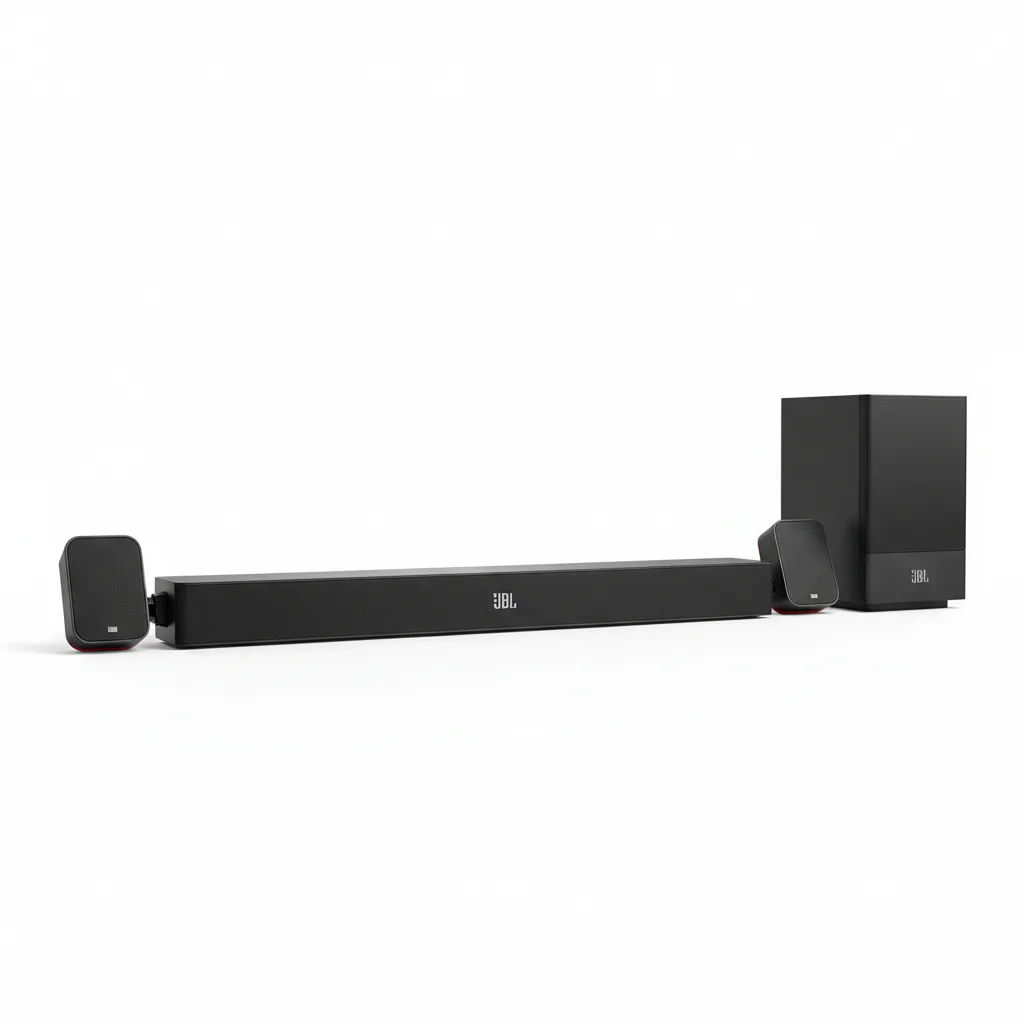
The JBL Bar 1300XMK2 solves the single biggest problem in home theater: the wireless rear speakers that actually work. At 1570W across 23 drivers in an 11.1.4 configuration, it delivers genuine cinema-scale audio with battery-powered surrounds that run for 10 hours without wires. The subwoofer hits hard, dialogue stays intelligible at reference volume, and MultiBeam 3.0 creates convincing height effects without ceiling-mounted speakers. The $1,699 price is real money, and the size demands a large room. For anyone serious about Dolby Atmos performance without hiring an installer, this is the most capable out-of-box system available.
Why 1570W Matters: Understanding the Numbers
JBL rates the Bar 1300XMK2 at 1570W total peak output across the complete system. Understanding what this means requires separating the figure into components: 950W powers the 19 drivers in the main soundbar, 160W drives each of the two wireless surround speakers, and 300W runs the 12-inch subwoofer.
These are peak figures measured at 1% total harmonic distortion, which is the industry-standard measurement for maximum clean output. In real listening conditions at reference levels, the system draws significantly less — but the peak headroom is what prevents audible distortion during the dynamic peaks of action sequences, where the gap between dialogue and explosions can span 30dB or more.
The practical result: in a 450-square-foot room, the Bar 1300XMK2 reaches reference cinema levels (approximately 85dB average, 105dB peaks) without straining. Most 5.1 soundbar systems at this price cap out at 500-600W total and compress dynamic peaks to avoid distortion. The JBL does not.
The Wireless Surrounds: The Feature That Justifies the Price
Every previous wireless surround speaker system for soundbars shared a fundamental problem: they still required AC power cables running to each rear speaker. The cables might be thinner than traditional speaker wire, but you were still routing something from a power outlet to a position behind the couch.
The Bar 1300XMK2’s detachable rear speakers are genuinely battery-powered. Each contains its own amplifier, four drivers (three forward-facing plus one up-firing), a rechargeable battery good for 10 hours, and the wireless receiver hardware. They detach from either end of the main soundbar by releasing a magnetic lock — the same connection that charges them when docked.
Place them behind your seating position, switch the system on, and the Atmos overhead layer now extends behind you with no cables. During testing at Tom's Guide, the surrounds maintained perfect synchronisation at 18 feet from the main bar through concrete walls — the kind of distance that causes dropouts in competing wireless audio systems. Battery life hit the claimed 10 hours consistently in mixed usage.
The surrounds can also be detached and used as standalone Bluetooth speakers — a genuinely useful feature when you want audio in another room without setting up a separate speaker.
Sound Performance: Cinema Scale With Musical Competence
The 1570W total system does exactly what the specification promises — it is loud, clean, and spatially immersive. In Dolby Atmos content, the four up-firing drivers in the main bar create convincing height layers that separate clearly from the surround field. Overhead effects — helicopter rotors, rainfall, aircraft — position themselves above rather than around the listener in a way that cheaper Atmos soundbars fail to achieve.
Bass performance from the 12-inch subwoofer is authoritative without bloat. The 300W dedicated amplification hits low extension down to approximately 28Hz, which puts genuine physical pressure in large-scale movie effects. The crossover integration between the subwoofer and the main bar’s woofer elements is clean — there is no audible seam between bass handled by the sub and mid-bass handled by the bar itself.
PureVoice 2.0 represents an improvement over the original Bar 1300’s dialogue clarity. Rather than applying a static EQ boost to the vocal frequency range, it uses neural processing to identify and enhance the voice signal relative to the surrounding sound design. The difference is most obvious during densely mixed action sequences — voices remain intelligible at 90dB without the artificial telephone-voice quality many dialogue enhancement modes produce.
Music performance is better than the home-theater focus suggests. Tidal Connect streams lossless audio directly without device handoffs. In Pure Direct mode, which bypasses spatial processing, the system renders stereo music with a wide, stable image that serves classical, jazz, and acoustic content well. Electronic music at volume is impressive — the sub delivers proper physical impact that smaller soundbars cannot achieve.
MultiBeam 3.0 and Room Calibration
MultiBeam 3.0 is JBL’s beam-forming technology, which analyses room reflections in real time and adjusts the angle and delay of the sound output accordingly. This matters because Dolby Atmos height effects depend on ceiling reflections from up-firing drivers — a technique that only works correctly when the system knows the room’s geometry.
The Calibrated Audio room measurement process uses the wireless surrounds as reference microphones to measure the speed and reflection pattern of test tones from seven positions. The entire process takes 90 seconds and delivers noticeably improved bass tightness and height channel placement compared to the uncalibrated default. It is the kind of step that enthusiasts might spend hours doing manually with a calibration microphone and Audyssey software — automated here in a minute and a half.
Gaming Performance: Excellent Audio, One Limitation
The Bar 1300XMK2 delivers excellent Dolby Atmos gaming audio on PS5 and Xbox Series X. Input lag is minimal. ALLM switches the system to low-latency mode automatically when a game console is detected. Height effects in supported titles — particularly first-person shooters and games with significant vertical audio design — position sounds convincingly in three-dimensional space.
The one limitation is the HDMI passthrough. The Bar 1300XMK2’s HDMI port passes 4K video at 60Hz maximum. Running a console through the soundbar for one-cable convenience means playing at 4K/60fps rather than 4K/120fps. This is only relevant for the specific games that support 4K/120fps mode — most AAA titles do not — but it is a documented limitation that has not been addressed from the previous generation Bar 1300.
Workaround: connect the console directly to a TV HDMI 2.1 port and route audio through the eARC connection to the soundbar. This achieves 4K/120fps gaming with full Dolby Atmos audio, at the cost of one extra cable and settings change.
How It Compares to Rivals
Against the Samsung HW-Q990D, the Bar 1300XMK2 wins on wireless freedom — Samsung’s rear speakers still require power cables — and on raw power output. The Samsung wins on smart TV integration for Samsung TV owners and has slightly tighter bass transient response. The JBL’s Calibrated Audio room correction is more thorough than Samsung’s Space Fit Sound.
The Sonos Arc Ultra + Sub 4 + Era 300 setup offers superior multi-room audio integration and Sonos’s mature streaming ecosystem. The complete Sonos system costs approximately $2,800 assembled — significantly more than the JBL. The JBL delivers superior cinema dynamics; Sonos delivers superior whole-home audio integration. Choose based on whether you prioritise the home theater room or the whole house.
Against the Bose Smart Ultra Soundbar + Bass Module 500 + Surround Speakers 700, the JBL wins on power, driver count, and channel configuration. Bose wins on industrial design and app refinement. The Bose system costs over $2,500 assembled and does not deliver 11.1.4 channel audio in the result.
Who Should Buy the JBL Bar 1300XMK2
Buy this system if you have a dedicated media room larger than 300 square feet and currently route speaker wire across the floor to rear surrounds. The wireless surrounds solve this problem permanently.
Buy it if you host regular movie nights and want guests to experience genuine Dolby Atmos without complex installation. The one-cable HDMI eARC setup takes under 15 minutes from unboxing to calibrated playback.
Buy it for a PS5 or Xbox Series X gaming setup where 4K/120fps is not a priority but spatial audio immersion is. Titles like Spider-Man 2 and Returnal use Dolby Atmos height channels in ways the Bar 1300XMK2 reproduces convincingly.
Skip it if your room is under 250 square feet — the 1570W output is overkill and the physical size of the bar may dominate the space disproportionately. Also skip it if 4K/120fps gaming through the soundbar HDMI is a specific requirement, as the passthrough limitation applies here.
Verdict
The JBL Bar 1300XMK2 earns its place at the top of the soundbar market by solving real problems rather than adding incremental specifications. The genuinely battery-powered wireless surrounds represent the most meaningful advance in soundbar design in years — they eliminate the cable compromise that has defined every competing surround system without requiring custom installation.
1570W total output across 23 drivers delivers the kind of dynamic range that puts movie audio exactly where it belongs: sounding uncomfortably close to the real thing. PureVoice 2.0’s contextual dialogue processing maintains intelligibility without sacrificing the rest of the soundtrack. MultiBeam 3.0 with automatic room calibration ensures the height effects work regardless of room geometry.
The 4K/60Hz HDMI passthrough limitation and the $1,699 price are the honest objections. Both are worth understanding before purchasing. Neither disqualifies the system for its primary audience: movie lovers and gamers who want cinema audio without hiring an installer.
Rating: 4.4 / 5 — The best wireless surround soundbar system available in 2026, with enough power and driver count to justify every dollar of the premium price.
Reviewed based on JBL official Bar 1300XMK2 product page, Amazon listing with full specifications, Tom's Guide Bar 1300XMK2 review, and B&H Photo technical specifications — July 2026.
Frequently Asked Questions
What is the total wattage of the JBL Bar 1300XMK2?
How many drivers does the JBL Bar 1300XMK2 have?
How long do the wireless surround speakers last on battery?
Does the JBL Bar 1300XMK2 support 4K 120Hz gaming?
How does the JBL Bar 1300XMK2 compare to the Samsung HW-Q990D?
What streaming services does the JBL Bar 1300XMK2 support?
Is the JBL Bar 1300XMK2 worth the price?
Does the JBL Bar 1300XMK2 have Wi-Fi?
+Pros
- 1570W total output drives rooms up to 600 square feet without distortion
- Wireless battery-powered surrounds eliminate rear speaker cable management permanently
- 23-driver array produces height effects that convincingly separate overhead from front-stage audio
- PureVoice 2.0 adapts dialogue enhancement dynamically — never sounds artificially boosted
- Calibrated Audio room correction works in 90 seconds and makes a meaningful audible difference
- Magnetic charging dock for surrounds is elegant and practical
−Cons
- HDMI passthrough limited to 4K/60Hz — 4K/120Hz gaming requires TV HDMI connections directly
- Main bar is 40 inches wide — unsuitable for rooms with TVs smaller than 65 inches
- Full system weighs approximately 48 pounds — wall mounting requires two people
- Surrounds need recharging after 10 hours — inconvenient for all-day listening sessions
- App requires account creation and cannot be used anonymously
- $1,699 US price is a significant commitment against soundbar-only alternatives