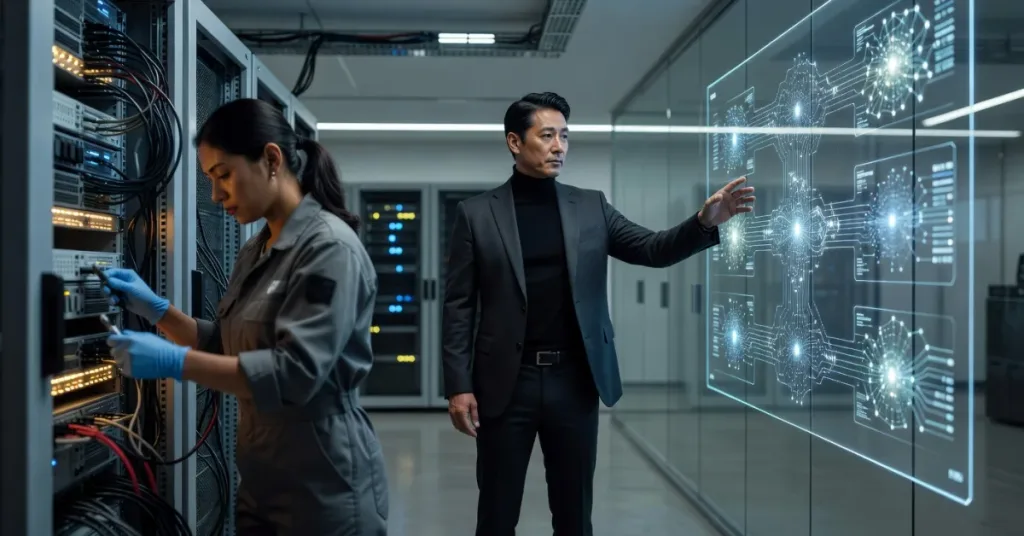
80% of IT professionals now oversee AI shifts IT roles from manual operations to automated orchestration, per the 2026 SolarWinds IT Trends Report. This pivot means network engineers spend less time troubleshooting BGP flaps or SDN controller configs and more time directing AI-driven workflows that self-heal latency spikes or predict traffic surges via ML models like those in Cisco AI Network Analytics.
In enterprise networks, this manifests as IT orchestrators using tools like Ansible Tower integrated with AI agents to automate intent-based networking. Instead of scripting every OSPF adjacency tweak, pros define high-level policies—”ensure 99.99% uptime across hybrid WAN”—and let AI handle the orchestration via platforms such as VMware Tanzu or HashiCorp Waypoint. The report highlights how this reduces hands-on tasks, freeing bandwidth for strategic alignment with business KPIs like zero-trust enforcement.
Orchestration in Networking
AI shifts IT roles by embedding intelligence into core protocols. Consider intent-based networking (IBN) from Juniper Mist or Arista’s Cognitive Campus: admins specify outcomes, and AI translates them into YANG models pushed via NETCONF. Network engineers now monitor AI anomaly detection—spotting DDoS precursors in NetFlow data 30 minutes earlier—rather than sifting logs manually.
- Automated remediation: AI reroutes via SRv6 segments during fiber cuts, minimizing MTTR from hours to seconds.
- Predictive scaling: Tools forecast EVPN VXLAN overlays for 5G backhaul surges using time-series models like Prophet.
- Policy enforcement: AI dynamically applies micro-segmentation in Cisco ACI fabrics, blocking lateral movement without static ACLs.
This demands upskilling in orchestration platforms; ignore it, and teams lag as competitors deploy NIST-aligned AI governance.
Skill Gaps Exposed
The SolarWinds data reveals friction: while 80% report the AI shift, many lack fluency in GitOps pipelines or Kubernetes operators for network functions. IT orchestrators must master declarative configs—think FluxCD syncing Istio service meshes with underlay BGP—over imperative scripting. For networking pros, this means auditing AI explainability in tools like Splunk’s ML Toolkit to validate why a traffic steering decision favored one path over another.
Link this to emerging automation pitfalls in enterprise infrastructure, where misconfigured AI amplifies shadow IT risks.
Vendor Strategies Evolving
Vendors accelerate this: Nokia’s AVA platform uses AI for cross-domain orchestration, correlating SONiC white-box switches with telco 5G cores. HPE Aruba Edge Services Platform pushes AI ops to APs, offloading central controllers. IT teams should pilot these in non-prod labs, measuring KPIs like policy convergence time post-failover.
Integrate with streamlined workflow tools for hybrid environments to bridge ops silos.
Human-AI Symbiosis
AI doesn’t replace pros; it amplifies them. Orchestrators intervene in edge cases—like quantum-safe crypto rollouts amid post-quantum threats—where AI flags but humans decide. Per IEEE insights, this symbiosis cuts error rates in SD-WAN deployments by prioritizing human oversight on high-stakes paths.
Key Takeaways
The AI shift in IT roles demands orchestrators prioritize AIOps certification (e.g., Broadcom’s DX Orchestration) and simulate failure modes in tools like Chaos Mesh. Enterprises gain resilient networks; pros gain leverage against burnout.
Forward: Expect AI-native fabrics dominating by blending neuromorphic chips with eBPF programmability. Audit your stack now—map manual tasks to AI proxies—to lead the transition.