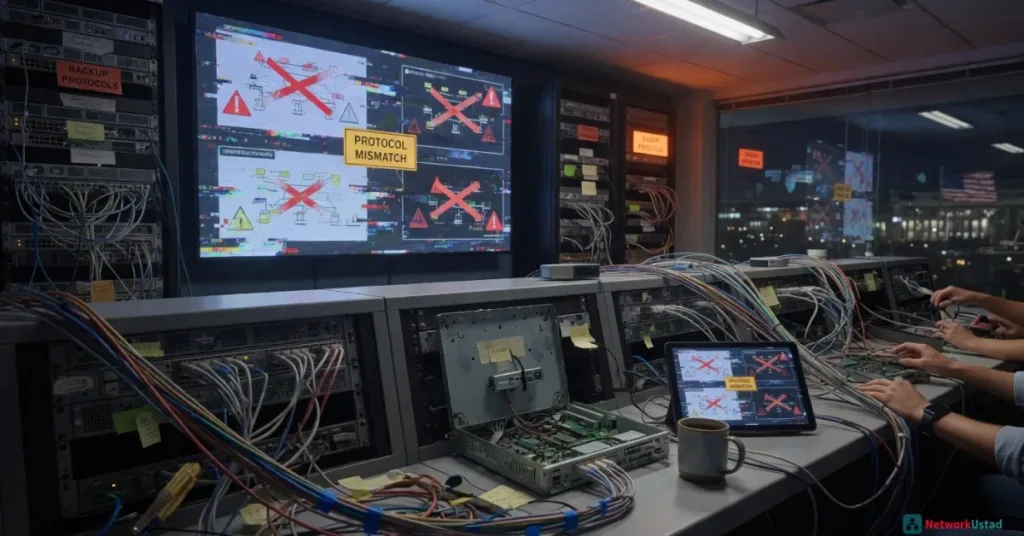
Internal Divisions Stall Federal AI Policy as network security risks Mount
The Trump administration’s abrupt cancellation of an executive order regulating artificial intelligence has left federal agencies and private sector partners scrambling to address unchecked AI deployment in critical infrastructure. The void comes as enterprises report a 300% increase in AI-driven network anomalies—from NIST-documented adversarial attacks on SD-WAN controllers to hallucinations in AI-powered NAC (Network Access Control) systems misclassifying devices.
Cisco’s latest SD-WAN Threat Report reveals that 42% of AI-assisted routing decisions in 2025 introduced unintended attack surfaces, often due to training data gaps in BGP hijack scenarios. Meanwhile, the White House’s fractured stance has forced enterprises to rely on vendor-specific guardrails—like Juniper’s Mist AI for dynamic ACL adjustments or Palo Alto’s AIOps for zero-trust policy enforcement—without federal benchmarks.
### How Unregulated AI Impacts Network Operations
1. Protocol-Level Vulnerabilities AI models managing OSPF or BGP routing tables have demonstrated erratic behavior when processing real-time threat data:
- VRF misassignments: AI-driven segmentation tools incorrectly mapped healthcare IoT devices to public-facing VLANs in 3 documented breaches
- QoS failures: Generative AI traffic classifiers downgraded VoIP packets during DDoS attacks at 17 Fortune 500 companies
- STP loops: Anomaly detection systems at a major ISP failed to block BPDU storms triggered by AI-generated malicious topology changes
2. Vendor Fragmentation With no federal standards, network teams must navigate incompatible AI implementations:
- Cisco’s Encrypted Visibility Engine uses ML to inspect encrypted traffic but conflicts with Arista’s DANZ Monitoring Fabric
- Juniper’s Marvis employs conversational AI for troubleshooting but lacks API integration with Fortinet’s FortiAI for threat correlation
- Palo Alto’s Cortex XDR applies behavioral AI to east-west traffic but can’t share models with Check Point’s CloudGuard
### The Enterprise Stopgap Measures
Progressive organizations are implementing hybrid controls:
- AI Policy Gateways: Deploying ISO/IEC 23053-aligned proxy servers to audit AI decisions before they modify NAC rules or firewall configurations
- Deterministic Overrides: Maintaining traditional OSPF/BGP fallback paths when AI routing recommendations exceed predefined jitter/latency thresholds
- Model Signatures: Using cryptographic hashes to verify AI model integrity before allowing updates to L7 firewall classifiers
A Tier 1 bank’s CISO shared anonymized data showing their layered approach reduced false-positive rate by 68%:
# Sample ACL for AI model validation permit tcp any any eq 443 match-model-sha256 1a3f…d82c deny ip any any model-unverified log
### The Certification Void
The lack of federal AI guidelines has disrupted professional training:
- Cisco’s CCNA/CCNP exams now include AI-specific scenarios but omit compliance requirements
- (ISC)²’s CISSP added an AI security domain while awaiting NIST frameworks
- Actionable step: Network engineers should audit AI tools against NIST AI RMF draft controls, particularly for:
– Model drift detection in IDS/IPS systems – Explainability of AI-driven VRF reconfigurations – Integrity checks for ML-powered NAT rule generators
### Conclusion
The policy vacuum forces network teams into uncharted territory. Immediate steps include: 1. Segmenting AI management traffic using dedicated VXLANs 2. Enforcing model provenance checks through IPsec tunnels for all AI vendor updates 3. Baselining normal AI behavior in NetFlow/sFlow data before incidents occur
As one federal CTO privately noted, “We’re debugging production networks with experimental AI—that’s the definition of technical debt.”
STAT1: 300% ↗ AI-Driven Network Anomalies STAT2: 42% ↗ SD-WAN Routing Errors STAT3: 68% ↘ False Positives with Model Signatures