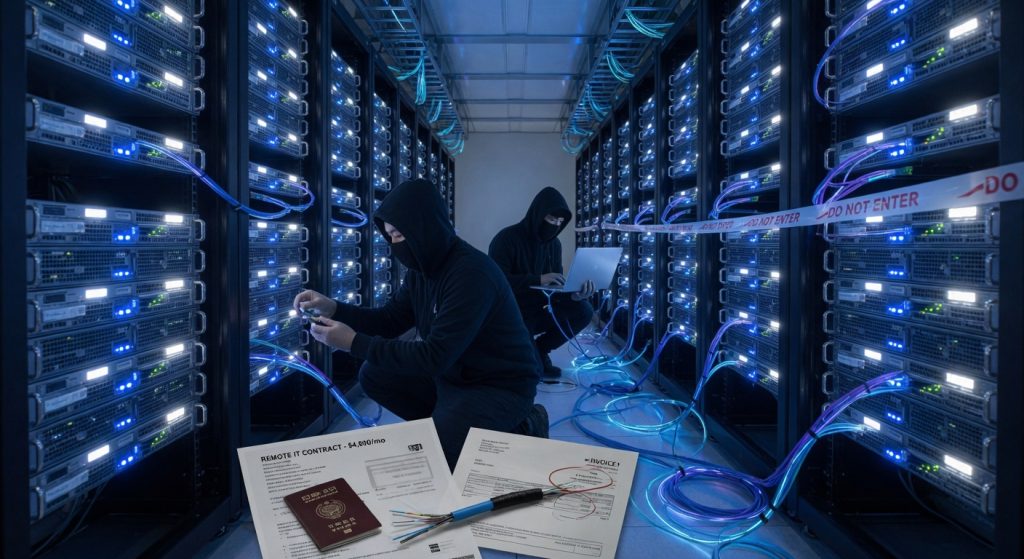
Two U.S. nationals, Matthew Issac Knoot from Nashville and Erick Ntekereze Prince from New York, each received 18-month prison sentences for running laptop farms that funneled North Korean IT workers into nearly 70 American companies. These operations generated over $1.2 million for Pyongyang, bypassing U.S. sanctions through remote work schemes. For IT leaders hiring freelancers, this exposes a hidden vector in North Korean IT remote workers—a fast track not just to sanctions evasion, but to felony convictions.
The schemes relied on virtual private networks (VPNs) and proxy servers to mask IP addresses originating from North Korea, often routing through China or Russia. Workers posed as U.S.-based talent on platforms like Upwork and LinkedIn, delivering software development under false identities. Companies unknowingly paid salaries that Pyongyang skimmed via cryptocurrency wallets, funding missile programs. This isn’t isolated; federal indictments reveal similar networks targeting tech firms since 2023.
Laptop Farms Exposed
Laptop farms involve clusters of U.S.-based machines remotely controlled by overseas actors. Knoot and Prince configured these with tools like TeamViewer and AnyDesk, enabling real-time access while spoofing geolocation via residential proxies. North Korean operatives, trained in languages and coding bootcamps by state entities like the Reconnaissance General Bureau, handled tasks from web app development to DevOps.
- Detection clues: Anomalous login patterns from U.S. IPs with zero local activity, mismatched resumes lacking verifiable GitHub histories, or rates 20-30% below market for high-skill work.
- Revenue flow: Funds laundered through mixers like Tornado Cash before conversion to fiat, evading FinCEN monitoring.
IT pros must audit vendor risk; a single hire can trigger OFAC violations under the International Emergency Economic Powers Act.
Sanctions Evasion Tactics
North Korea’s IT export economy thrives on remote worker infiltration, exploiting gig platforms’ weak KYC. Operatives use stolen or fabricated identities, often buying U.S. Social Security numbers on dark web markets. Companies like those hit here lost intellectual property while funding adversaries—codebases potentially backdoored with implants mimicking legitimate tools like Log4j exploits.
For deeper context on state-sponsored cyber ops, see CSIS analysis of DPRK hacking. Network engineers should deploy IP geofencing with tools like MaxMind GeoIP2, cross-referenced against WHOIS data.
Internal vetting aligns with spotting freelance scams early, where red flags mirror these ops.
Detection for IT Teams
Hiring managers overlook North Korean IT remote workers amid talent shortages, but tools exist:
- Behavioral analytics: Monitor keystroke dynamics via solutions like BehavioSec; DPRK workers often exhibit non-native typing cadences.
- Blockchain forensics: Trace crypto payouts using Chainalysis—Pyongyang favors mixers but leaves trails.
- Video verification: Mandate live calls with reverse image search on faces via PimEyes.
Implement zero-trust access with NIST frameworks, enforcing multi-factor authentication (MFA) beyond SMS. For supply chain risks, consult NIST SP 800-161 on vendor cybersecurity.
Enterprise Risk Imperatives
Conduct quarterly third-party risk assessments, prioritizing platforms with lax ID checks. Train HR on OFAC’s SDN list screening via automated APIs from Refinitiv.
The Bottom Line
North Korean IT remote workers represent a dual threat: financial sanctions breaches and IP theft. With 70 firms compromised and $1.2 million siphoned, enterprises face DOJ scrutiny—fines up to $1 million per violation. IT leaders must pivot to verified domestic talent pools or EU-compliant platforms like Toptal.
Forward: As AI hiring tools emerge, integrate them with threat intel feeds from Recorded Future. Prioritize now—ignoring this invites audits and blacklisting.