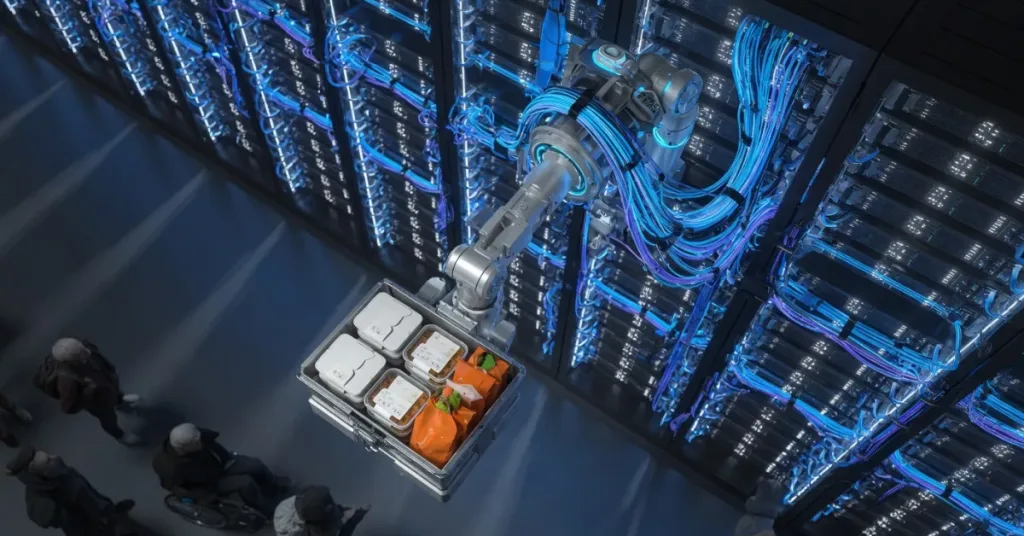
In San Francisco’s Tenderloin district—a neighborhood grappling with homelessness, poverty, and food insecurity—a nonprofit has deployed robotic meal prep systems to address a critical shortage of human volunteers. This initiative highlights how automation and AI are being repurposed for social good, particularly in environments where traditional volunteer models struggle to scale.
For IT professionals, this case study offers insights into the networking and infrastructure demands of robotic food service systems. From real-time sensor data processing to secure IoT device management, the deployment underscores the growing intersection of AI, edge computing, and public service infrastructure.
The Networking Backbone of Robotic Meal Prep
The robotic system relies on a distributed architecture combining:
- Edge computing nodes for low-latency processing of food prep instructions
- QoS-prioritized VLANs to ensure uninterrupted communication between robots and control systems
- IPsec tunnels for secure remote monitoring by off-site nutritionists
Key protocols in play include OSPF for dynamic routing between kitchen stations and STP to prevent loops in the robotic control network. The system’s SD-WAN configuration allows failover to cellular when primary connections falter—a critical feature given the Tenderloin’s aging infrastructure.
> *”We treat each robotic unit as an IoT endpoint with zero-trust principles,”* explains the nonprofit’s CTO. *”Every command packet is authenticated via mutual TLS, and we segment control traffic from sensor data using VRF instances.”*
Cybersecurity Considerations for Humanitarian Robotics
Deploying automation in high-risk environments introduces unique challenges:
- Physical attack surfaces: Robots in public spaces face tampering risks absent in controlled factories
- ACL policies must balance strict access controls with emergency override capabilities for staff
- Behavioral anomaly detection: AI models monitor for deviations from normal meal prep sequences that might indicate compromise
The organization implemented Palo Alto NGFW rules to inspect robotic control traffic, blocking unexpected GRE tunnel initiation attempts that could signal lateral movement. Their Cisco ISE deployment enforces 802.1X authentication for all robotic endpoints.
Scaling Lessons for IT Teams
Three infrastructure takeaways from this deployment:
1. Bandwidth planning: Each robotic unit generates 15-20Mbps of telemetry during operation, requiring careful MPLS or SD-WAN capacity planning 2. Latency thresholds: Control commands must be delivered in <50ms to prevent meal prep errors—dictating edge compute placement 3. Disaster recovery: The system maintains a hot spare robot that automatically syncs state via LACP-bonded 10Gbps links
The nonprofit’s Arista switches provide the microsecond-level latency needed for synchronized multi-robot operations, while Juniper EX series handles the higher-layer policy enforcement.
Looking Ahead
This case demonstrates how AI and networking technologies are expanding beyond traditional enterprise use cases. For IT professionals, it highlights:
- The need for VRF-grade segmentation in mixed criticality environments
- How QoS policies must evolve when human safety depends on network performance
- Why zero-trust principles apply equally to humanitarian tech as they do to corporate networks
As similar deployments spread, network architects will play a pivotal role in ensuring these systems remain as reliable as the communities they serve.