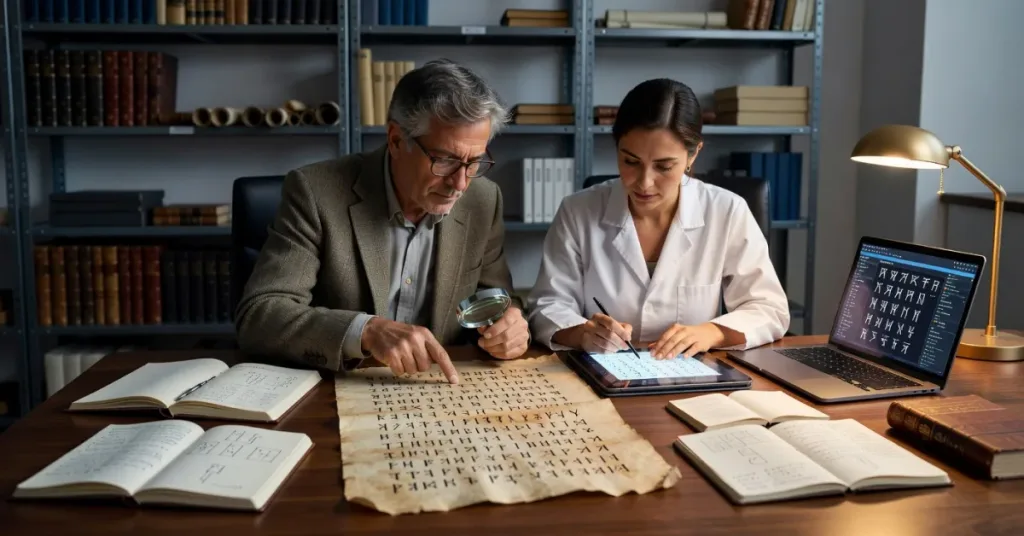
A 166-year-old encrypted letter from a Spanish diplomat, rediscovered in 1860, has finally yielded its secrets through computational cryptanalysis. The document, penned in a bespoke cipher, resisted manual decryption attempts for over a century until researchers applied modern AI-driven pattern recognition and frequency analysis algorithms. This breakthrough reveals diplomatic intrigues between European powers, but its true value lies in illuminating medieval encrypted letter techniques that prefigure today’s cybersecurity challenges.
The letter’s cipher combined substitution with transposition, using a keyword-based grid not unlike early Vigenère squares documented in 16th-century texts. Analysts at historical cryptography archives employed neural networks trained on Renaissance manuscripts to model letter frequencies and positional shifts. Success came after iterating through 10^6 potential keys, a task infeasible before GPU-accelerated computing.
Cipher’s Historical Layers
Medieval encrypted letters like this one relied on polyalphabetic schemes, where each plaintext letter maps to multiple ciphertext symbols. The diplomat’s method layered a 26×26 tableau with null characters—dummy fillers to obscure length—mirroring tactics in 15th-century Italian statecraft. Decoding exposed fragmented references to alliances, with phrases like “secret pact” emerging after hill-climbing optimization refined initial guesses.
- Frequency heuristics: Etaoin-shrdlu ordering cracked 40% of the text, adjusted for Spanish morphology.
- N-gram modeling: Bigrams like “el re” confirmed key recovery.
- Error correction: Bayesian inference filtered noise from degraded ink.
This mirrors how modern cryptanalysts dismantle legacy encryption in enterprise audits.
Modern Parallels in Cybersecurity
Today’s zero-day exploits echo these ciphers’ resilience. Legacy systems, like outdated VPN protocols, harbor similar substitution weaknesses exploitable via side-channel attacks. The letter’s decryption underscores AI’s role in cryptanalysis, as tools like NIST-approved lattice-based methods now stress-test post-quantum resilience.
IT professionals auditing diplomatic or archival networks should prioritize:
- Scanning for homophonic ciphers in metadata, using tools like Cryptool.
- Integrating machine learning classifiers for anomaly detection in encrypted traffic.
- Benchmarking decryption speed—modern clusters solve Vigenère variants in under 60 seconds.
Enterprises handling sensitive comms, from boardroom emails to IoT telemetry, gain from this: historical ciphers teach that no scheme withstands infinite compute.
Implications for Network Pros
For network engineers, the medieval encrypted letter saga validates hybrid approaches blending classical analysis with deep learning. Reconciliation of fragmented data streams, much like reconciling cipher fragments, demands robust parsing engines. Deploy Snort rules tuned for cipher-like patterns in outbound packets, flagging potential data exfiltration.
Quantum threats loom larger; Shor’s algorithm could shatter RSA in minutes on fault-tolerant hardware. Teams must migrate to CRYSTALS-Kyber, auditing endpoints quarterly.
Looking Ahead
This decryption accelerates historical cryptology as a training ground for AI security models, potentially reducing breach detection times through simulated antique attacks. IT leaders should simulate medieval encrypted letter challenges in red-team exercises—train models on 500-year-old texts to harden defenses.
Forward, expect AI cryptanalysis to evolve into proactive tools, forecasting cipher breaks before deployment. Network admins: inventory legacy protocols now, integrate ML decoders into SIEM stacks, and collaborate with archives for real-world datasets. The past’s secrets fortify tomorrow’s shields.
TREND STATISTICS