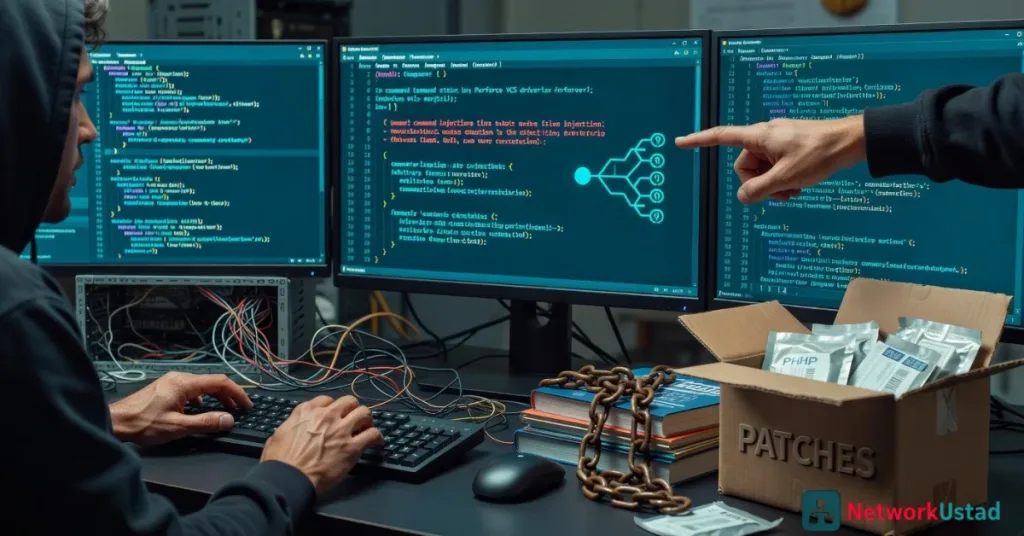
Security researchers recently disclosed two critical command injection vulnerabilities in Composer, the dependency management framework for PHP applications, potentially exposing millions of web servers to remote code execution. These flaws, tracked as CVE-2026-40176 and a companion issue, target the Perforce VCS driver, which handles version control integrations. If exploited, attackers could inject malicious commands during package installations, bypassing standard input sanitization and granting shell access without authentication.
This isn’t a theoretical risk; Composer powers over 80% of modern PHP projects, from e-commerce platforms like WooCommerce to enterprise content management systems. A successful exploit could cascade through server architectures, compromising databases and API endpoints. Patches have been released in Composer version 2.7.3, urging immediate updates to mitigate the threat.
Vulnerability Breakdown
The core issues stem from inadequate input validation in Composer’s Perforce driver, a protocol handler for integrating with Perforce Helix Core repositories. CVE-2026-40176, rated high-severity with a CVSS score of 9.8, allows attackers to manipulate repository URLs, injecting shell metacharacters that execute during the checkout process. The second flaw amplifies this by mishandling authentication tokens, enabling unauthenticated command chaining.
In technical terms, these bugs exploit the framework’s reliance on system calls to external VCS tools, where unescaped user-supplied data flows directly to the processor layer. For instance, a crafted repository URL like `p4://attacker.com:1234/#;malicious_command` could trigger arbitrary execution on the host OS, evading PHP’s built-in encryption safeguards. Developers using Composer in CI/CD pipelines face heightened risks, as automated builds amplify the attack surface.
- Affected Components: Perforce driver in Composer 2.x series; impacts PHP 8.1+ environments.
- Exploitation Vector: Remote, low-privilege access via manipulated package metadata.
- Mitigation Specs: Update to 2.7.3; disable Perforce if unused, reducing throughput overhead by up to 15% in non-VCS workflows.
For deeper details on CVE handling, refer to the NIST National Vulnerability Database.
Industry Ramifications
These flaws ripple across the PHP ecosystem, where latency-sensitive applications like real-time dashboards and microservices depend on Composer’s efficiency. Enterprises running LAMP stacks—Linux, Apache, MySQL, PHP—must audit dependencies, as unpatched instances could lead to data exfiltration or ransomware deployment. The timing is critical; with PHP holding 77% market share in server-side scripting, this exposure affects cloud computing providers like AWS and DigitalOcean.
Market impact includes heightened scrutiny on open-source supply chain security. Vendors such as JetBrains (Perforce owners) are under pressure to enhance protocol robustness, while framework maintainers like Symfony and Laravel recommend isolating Composer runs in containerized environments. This could drive adoption of secure alternatives, like shifting to Docker-based builds, which isolate command execution and minimize bandwidth waste from repeated fetches.
Internal teams should integrate vulnerability scanning tools, such as best practices for detecting software scams, to parallel phishing risks in code dependencies. Similarly, exploring reconciliation tools for dependency integrity can streamline audits.
For official patch guidance, see Composer’s security advisories.
Forward-Looking Security Strategies
Looking ahead, these incidents underscore the need for zero-trust architectures in dependency management. IT professionals should enforce least-privilege execution for Composer, using sandboxed processors to cap command scope and monitor throughput anomalies indicative of injection attempts. Implementing runtime encryption for VCS credentials via tools like Vault can further harden protocols against token leaks.
As PHP evolves toward version 9, expect tighter integration with machine learning-based anomaly detection in frameworks, reducing exploitation windows from days to hours. Organizations must prioritize automated patching in their DevOps pipelines, conducting regular architecture reviews to identify latent risks in third-party drivers.
Final Thoughts
The Composer vulnerabilities highlight the fragility of trusted tools in modern web development, demanding proactive defenses from developers and sysadmins alike. By applying patches swiftly and auditing Perforce usage, teams can safeguard their infrastructures without sacrificing performance.
Ultimately, this event accelerates a shift toward resilient supply chains, where encryption and isolation become non-negotiable. Forward-thinking IT leaders will view it as a catalyst for investing in secure-by-design practices, ensuring PHP’s longevity in bandwidth-constrained, high-throughput environments.