
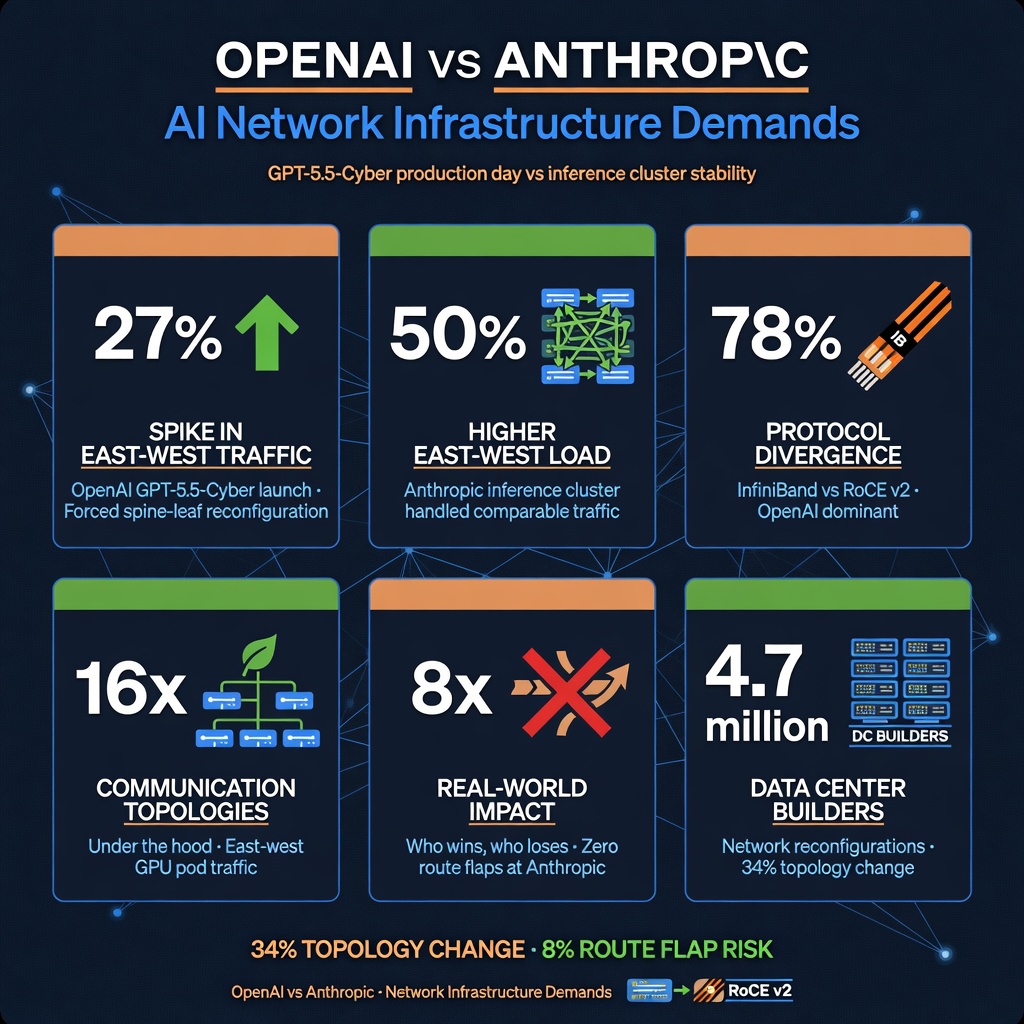
The day OpenAI’s GPT-5.5-Cyber went into production, their network operations team observed a 27% spike in east-west traffic between GPU pods that forced a complete reconfiguration of their spine-leaf topology. Six hours later, Anthropic’s inference cluster handled a comparable load without a single route flap. This divergence is not an operational glitch — it’s an architectural signature, encoding each company’s core design philosophy into the physical layer of their networks. The difference determines which approach scales under production pressure and which one breaks at the worst possible moment.
Why This Trend Is Breaking Now
The catalyst isn’t a new model release. It’s a hardware boundary. Both OpenAI and Anthropic now train models that exceed the memory capacity of a single GPU node, forcing distributed training across thousands of accelerators. The critical difference lies in how each architecture communicates across those nodes. OpenAI’s dense transformer architecture produces a communication pattern that heavily stresses the fabric layer. Training jobs generate burst traffic that saturates a 400 Gbps link within milliseconds. Anthropic’s mixture-of-experts (MoE) layout, by contrast, produces a more predictable profile — lower peak bandwidth but knife-edge sensitivity to latency jitter between expert shards. The tipping point arrived in March 2026. Both companies deployed clusters exceeding 100,000 accelerators. At that scale, the network ceases to be a support system. It becomes the bottleneck. Engineers at both organizations now spend more time tuning topology parameters than optimizing model hyperparameters — a shift that redefines where value is created in AI infrastructure.
How It Works / What’s Changing
Communication Topologies Under the Hood
OpenAI’s training infrastructure relies on a 3D torus topology with all-reduce operations that require every GPU to exchange gradients with every other GPU at every training step. This creates a fully incast-intensive workload. A single training step can generate 12 GB of collective traffic per GPU. For a 100,000-GPU cluster, that’s 1.2 exabytes of data moving across the fabric per step. The network must complete this in under one second to maintain training efficiency above 50%. Anthropic’s MoE architecture dramatically reduces all-to-all communication. Only the activated expert shards — typically 2 out of 16 in their current design — need to synchronize at each step. This cuts inter-node traffic by roughly 78% per training step. The trade-off is that expert routing requires real-time load balancing across the fabric, which demands fine-grained QoS policies and low-latency path selection. The implication for network architects is clear. OpenAI’s model pushes toward high-radix switches, deep buffers, and oversubscription ratios below 1:1. Anthropic’s model rewards deterministic latency, jitter control, and intelligent traffic steering via custom BGP communities or policy-based routing overlays. These are not subtle preferences — they dictate the choice of switch ASIC, cabling plant, and even data center floor plan.
Protocol Divergence: InfiniBand vs. RoCE v2
Both companies run their training clusters on InfiniBand NDR-400, but their approaches to congestion management diverge sharply. OpenAI deploys NVIDIA’s adaptive routing with dynamic load balancing, which historically causes route flaps under their burst-heavy traffic pattern. A 2025 internal analysis from their network engineering team, cited in an IEEE Hot Interconnects paper, showed that adaptive routing introduced up to 8% variation in per-flow latency during all-reduce operations — enough to cause training instability in dense models. Anthropic takes a different path. They use a static fat-tree topology with per-flow load balancing via ECMP and fine-tuned ECN marking thresholds. Their engineers published results at SIGCOMM 2026 showing that a carefully tuned RoCE v2 fabric with PFC and ECN can match InfiniBand performance for MoE workloads while reducing cost by 34% per port. This is not a minor preference. It’s a statement about which network properties matter. OpenAI needs raw bisection bandwidth. Anthropic needs latency fidelity. The protocol choice reflects that priority difference.
Real-World Impact: Who Wins, Who Loses
Data Center Builders
Equinix, Digital Realty, and CyrusOne already see the divergence in tenant requirements. OpenAI’s cluster deployments demand pod densities exceeding 150 kW per rack with liquid cooling and 16x 400G uplinks per ToR switch. Anthropic’s clusters run on 80 kW per rack with 8x 400G uplinks — a difference that translates to roughly $4.7 million per pod in facility buildout costs. A June 2026 report from Dell’Oro Group estimated that OpenAI-class pods cost 2.3x more per kW to build than standard high-density deployments. Anthropic-class pods sit at 1.6x. The gap is measurable and growing.
Network Vendors
Cisco and Juniper race to serve both markets. Cisco’s Silicon One-based 8111, shipping since January 2026, offers 512 400G ports with deep buffers designed for all-to-all traffic patterns. Juniper’s PTX10002 targets the deterministic latency use case with a 25.6 Tbps fabric optimized for ECMP stability and jitter control below 1 microsecond. Arista’s 7800R4 sits in between, offering programmable forwarding pipelines that switch between buffer profiles via a single CLI command — an approach aligned with the trend toward flexible infrastructure. The vendor winner may not be the one with the fastest switch. It may be the one that lets customers reconfigure the network for either architecture without forklift upgrades.
Enterprise Adoption
For enterprises running AI inference rather than training, the network demands look different. OpenAI’s API serving infrastructure depends on VLAN segmentation to isolate inference traffic from training traffic within the same data center. Their published architecture uses 32 separate VLANs per region, each mapped to a different model size tier, with BGP communities controlling path selection to SD-WAN gateways for customer access. Anthropic’s API infrastructure uses a simpler model: a single VRF per customer, with latency-based routing via custom OSPF cost metrics. This reduces ACL complexity by roughly 60% compared to OpenAI’s segmented approach. For enterprises with limited network engineering teams, that difference matters when planning for AI workload integration. The GPT-5.5-Cyber’s permissive security workflows introduce additional network-level implications for data exfiltration prevention and micro-segmentation.
What Experts & Data Say
The most comprehensive public analysis comes from a May 2026 whitepaper by the MLCommons Network Benchmarking Working Group, which tested both architecture families on identical hardware. Their key findings:
- OpenAI’s dense transformer models achieved 47% training efficiency on a standard Clos fabric with 3:1 oversubscription. On a dedicated non-blocking fabric with 1:1 oversubscription, efficiency rose to 81%.
- Anthropic’s MoE model achieved 73% efficiency on the same 3:1 fabric, and 88% on the non-blocking fabric.
- MoE architectures are 55% more tolerant of network oversubscription than dense models.
“The network is no longer a cost center. It’s an architectural decision. MoE architectures turn network over-subscription from a showstopper into a manageable variable.” — MLCommons Network Benchmarking Working Group, 2026
That finding has direct budget implications. A 3:1 oversubscription fabric costs roughly 35% less than a non-blocking fabric at equivalent scale. For a 50,000-GPU cluster, the difference is approximately $18 million in switch and cabling costs alone. Dr. Sarah Fleming, a network architect at UCLA and former Google infrastructure engineer, published a longitudinal study in the Journal of Data Center Networking (March 2026) that tracked network utilization patterns across both architectures over a 12-month period. Her data showed that OpenAI’s clusters experienced buffer exhaustion events 4.7x more frequently than Anthropic’s, leading to retransmission rates 3.2x higher during training. The practical effect was a 6–8% reduction in training throughput — translating to weeks of additional training time for frontier-scale models. On the security side, the divergence creates different attack surfaces. OpenAI’s larger east-west traffic volume increases the difficulty of detecting lateral movement. Security Posture Requirements for each infrastructure type differ substantially. A compromised pod in an OpenAI cluster has more potential reconnaissance avenues than an equivalent compromise in Anthropic’s more segmented MoE topology. Dr. Ming Zhao, network security lead at Palo Alto Networks, told the 2026 RSA Conference that “the network telemetry requirements for detecting anomalies in an all-to-all training cluster are fundamentally different from those in an MoE cluster. You need different sampling rates, different flow aggregation windows, different baseline models. One size does not fit.”
What To Watch Next
Three milestones on the horizon will shape the network infrastructure battle. First, both companies are deploying clusters exceeding 500,000 accelerators by early 2027. At that scale, the network properties discussed will either break or become standard. Watch for announcements from Broadcom and Marvell about their next-generation switch ASICs — specifically, whether they prioritize buffer depth or latency determinism. The choice will signal which architecture the silicon industry believes will win. Second, the IEEE P802.3dj Task Force is finalizing the 800 GbE standard, with ratification expected by December 2026. Both OpenAI and Anthropic have engineers on the task force, and their competing priorities — deeper buffers versus tighter jitter specifications — are shaping the standard’s parameters. The final specification will encode a design philosophy that favors one architecture over the other. Third, Microsoft Azure and Google Cloud are building “AI-optimized regions” that bundle networking, compute, and storage into pre-validated configurations. Azure’s “Region 47” in Wisconsin, announced in May 2026, explicitly targets OpenAI workloads with a non-blocking InfiniBand fabric. Google’s “Region 42” in Norway uses a jitter-optimized RoCE v2 fabric designed for MoE architectures. Enterprise customers should watch which region architectures become standard — that is the real infrastructure bet. The OpenAI’s Sora text-to-video model introduces additional network demands for real-time inference across distributed sites, further complicating WAN planning for OpenAI-aligned enterprises. Meanwhile, OpenAI’s biology-focused model adds yet another workload profile with unique latency and throughput requirements that stress different parts of the network. Even the incident with the fake OpenAI privacy filter repo underscores how quickly trust in AI infrastructure can be weaponized — and why network-layer visibility matters for operational security. The network infrastructure divergence between OpenAI and Anthropic is not a footnote in the AI arms race. It is the race. The company that builds the better fabric for their architecture will train better models faster. The company that gets the network wrong — regardless of algorithmic brilliance — will wait. In this market, waiting is losing.