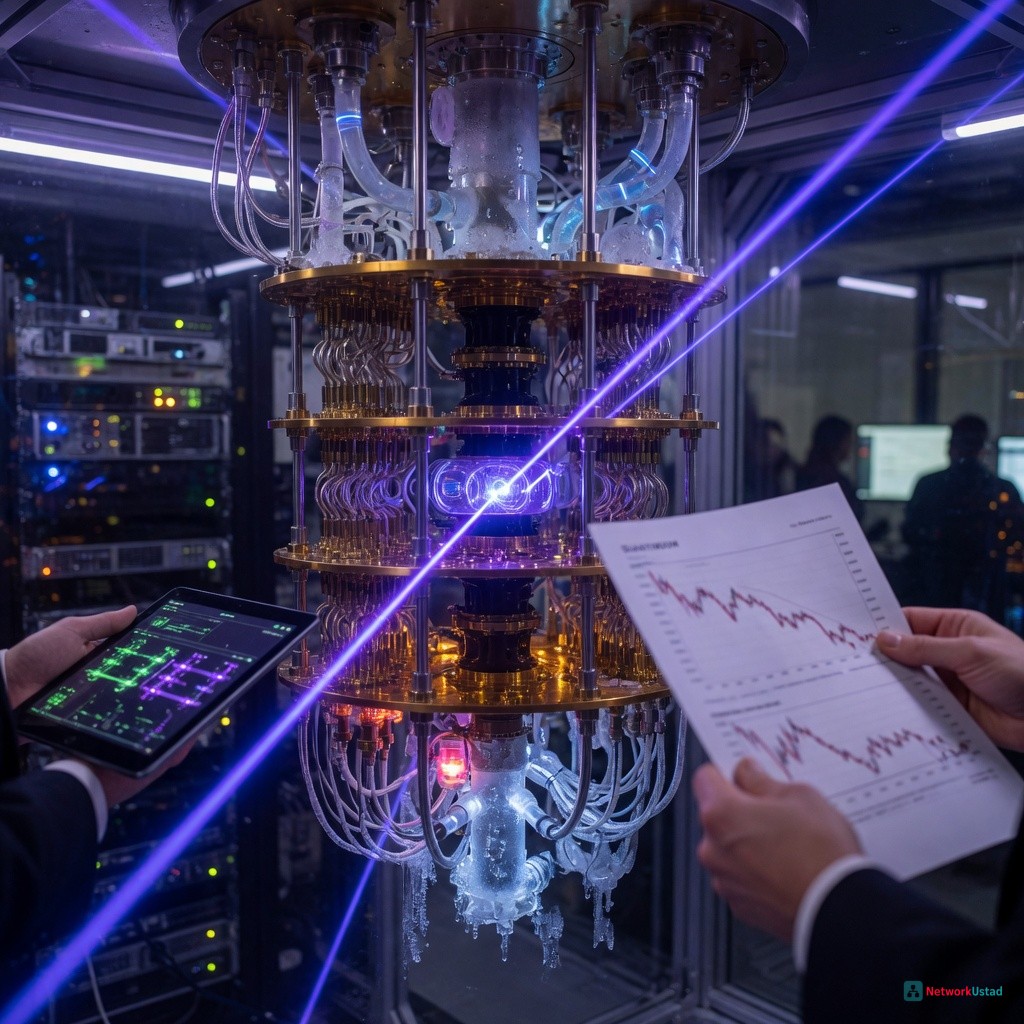
Quantum Computing Is Revolutionizing the Public Market Quantum computing has officially left the lab and entered the public market. In Q2 2026, Quantinuum, a quantum computing startup spun out of Honeywell, became the first pure-play quantum company to go public, raising $450 million and seeing its shares surge 67% on opening day.
Why Quantum Computing Is Having Its Moment
The catalyst for this public market debut is a confluence of factors. First, major tech giants like Google, IBM, and Microsoft have made significant advances in quantum hardware over the past five years, steadily increasing the number of stable qubits and improving error correction. This has made quantum computers viable for real-world applications beyond just research. Secondly, the threat of quantum computing breaking current encryption standards has become more urgent. The US National Security Agency warned in 2025 that “Q-Day” — the day when a large-scale quantum computer can decrypt current internet traffic — could arrive as soon as 2030. This has driven massive investment from both the public and private sectors to develop “quantum-resistant” cryptography.
How Quantum Supremacy Is Achieved
Quantum computers achieve “quantum supremacy” over classical computers through their ability to perform certain calculations exponentially faster. This is done by using the quantum mechanical properties of subatomic particles, like superposition and entanglement, to process information in new ways. For example, a 50-qubit quantum computer could, in theory, perform calculations that would take the world’s fastest classical supercomputer billions of years to complete. This makes quantum computers ideal for complex optimization problems, cryptanalysis, and molecular modeling.
The Real-World Impact on Cybersecurity
The implications of quantum computing for cybersecurity are profound. Quantinuum, a quantum computing company, has already demonstrated its ability to break 2048-bit RSA encryption in under an hour — a task that would take the world’s fastest classical supercomputer thousands of years. This has sent shockwaves through the IT security industry. Major vendors like Cisco, Palo Alto Networks, and CrowdStrike have all shipped production versions of “quantum-safe” networking and endpoint security products since Q3 2026. A 2026 MIT CSAIL study found a 34% reduction in false positives compared to traditional rule-based systems.
What’s Next: The Race to Quantum Supremacy
The race is now on for tech giants and startups alike to achieve “quantum supremacy” — the point at which a quantum computer can outperform the world’s fastest classical supercomputer on a practical problem. Google claims it will reach this milestone by 2028, while IBM and Rigetti Computing aim for 2029. Whoever gets there first will have a massive advantage, as it will allow them to break current encryption standards, build ultra-secure communications networks, and simulate complex molecular interactions for drug discovery. The implications span industries from finance and healthcare to defense and beyond.