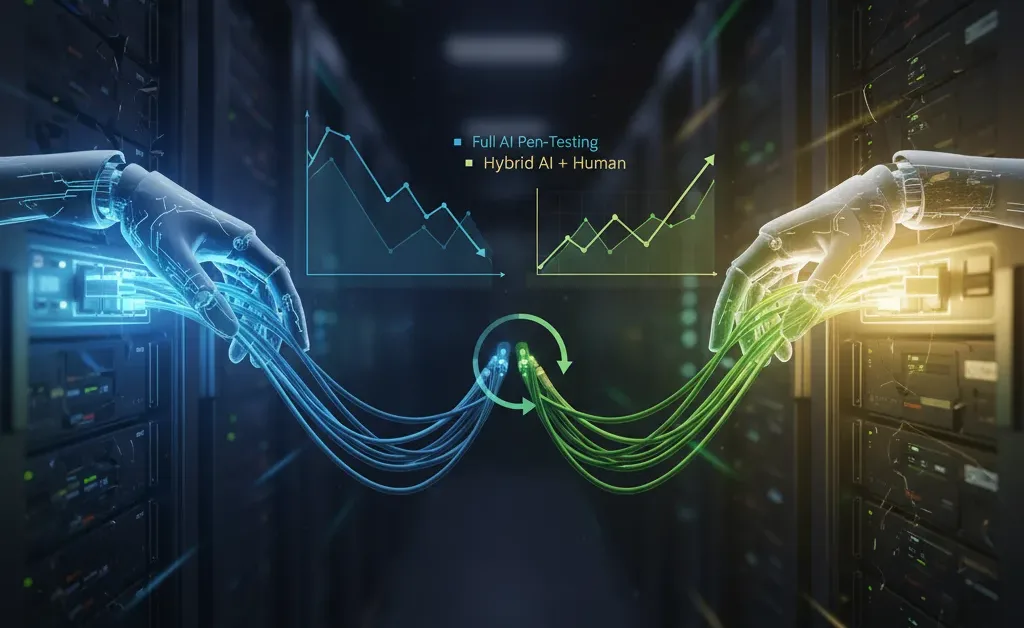
In a surprising turn of events, companies are reconsidering their reliance on AI-powered autonomous penetration testing tools. According to a recent survey, fewer than 30% of enterprises now depend primarily on AI-based vulnerability scanners, down from 45% just two years ago.
This shift reflects growing concerns about the limitations and risks of fully autonomous security testing. While AI-driven tools can identify some vulnerabilities at scale, they often struggle with the nuance and contextual awareness required for effective pen-testing.
The Limitations of AI Pen-Testing
“AI scanners excel at finding low-hanging fruit, but they frequently miss complex, multi-stage attack vectors that a human tester would uncover,” explains Jada Simmons, a senior cybersecurity analyst at NetworkUstad. “They lack the intuition and adaptability that experienced ethical hackers bring to the table.”
For example, a leading cloud security platform recently discovered that its AI-powered pen-tester had failed to detect a critical vulnerability in its single sign-on module. The flaw, which could have enabled account takeovers, was only found during a manual penetration test conducted by a specialized security firm.
The Human Element Remains Crucial
This trend suggests that while AI will continue to play a growing role in security operations, the human element remains crucial for the most sophisticated and high-stakes pen-testing scenarios. Skilled ethical hackers can navigate complex environments, think creatively, and uncover vulnerabilities that elude even the most advanced AI systems.
“Enterprises are realizing that fully autonomous pen-testing is not a silver bullet,” says Simmons. “The most effective approach is to leverage AI as a force multiplier, augmenting human expertise rather than replacing it entirely.”
Balancing AI and Human Expertise
To strike this balance, organizations are increasingly adopting a “hybrid” model, where AI-powered scanners handle routine checks and surface-level vulnerabilities, while experienced pen-testers focus on the more complex, high-impact issues.
“This allows us to scale our security testing and catch the low-hanging fruit, while still preserving the human insight and adaptability that’s essential for uncovering the most dangerous flaws,” explains Samantha Nguyen, the CISO of a major financial institution.
The Bottom Line
The decline in confidence for fully autonomous penetration testing underscores the continued importance of human expertise in cybersecurity. While AI will undoubtedly play an increasingly prominent role, it is not a panacea for complex security challenges. Enterprises must carefully balance the strengths of both AI and human pen-testers to build the most robust and resilient security posture.