
At 2 a.m., a purple team analyst pastes a malware hash from a PDF into a SIEM query, only to manually rewrite a red team script for blue team testing. Meanwhile, a critical patch sits in a change-approval queue longer than the attacker’s exploitation window. These aren’t isolated errors—they expose why most purple teams remain siloed red-and-blue operations masquerading as collaborative defense.
This breakdown stems from entrenched organizational friction, not skill gaps. Red teams craft evasive payloads using tools like Cobalt Strike or custom PowerShell obfuscators, while blue teams rely on SIEM platforms such as Splunk or Elastic for detection. Without true integration, purple exercises devolve into scripted demos, failing to simulate real-world chaos like NIST SP 800-53 adversary emulation.
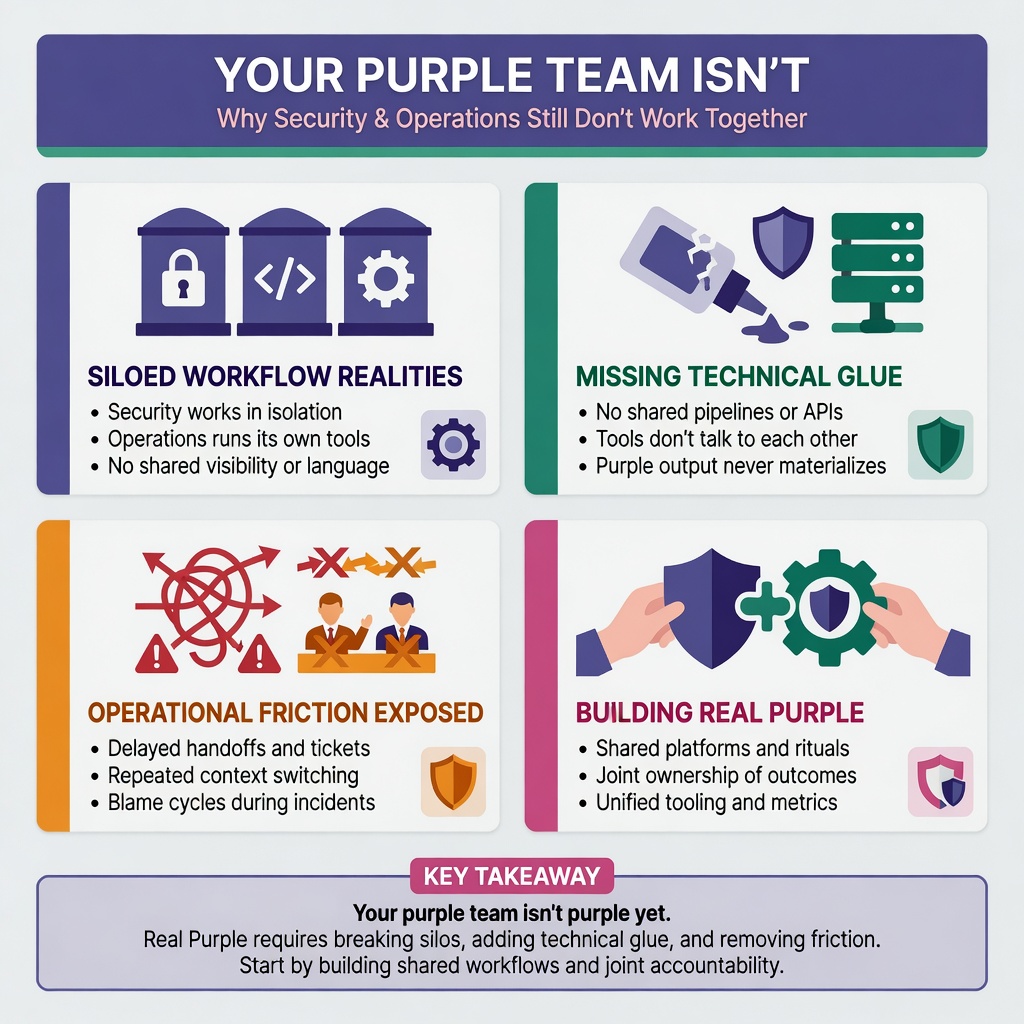
Siloed Workflow Realities
Purple team efforts often collapse under process mismatches. Red simulates lateral movement via SMB relays or Kerberoasting, but blue lacks automated artifact sharing. Manual hash lookups delay mean-time-to-respond (MTTR) from minutes to hours.
- Hash extraction: Analysts scour PDFs or VirusTotal for IOCs, bypassing API integrations.
- Script adaptation: Red’s Python exploits get hand-typed into blue’s SOAR playbooks like Phantom or Demisto.
- Approval bottlenecks: Change windows—often 4-8 hours—exceed TTP dwell times documented in MITRE ATT&CK.
IT leaders see 2-3x faster remediation in integrated setups, per industry benchmarks, yet adoption lags due to tool silos.
Missing Technical Glue
True purple requires shared threat intelligence platforms like MISP or ThreatConnect, enabling real-time IOC exchange. Absent this, teams duplicate efforts: red generates YARA rules post-engagement, blue rebuilds them for endpoint detection.
Consider SOAR integration pitfalls. Without APIs linking red’s Caldera framework to blue’s Chronicle or Falcon, exercises end in static reports. For network pros, this means untested zero-trust segments, where purple should validate micro-segmentation via tools like BloodHound.
Internal audits reveal similar issues; teams managing phishing simulation platforms often overlook purple’s role in chaining social engineering to network pivots.
Operational Friction Exposed
Change management exacerbates risks. Patches for CVEs like Log4Shell wait days, while exploits proliferate in hours. Purple teams must pressure-test these via gamified scenarios, but without executive buy-in, they remain theater.
Blue inherits red’s evasion tactics—say, LOLBAS abuse—but lacks context for proactive hunting. This gap fuels alert fatigue, with SIEM false positives overwhelming tier-1 analysts.
Building Real Purple
Shift to purple team maturity with these steps:
- Deploy MSSP platforms bridging red-blue via shared tenants.
- Automate via NIST IR workflows, scripting hash-to-query pipelines in Python.
- Run bi-weekly emulations, measuring exploitation-to-patch cycles.
Network engineers should prioritize EDR telemetry sharing, integrating with collaborative defense metrics for quantifiable gains.
Conclusion
Purple teams that stay red-and-blue in one room leave networks vulnerable to agile threats. True fusion demands automated pipelines and cultural overhaul, slashing response friction. IT pros: audit your next exercise— if manual copy-pasting persists, redesign now. Forward momentum favors teams wielding integrated ATT&CK mappings, turning defense into predictive advantage.