Wedding videography sits in an unusual position in the creative industry. The subject matter is inherently meaningful — these are real moments in real people’s lives that they’ll want to revisit for decades — and that weight creates expectations that are different from almost any other video production context. A client who commissions a commercial video and finds the result disappointing is frustrated. A couple who watches their wedding film and finds it mediocre feels something closer to grief. The emotional stakes are high in a way that sharpens every creative decision the videographer makes and amplifies every shortcoming in the final product.
The practical constraints are equally particular. A wedding videographer doesn’t get a second take. The ceremony happens once. The first dance happens once. The candid moment between the couple during the cocktail hour either gets captured or it doesn’t, and if the camera wasn’t in the right place at the right time, that moment is gone. Every other video production category allows for some degree of coverage correction — you can reshoot, you can rearrange, you can go back for pickup shots. Wedding videography operates entirely in the uncontrollable territory of what actually happened.
These two factors together — high emotional stakes and no ability to reshoot — define the specific challenges that wedding videographers bring to post-production. They’re working with what they got, trying to build something meaningful from footage that may have gaps, technical inconsistencies, or moments that didn’t land as beautifully as the real event felt in person.
The Gaps That Every Wedding Film Has
Even the most experienced wedding videographer operating with a full team and ideal conditions will have gaps in their footage. Weddings are complex, multi-location events with overlapping timelines and unpredictable moments. Something meaningful happens in a corner of the room while both cameras are covering the dance floor. A transition between locations loses coverage because the team was moving. The getting-ready sequence has strong moments but also long stretches of standing around that don’t edit cleanly into a coherent sequence.
Post-production for wedding films has always involved making creative decisions about how to handle these gaps — finding music that carries the edit through thin sections, using reaction shots to bridge coverage holes, relying on audio to establish moments that the footage doesn’t fully capture. These are legitimate editorial tools, and experienced wedding editors use them skillfully. But they’re workarounds for the underlying problem of missing visual material, not solutions to it.
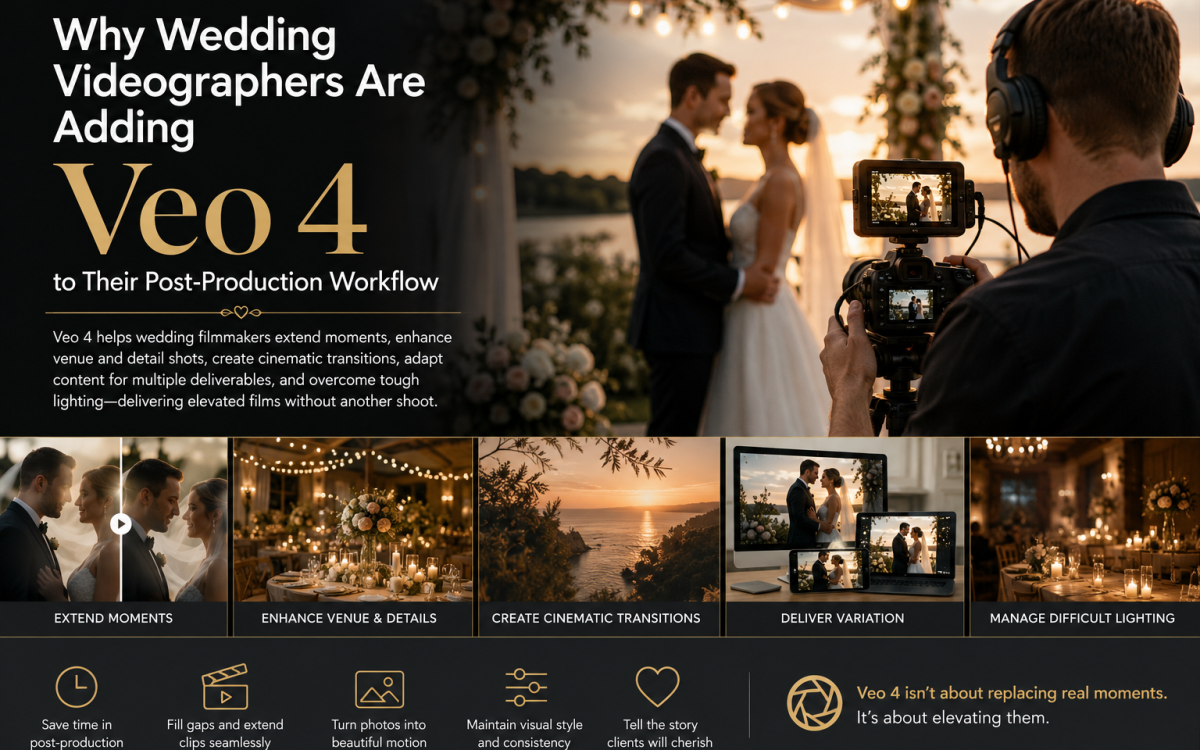
AI video extension offers something different: the ability to extend existing clips seamlessly when the captured footage is slightly too short for the edit to breathe properly. A shot of the couple during the ceremony that ends a beat too early can be extended by a few seconds to let the moment land at the pace the editor needs. A transition sequence that has the right visual character but insufficient duration can be lengthened without the artificial quality of slowing the footage down. For the specific, recurring problem of footage that’s almost right but not quite long enough, video extension addresses the underlying issue rather than working around it.
Enhancing Ambient and Venue Footage
Wedding films aren’t only about the couple — they’re also about the world that surrounded the event. The venue, the decor, the atmosphere of the location at a particular time of day. This establishing and ambient material serves important structural functions in a wedding film: it places the viewer in the world of the event before the main moments begin, it provides breathing room between emotionally intense sequences, and it communicates the aesthetic character of the day in ways that close coverage of the couple alone cannot.
Venue and ambient footage is also the category of wedding film material that’s most susceptible to the constraints of the shooting day. The ceremony location that looked beautiful in the morning when the videographer scouted it is filled with guests by the time coverage begins. The golden hour light that would have been perfect for exterior establishing shots coincides with the reception dinner and can’t be captured. The intimate details of the table settings and floral arrangements get shot quickly between setup and guests arriving, with whatever time and light are available.
Veo 4‘s image-to-video conversion can extend the value of venue and detail photography in ways that are practically useful for wedding film production. Still photographs of floral arrangements, venue spaces, and decorative details — which are almost always captured more thoroughly than video coverage of the same subjects — can be animated into moving sequences that provide the establishing and ambient material the edit needs. The visual character of the photography carries through into the generated video, maintaining consistency with the overall look of the film.
Cinematic Transitions and Visual Connective Tissue
One of the distinguishing characteristics of high-end wedding filmmaking is the quality of transitions — the visual connections between scenes that in lesser hands are simply cuts, but in skilled hands carry emotional and narrative meaning. A transition that moves from the intimacy of the getting-ready sequence to the formality of the ceremony, or from the joy of the reception to the quiet of the couple’s departure, is doing real work in the film. It’s not just moving the viewer from one place to another; it’s managing the emotional transition between two different registers of the day.
Generating this kind of transitional material — atmospheric sequences that bridge between the major moments of the film — is an application of AI video generation that fits naturally into a wedding filmmaker’s workflow. Rather than relying entirely on what was captured during the shooting day, the editor can generate transitional sequences that are designed specifically for the edit they’re building, with the visual character and pacing that the film needs rather than whatever happened to be available.
Delivering Variation Without Additional Shooting
Wedding clients increasingly want multiple deliverables from a single event: a full-length film, a highlight reel, a short social cut, sometimes a same-day edit that’s shown at the reception itself. Producing all of these from the same footage requires significant editing time, and the challenge is that each format serves a different purpose and requires a different structural approach. The full film can breathe and develop; the highlight reel needs to compress the emotional arc of the day into three minutes; the social cut needs to hook in the first two seconds and hold attention in a feed environment.
AI video generation helps manage this variation in a specific way: it allows the editor to generate format-appropriate material rather than trying to make footage shot for one purpose serve another. A wide, slow establishing shot that works in the full film might not cut well into a fast-paced highlight reel. Generating a tighter, more dynamic version of the same visual content for the highlight version — rather than trying to rework footage that doesn’t have the right character for that format — produces better results and takes less time than elaborate editorial workarounds.
Managing Difficult Lighting Conditions
Wedding videographers deal with lighting conditions that are often far from ideal. Indoor ceremonies with mixed artificial and natural light. Receptions in venues with flattering lighting for the atmosphere but challenging lighting for video capture. Outdoor events where the weather doesn’t cooperate with the shot list. These are conditions that experienced videographers manage as well as possible in the field and then work around in color grading during post, but there’s a limit to what color correction can fix when the underlying footage has fundamental exposure problems.
AI video generation doesn’t solve bad footage — content that’s technically unusable remains unusable. But it provides an alternative path for the specific situation where footage from a key moment has usable emotional content but significant technical problems. Using still photography from the same moment as a reference — photography, often captured by a separate photographer at the same event, which may have been shot with better settings for the conditions — to generate video that has the visual character of the moment without the technical limitations of the problematic footage is an approach that some videographers are beginning to explore for specific, targeted applications rather than as a general replacement for captured footage.
The Relationship With Clients
One dimension of AI video tools in wedding filmmaking that’s worth addressing directly is the relationship with clients and the question of disclosure. Wedding clients are commissioning a document of their actual day — a record of what really happened. The use of AI-generated content to fill gaps or enhance footage is a creative decision that sits in genuinely complicated territory when the expectation is documentary authenticity.
The applications that feel most unambiguous are the ones that use AI generation for material that was never going to be captured footage in the first place: transitional sequences, extended versions of clips that happened, atmospheric content generated from real photography of the actual event. These feel different from generating fictional moments or replacing real captured content with AI fabrication, which most serious wedding filmmakers would rightly reject as a betrayal of what the client commissioned.
Where this lands for individual practitioners depends on their creative values and their relationship with their clients. What’s clear is that the tool’s most legitimate applications in wedding filmmaking — extension, enhancement, and the generation of connective material that serves the edit — are real enough to make it worth understanding, and distinct enough from more ethically fraught uses that they can be evaluated on their own terms.