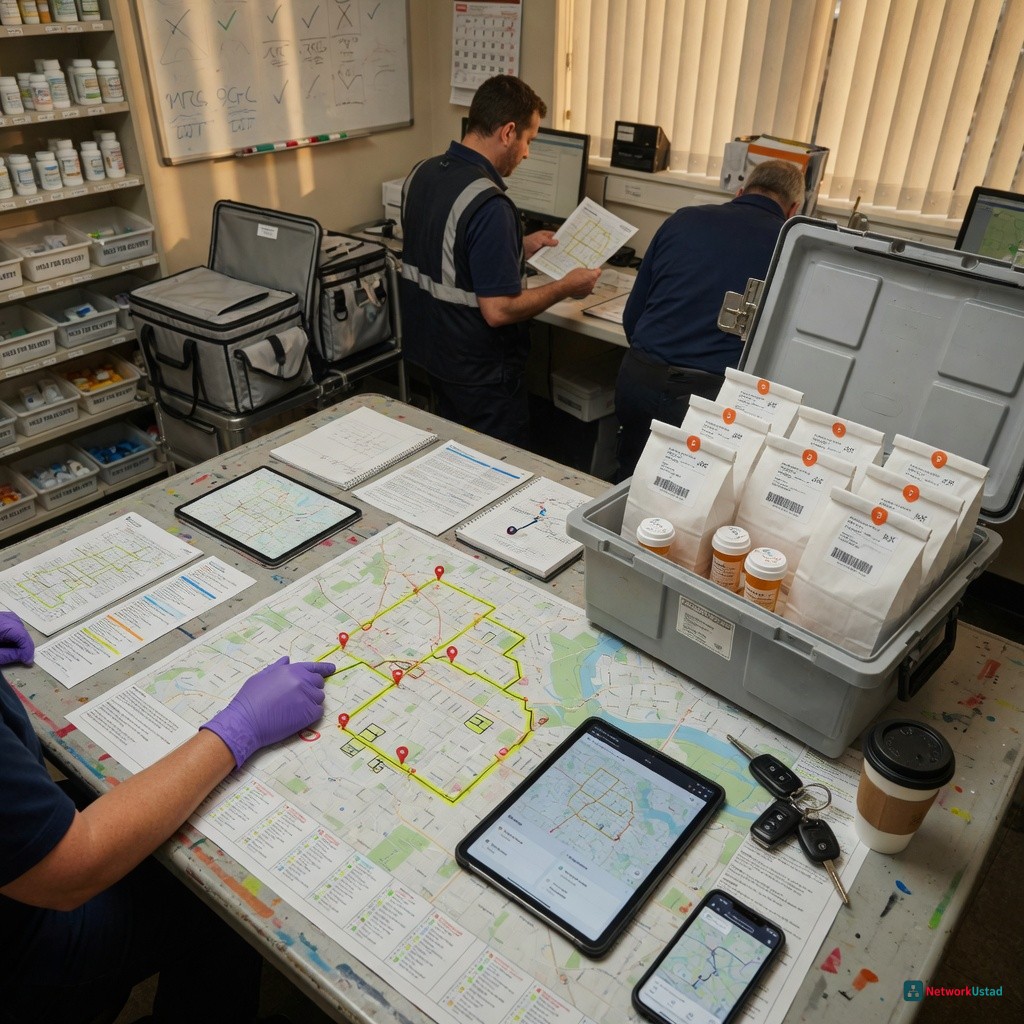
Prescription delivery demand can grow faster than a pharmacy’s delivery team. More patients want convenient medication delivery, but hiring additional drivers is not always the easiest or most profitable response. Before increasing payroll, pharmacies should examine how efficiently their current routes are planned. In many cases, better routing can help existing drivers complete more stops with less wasted time.
Why Scaling Pharmacy Delivery Is Difficult
Pharmacy delivery is not a simple matter of adding more orders and assigning more drivers. Scaling requires stronger planning, realistic timing, driver productivity, customer communication, and cost control.
Delivery volume can grow unevenly
Some days may include only a small number of deliveries, while others involve large prescription batches across several neighborhoods. This uneven demand makes staffing and route planning more difficult.
Driver availability is limited
Hiring, training, and managing drivers takes time. It also adds ongoing expenses, including wages, scheduling, insurance, vehicle use, and operational supervision.
Manual planning becomes harder as volume grows
A process that works for 10 stops may fail when the pharmacy has 40, 80, or 150 stops. As the number of addresses increases, manual planning becomes slower and more error-prone.
Poor routes reduce delivery capacity
If drivers backtrack, cross the same areas repeatedly, or follow inefficient stop sequences, the pharmacy loses capacity without realizing it. The team may feel overloaded even when the real issue is poor route structure.
Why Hiring More Drivers Is Not Always the First Answer
Adding drivers can help in some cases, but it also increases payroll, scheduling complexity, vehicle costs, insurance needs, and management workload. Hiring should be based on route data, not only on rising delivery volume.
More drivers can increase operational complexity
More people means more dispatching, more coordination, and more chances for communication gaps. Without a clear routing process, a larger team can become harder to manage.
Extra labor does not fix inefficient routes
If routes are poorly planned, adding another driver may only spread the same inefficiency across more people. The pharmacy may still face late deliveries, wasted mileage, and unclear ETAs.
Delivery costs can rise faster than revenue
If every increase in delivery demand requires more labor, delivery may become less profitable as it grows. Pharmacies need a way to increase capacity without allowing costs to climb too quickly.
The Better Question: Are Your Current Routes Efficient Enough?
Before hiring, pharmacies should evaluate whether existing drivers are being used effectively. A delivery team may have more capacity than it appears if routes are planned more efficiently.
How many stops can one driver complete per shift?
This metric helps the pharmacy understand current delivery productivity. If completed stops vary widely by day or route, planning quality may be part of the problem.
How much time is lost to backtracking?
Backtracking is one of the clearest signs of poor route planning. When drivers repeatedly return to the same areas, they lose time that could have been used for additional deliveries.
Are ETAs accurate?
Unreliable ETAs can create customer frustration and extra support calls. Accurate timing helps pharmacies communicate clearly with patients and caregivers.
How long does route planning take each day?
If staff spend too much time arranging stops manually, the delivery process is already difficult to scale. Planning time can become a hidden operational cost.
How Better Route Planning Helps Pharmacies Increase Delivery Capacity
Better route planning allows pharmacies to make stronger use of the drivers, vehicles, and staff they already have. It reduces wasted time before and during delivery.
Drivers can complete more stops in less time
Optimized routes reduce unnecessary driving and help drivers move through stops in a more logical order. This can increase completed deliveries per shift without adding headcount.
Dispatchers can prepare routes faster
Instead of manually sorting addresses, pharmacy teams can plan routes quickly before drivers leave. Faster dispatching helps reduce delays at the start of the route.
Delivery windows become more predictable
Better ETAs help pharmacies communicate more clearly with patients and caregivers. Predictable timing can reduce missed handoffs and delivery status calls.
Existing resources go further
The pharmacy may be able to handle more deliveries using the same drivers, vehicles, and staff. This gives the business more room to grow before making new hires.
Where a Pharmacy Delivery Route Planner App Fits In
A Pharmacy Delivery Route Planner App helps pharmacies organize multiple prescription delivery stops into a more efficient sequence. Instead of relying on manual route planning, teams can optimize delivery routes, review ETAs, and send drivers out with a clearer plan.
This kind of tool is especially useful when a pharmacy wants to increase delivery capacity without immediately hiring more drivers.
How Optiway Helps Pharmacies Handle More Deliveries With the Same Team
Optiway helps pharmacies plan and optimize multi-stop delivery routes in seconds. Teams can add up to 200 stops, get accurate ETAs, and navigate using Apple Maps, Google Maps, or Waze.
Optimize large delivery batches
Pharmacies can add multiple stops and quickly organize them into a more efficient route. This is useful for growing delivery demand, recurring prescription deliveries, and high-volume days.
Save planning time
Staff can spend less time manually arranging addresses and more time on pharmacy operations, patient service, and prescription workflows.
Improve driver productivity
Better stop sequencing helps drivers complete deliveries with less wasted mileage. Drivers can focus on completing the route instead of deciding where to go next.
Support up to 200 stops
Support for up to 200 stops makes Optiway useful for growing pharmacies, courier partners, and delivery teams managing larger daily routes.
Keep navigation simple
Drivers can use Apple Maps, Google Maps, or Waze. Familiar navigation tools help reduce training friction and make adoption easier.
Example: A Pharmacy Growing From 25 to 90 Daily Deliveries
A local pharmacy starts with 25 daily deliveries, which staff can manage manually. Over time, demand grows to 90 deliveries per day. The same manual process now causes delays, unclear ETAs, driver backtracking, and pressure to hire another driver.
With better route optimization, the pharmacy can organize delivery stops more efficiently, reduce wasted driving time, and understand whether its current team can handle the increased volume before adding more staff. A tool like Optiway can help pharmacy teams quickly turn dozens of addresses into optimized multi-stop routes.
Signs Your Pharmacy May Be Ready to Optimize Before Hiring
A pharmacy may need better route planning before it needs more drivers. Warning signs often appear in daily operations before they show up clearly in delivery costs.
Common signs include:
- Drivers are busy all day but complete fewer stops than expected
- Delivery routes are planned manually
- Staff spend too much time sorting addresses
- Drivers often backtrack between neighborhoods
- ETAs are vague or frequently wrong
- Customers call asking about delivery status
- Delivery demand is growing, but adding drivers feels expensive
- Some routes finish early while others run late
How to Scale Pharmacy Delivery More Efficiently
Scaling delivery efficiently requires a structured process. Pharmacies should focus on batching, sequencing, measurement, and communication before increasing headcount.
Batch deliveries before dispatch
Group deliveries together instead of sending drivers out one order at a time. Batch planning helps create denser, more efficient routes.
Optimize stop order
Smarter sequencing can reduce mileage, unnecessary turns, and wasted time. It also helps drivers move through routes with fewer delays.
Track route performance
Review delivery completion time, mileage, delays, and driver workload. Route data helps identify whether the current process is efficient enough.
Improve ETA communication
Clear ETAs can reduce support calls and improve the patient experience. Better timing also helps patients and caregivers plan around deliveries.
Add drivers only when the route data supports it
Hiring should come after the pharmacy understands whether current routes are already efficient. This makes staffing decisions more confident and cost-conscious.
Business Benefits of Scaling Delivery With Better Planning
Better planning helps pharmacies grow prescription delivery without immediately expanding payroll. It supports stronger productivity, lower costs, and a more reliable delivery experience.
Lower labor pressure
The pharmacy can increase delivery output without immediately increasing headcount. This gives managers more flexibility as demand grows.
Better profitability
More efficient routes help reduce mileage, fuel costs, and wasted driver time. Lower operating waste can protect delivery margins.
Stronger patient experience
More reliable deliveries help patients trust the pharmacy. Clear timing and fewer delays can improve satisfaction and retention.
Easier growth
A structured delivery process makes it easier to expand service areas or delivery volume. Growth becomes more manageable when routes are planned consistently.
More confident staffing decisions
Route data can help the pharmacy decide when hiring another driver is truly necessary. For pharmacies looking to scale delivery before scaling payroll, https://optiway.io/industries/pharmacy-delivery-route-planner-app-for-fast-secure-medical-deliveries/ offers a practical way to optimize multi-stop routes in seconds, add up to 200 stops, and help drivers navigate with Apple Maps, Google Maps, or Waze.