No firewall stops an employee from voluntarily handing over their password to someone who sounds exactly like their CFO. Social engineering exploits human psychology rather than technical vulnerabilities, and it remains one of the most consistently effective tactics in a cybercriminal’s toolkit precisely because it doesn’t need to defeat your security software at all — it just needs to convince a person to act.
This guide covers the major categories of social engineering, a verified real-world case study, the psychological principles these attacks exploit, and defenses that genuinely reduce risk.
What Is Social Engineering?
Social engineering is the practice of manipulating people into violating normal security procedures, bypassing technical defenses entirely by targeting human trust, curiosity, fear, authority bias, or greed instead. Rather than exploiting a software vulnerability, a social engineer might call an employee posing as IT support — increasingly using AI-generated voice cloning — to trick them into revealing a password or multi-factor authentication code directly.
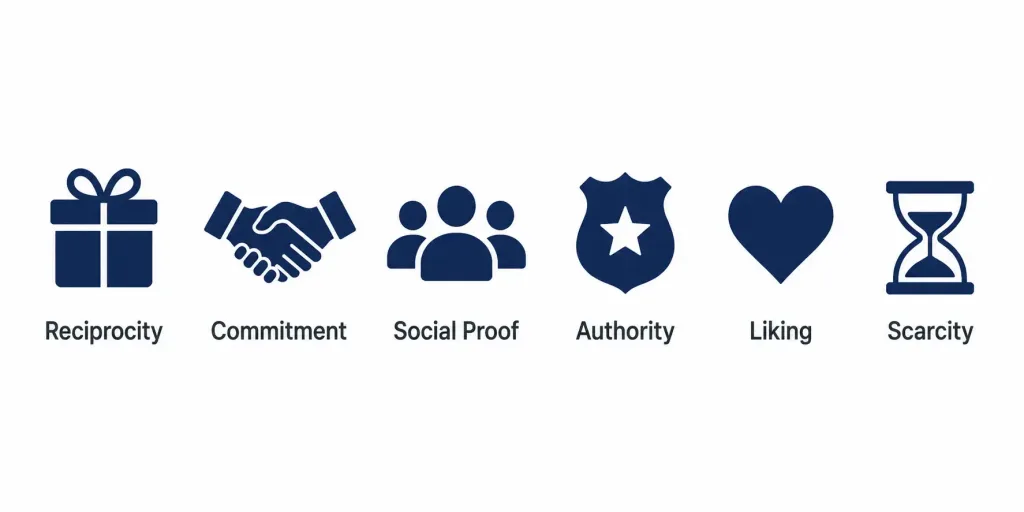
Much of this exploits well-documented psychological principles, most famously Robert Cialdini’s six keys to influence: reciprocity, commitment, social proof, authority, liking, and scarcity. Understanding these underlying levers explains why social engineering works even against people who genuinely know better in the abstract — the manipulation targets automatic, largely unconscious decision-making shortcuts, not a simple knowledge gap.
Common Types of Social Engineering Attacks
Pretexting
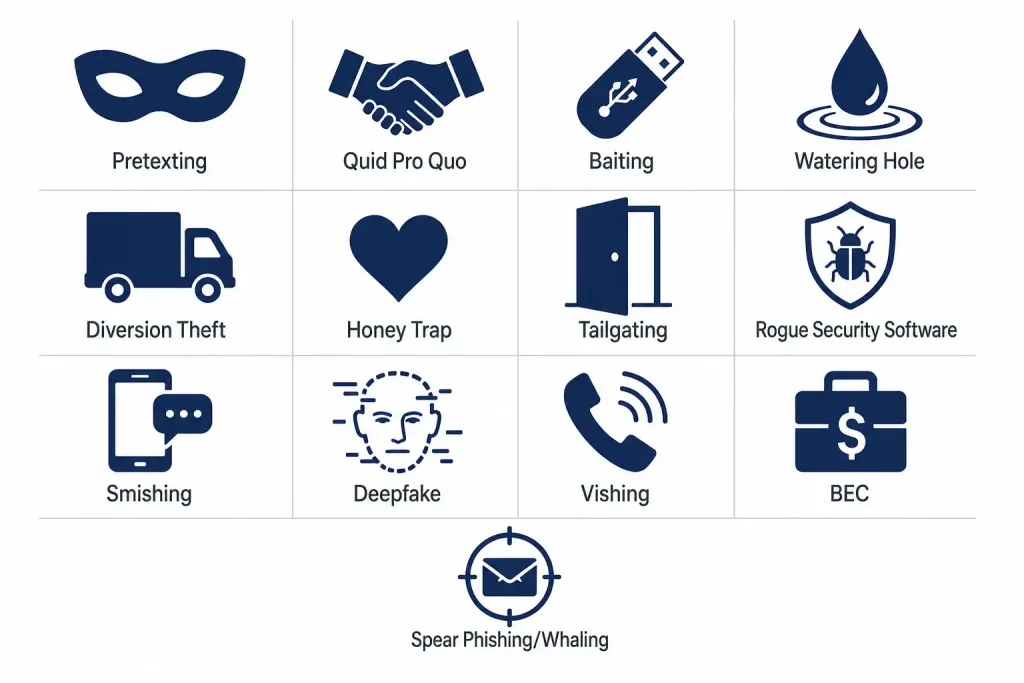
Pretexting fabricates a believable scenario or backstory to impersonate a trusted authority figure — IT support, HR, a vendor — to extract sensitive data or access. It exploits authority bias and a natural instinct to be helpful, typically through scripted phone calls, emails, or in-person interactions that build rapport before the actual request. AI-generated conversational tools have made these interactions more dynamic and harder to detect as scripted, since the attacker can adapt responses in real time rather than following a rigid script.
Quid Pro Quo
Quid pro quo (“something for something”) offers a favor or service in exchange for sensitive information or access — free tech support in exchange for login credentials is the classic example. It exploits reciprocity: once someone has received something, they feel a subtle obligation to reciprocate, even with something as sensitive as a password.
Baiting
Baiting tempts victims with appealing but infected “bait” — free downloads, a labeled USB drive left somewhere convenient, a torrent link — promising quick gratification. The psychological hook is curiosity or greed rather than obligation. Once the victim engages (plugging in the USB drive, running the downloaded file), malware deploys automatically. Physical baiting via strategically placed USB drives remains a genuinely effective technique specifically because curiosity about a labeled drive (“Confidential — Salaries”) tends to override caution.
Watering Hole Attacks
Watering hole attacks compromise a website the target group is known to frequent, injecting malware that infects visitors automatically upon access — no phishing email or direct contact required at all. Attackers research a target’s browsing habits, often through social media or traffic analytics, then compromise a site the target already trusts, exploiting that pre-existing trust rather than trying to build new trust from scratch.
Diversion Theft
Diversion theft redirects deliveries or payments by deceiving couriers or employees, commonly through spoofed emails or calls altering shipment or payment details. It exploits urgency and the routine nature of supply-chain communications, often overlapping with Business Email Compromise techniques when the target is a high-value payment rather than a physical shipment.
Honey Trap
A honey trap builds a fake romantic or personal relationship, typically online, to extract information — frequently used in espionage contexts, using catfishing profiles on social media or messaging apps. It preys on loneliness or flattery, sometimes escalating to blackmail once a relationship has been established. Honey-trap espionage cases targeting individuals with access to sensitive information are a real, recurring category of reported incident, not a hypothetical threat model.
Tailgating (Piggybacking)
Tailgating occurs when an unauthorized person physically gains entry to a restricted area by closely following an authorized person through a secured door, exploiting politeness and social norms around holding doors open for someone else. It’s a genuinely low-tech attack that remains effective precisely because refusing to hold a door for someone feels socially awkward in a way that overrides security awareness in the moment.
Rogue Security Software
Rogue security software mimics a legitimate antivirus tool, displaying fake infection alerts to scare victims into paying for “removal” or, worse, downloading actual malware disguised as the cleanup tool itself. It exploits fear of infection directly, using urgent pop-ups designed to short-circuit careful evaluation.
Smishing
Smishing uses deceptive SMS text messages posing as trusted entities — a bank, a delivery service — to trick recipients into clicking a malicious link or sharing information. It leverages the immediacy and relatively higher trust people place in text messages compared to email, combined with the fact that mobile screens make full URLs harder to inspect carefully before tapping.
Deepfake Social Engineering
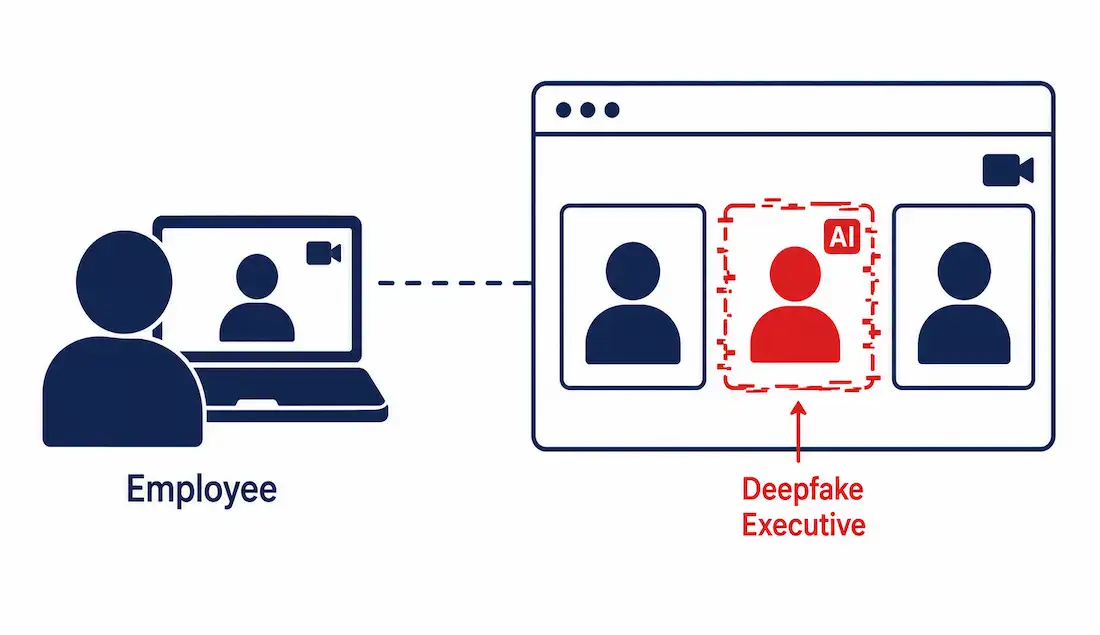
Deepfake social engineering uses AI-generated audio or video to impersonate a real person — commonly an executive — in calls or video meetings, exploiting the target’s familiarity with that person’s actual voice and appearance.
A verified real-world example, told accurately: in February 2024, an employee at Arup, a global engineering firm, was deceived into transferring approximately $25 million (HK$200 million) after participating in what appeared to be a video conference with the company’s CFO and several other colleagues — every participant except the victim was, in fact, a real-time deepfake. This remains one of the most well-documented and significant deepfake-enabled fraud cases publicly reported to date, illustrating just how convincing real-time deepfake technology had become even by early 2024 — and the technology has continued to improve since.
Vishing with Voice Cloning
Vishing enhanced with AI voice cloning mimics a specific real person’s voice in a phone call, impersonating an authority figure to extract credentials or authorize a transfer. It triggers urgency, often combined with a spoofed caller ID to add a second layer of apparent legitimacy beyond the voice itself.
Business Email Compromise (BEC)
BEC impersonates an executive, vendor, or partner — through a spoofed or genuinely compromised email account — to authorize fraudulent wire transfers or extract sensitive data. It exploits organizational hierarchy and urgency, and the FBI’s Internet Crime Complaint Center (IC3) has consistently tracked BEC as one of the costliest categories of reported cybercrime over the past decade, with cumulative losses reaching well into the tens of billions of dollars.
Spear Phishing and Whaling
Spear phishing targets a specific individual with a personalized message built from researched details — their name, role, colleagues, recent activity. Whaling applies the same targeted approach specifically to high-value executives, where a single successful attempt can authorize enormous fraud in one step. Both exploit personalization as a credibility signal: a message referencing accurate, specific details feels more trustworthy than an obviously generic one, even though the personalization itself proves nothing about the sender’s actual legitimacy.
Why These Attacks Keep Working
A few genuine, durable trends explain why social engineering remains effective even as awareness grows: AI has lowered the skill and cost barrier for producing convincing personalized content, voice clones, and even real-time video impersonation — capabilities that used to require significant resources are now accessible to far more attackers. Combined with the sheer volume of personal information available through social media and prior data breaches, attackers can build genuinely convincing pretexts with minimal manual research.
It’s worth being appropriately skeptical of any single, ultra-precise statistic claiming to measure “how much” of cybercrime involves social engineering — these figures vary enormously by methodology and what’s being counted, and an unsourced round number like “98% of attacks” should be treated as a red flag rather than taken at face value. What’s well-established and worth trusting is the general trend: social engineering remains a leading, not marginal, cause of successful breaches, and it’s grown more sophisticated rather than less as technical defenses have improved elsewhere.
Prevention Strategies
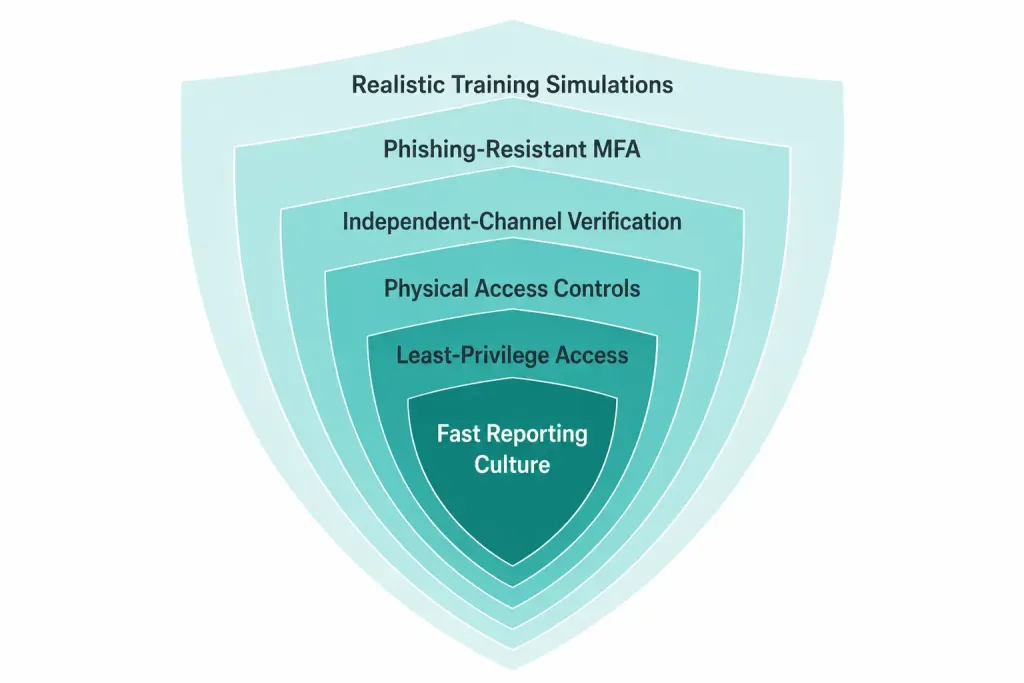
Employee training with realistic simulations: regular, realistic phishing and pretexting simulations build pattern-recognition skill that a one-off annual lecture doesn’t develop, and simulations should cover the full range of channels — voice and video, not just email — given how much the threat landscape has diversified.
Multi-factor authentication everywhere: MFA meaningfully raises the bar even when a credential is successfully phished, though it’s worth remembering that phishing-resistant MFA (passkeys, FIDO2 hardware keys) resists a wider range of attacks than SMS or push-notification-based MFA does.
Verify requests through an independent channel: call back on a number you already know to be legitimate — never one provided in the suspicious message itself. This single habit defeats the large majority of pretexting, vishing, and BEC attempts, since these attacks depend on the victim staying within the attacker’s own closed communication loop.
Physical access controls: badge policies that actively discourage tailgating (a “one badge, one entry” culture, rather than treating door-holding as simple courtesy) address the physical dimension of social engineering that purely digital defenses miss entirely.
Limit and monitor USB usage on corporate devices, since baiting via physical media remains a real and effective vector despite feeling old-fashioned.
Enforce least-privilege access, so a single successfully socially-engineered credential doesn’t automatically grant broad access to systems well beyond what that specific role actually needs.
Encourage fast, blame-free reporting of suspicious contact — the sooner a social engineering attempt is reported, the faster an organization can warn others who may be targeted by the same campaign.
Legal Implications
Social engineering attacks frequently violate laws like the U.S. Computer Fraud and Abuse Act (CFAA), and where personal data is involved, regulations like the EU’s GDPR — which allows fines of up to 4% of a company’s global annual revenue for serious violations, a figure worth knowing precisely since it’s often cited vaguely. Many jurisdictions now mandate breach reporting within a defined window (commonly 72 hours under GDPR specifically), with real financial penalties for organizations that fail to report promptly.
Social Engineering vs. Technical Hacking
| Aspect | Social Engineering | Technical Hacking |
|---|---|---|
| Method | Psychological manipulation | Exploiting code or configuration vulnerabilities |
| Target | People | Software and hardware |
| Tools needed | Social skills, increasingly AI-assisted content generation | Programming knowledge, exploit development |
| Detection | Awareness training, behavioral red flags | Firewalls, intrusion detection systems |
| Prevention | Education, independent-channel verification | Patching, encryption, secure configuration |
The two aren’t mutually exclusive in practice — many significant breaches combine an initial social engineering foothold with subsequent technical exploitation, which is exactly why defenses need to address both dimensions rather than treating them as separate problems handled by entirely separate teams.
Conclusion
Social engineering succeeds by targeting the one layer no software patch can fully secure: human judgment under pressure. AI has genuinely sharpened these attacks — more convincing voices, more personalized pretexts, real-time deepfakes that were science fiction a few years ago — but the core defense remains the same principle it’s always been: verify through a channel the attacker doesn’t control, and treat urgency itself as a signal worth pausing on rather than a reason to act faster.
FAQs
What is social engineering in cybersecurity?
Social engineering is a psychological manipulation tactic where attackers exploit trust, curiosity, fear, or authority bias to gain unauthorized access to systems, data, or physical locations, bypassing technical security controls by targeting the people who operate them instead. It remains a leading cause of successful breaches precisely because it doesn’t require defeating any specific technical defense.
What are the most common types of social engineering attacks?
Common types include phishing and its variants (spear phishing, whaling, smishing, vishing), pretexting, baiting, quid pro quo, tailgating, watering hole attacks, and increasingly AI-enhanced techniques like deepfake video impersonation and voice cloning. Each exploits a different specific psychological lever, though many share the common thread of manufactured urgency.
How can individuals and organizations prevent social engineering attacks?
Layered defenses work best: realistic training simulations covering multiple channels, multi-factor authentication (ideally phishing-resistant), independent-channel verification for any unusual request, physical access controls that discourage tailgating, and fast, blame-free reporting mechanisms. No single measure is sufficient alone, since social engineering specifically targets the gaps between individual defensive layers.
What is a verified real-world example of social engineering?
The February 2024 Arup case is one of the most well-documented: an employee at the global engineering firm’s Hong Kong office was deceived into transferring approximately $25 million after participating in a video call where every other “colleague” present, including an apparent CFO, was a real-time AI deepfake. It remains a significant, widely-reported illustration of how convincing deepfake technology had become even by early 2024.
Why is AI making social engineering more dangerous? A
I has lowered the cost and skill barrier for producing convincing personalized phishing content, cloned voices, and real-time deepfake video — capabilities that previously required significant resources or specialized skill are now accessible to a much broader range of attackers. This doesn’t change the underlying psychological principles being exploited, but it does make the content built on top of them significantly more convincing than earlier, more obviously fake attempts.
How does social engineering differ from technical hacking, and why does the distinction matter?
Social engineering targets human psychology rather than exploiting code or configuration vulnerabilities, which means it requires a fundamentally different defense: awareness and verification habits rather than patches and firewalls. In practice, many serious breaches combine both — a social engineering foothold followed by technical exploitation — which is why effective defense needs to address both dimensions together rather than treating them as entirely separate problems.