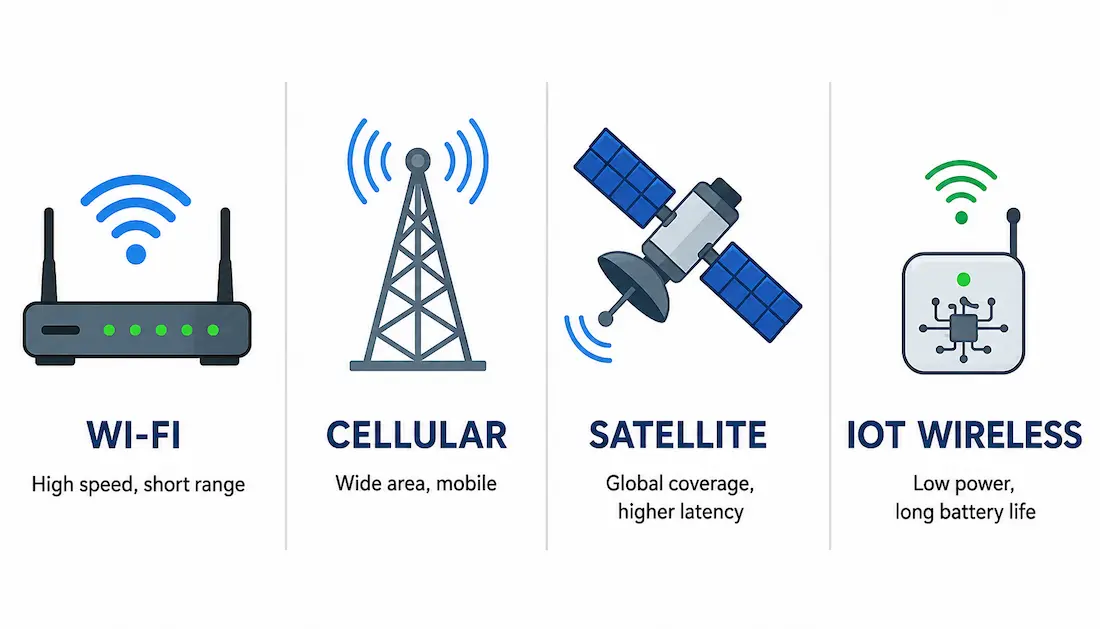
Wireless communication covers a wide range of distinct technologies, each built for a different range, use case, and set of trade-offs. This article surveys the major categories — Wi-Fi, cellular, satellite, and short-range IoT wireless — with verified figures rather than speculative predictions.
Wi-Fi: The Current Generations
Three Wi-Fi generations are in active use today, each an amendment to the IEEE 802.11 standard:
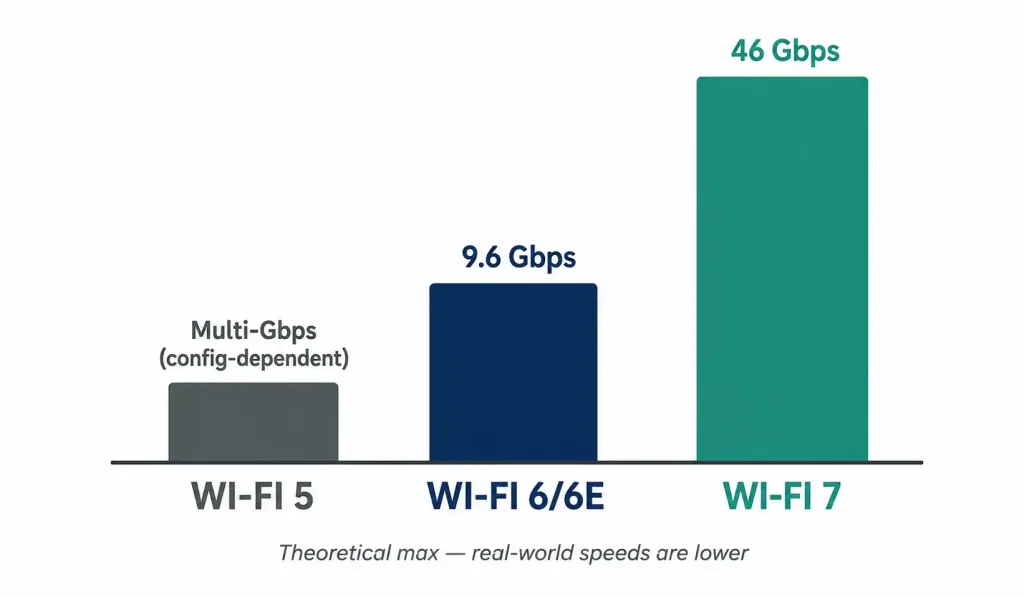
| Generation | Standard | Bands | Verified Max Theoretical Speed |
|---|---|---|---|
| Wi-Fi 5 | 802.11ac | 5 GHz | Up to several Gbps depending on configuration |
| Wi-Fi 6 / 6E | 802.11ax | 2.4, 5 GHz (6E adds 6 GHz) | 9.6 Gbps |
| Wi-Fi 7 | 802.11be | 2.4, 5, 6 GHz | 46 Gbps |
Wi-Fi 6 introduced OFDMA, which allows an access point to serve multiple client devices within a single transmission slot instead of handling them one at a time — a meaningful efficiency gain in environments with many connected devices, since older Wi-Fi generations effectively served one device’s request before moving to the next, creating a queuing delay that grows with device count. Wi-Fi 6E’s distinguishing feature is access to the 6 GHz band, which is typically far less congested than the crowded 2.4 and 5 GHz bands most other devices — including neighboring networks, Bluetooth accessories, and even some cordless phones and microwave ovens — compete for.
Wi-Fi 7 builds on this with wider 320 MHz channels (double Wi-Fi 6’s maximum), denser 4096-QAM modulation, and Multi-Link Operation, which lets a single device use more than one frequency band simultaneously. A critical caveat that applies to every generation: theoretical maximum speeds are lab figures assuming ideal conditions, a full-width channel, and multiple spatial streams — real-world speeds for any single client device are consistently well below the headline number, regardless of which generation is in use.
Cellular: 4G, 5G, and What Actually Changed
5G’s defining technical improvements over 4G are lower latency and higher peak bandwidth, achieved partly through millimeter wave (mmWave) spectrum in some deployments — very high frequency signals capable of extremely high throughput over short distances, but with poor penetration through walls and other obstacles, which is why mmWave deployments tend to be concentrated in specific high-density locations like stadiums and transit hubs rather than blanketing wide areas.
Standalone 5G (5G SA) refers to a 5G network built on entirely 5G-native core infrastructure, rather than a 5G radio layer sitting on top of an existing 4G core (the more common early-deployment approach). SA deployments generally unlock the lowest achievable latency, which matters for applications sensitive to delay.
Wireless Security: WPA3
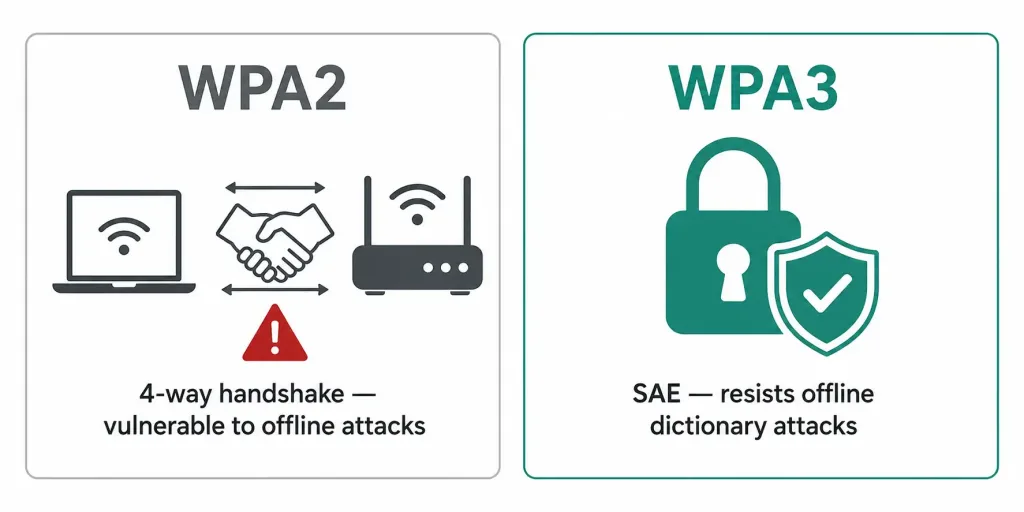
WPA3 replaced WPA2 as the current Wi-Fi security standard, and its most significant technical improvement is Simultaneous Authentication of Equals (SAE), a key exchange method that resists offline dictionary attacks far more effectively than WPA2’s four-way handshake — an attacker capturing WPA3 traffic can’t feasibly brute-force the password offline the way they historically could with a captured WPA2 handshake. WPA3 also supports opportunistic encryption on open networks, meaning traffic on an unsecured public Wi-Fi network can still be encrypted between the device and access point even without a shared password.
Satellite Internet: Low-Earth Orbit Basics
Modern satellite internet services increasingly rely on constellations of satellites in low-Earth orbit (LEO) — roughly 500-2,000 kilometers up — rather than the traditional geostationary satellites parked at roughly 36,000 kilometers. The practical difference is latency: a signal’s round trip to a geostationary satellite and back takes a fixed amount of time dictated by the speed of light over that much greater distance, adding a noticeable delay unsuitable for latency-sensitive applications. LEO satellites are close enough that round-trip latency drops to a range comparable to many terrestrial broadband connections, at the cost of needing many more satellites in a coordinated constellation to maintain continuous coverage as any individual satellite passes overhead and moves on.
This is the general technical reason LEO satellite internet has become commercially viable for applications like video calls that geostationary satellite internet historically struggled with.
Short-Range Wireless for IoT
Connecting large numbers of low-power devices — sensors, trackers, smart-home accessories — typically uses purpose-built protocols rather than standard Wi-Fi, since Wi-Fi’s power consumption and protocol overhead aren’t well suited to a battery-powered sensor that needs to last months or years on a single charge:
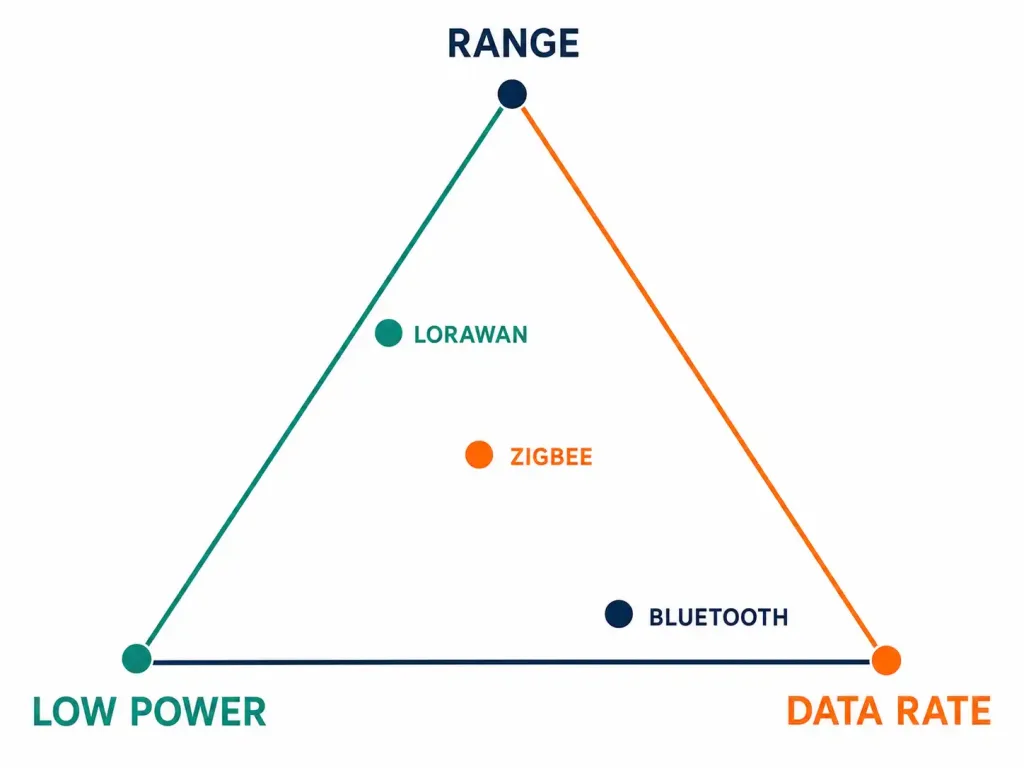
- Bluetooth / Bluetooth Low Energy (BLE) — short range (roughly 10 meters), very low power, common for wearables and accessories.
- Zigbee and Z-Wave — mesh-capable, low-power protocols common in smart-home device ecosystems, where devices can relay each other’s signals to extend effective range beyond what a single device’s radio could reach alone.
- LPWAN (Low-Power Wide-Area Network) technologies, such as LoRaWAN — designed for very long range (multiple kilometers) at very low data rates and very low power, suited to applications like agricultural or environmental sensors that send small amounts of data infrequently over a wide area.
Choosing among these is a genuine engineering trade-off between range, power consumption, and data rate — no single short-range wireless technology optimizes all three simultaneously, which is exactly why several different ones coexist rather than one displacing the rest.
Wireless Signals and Health: What’s Actually Established
This topic deserves care rather than either alarm or dismissal. Radiofrequency signals used by Wi-Fi and cellular networks, including 5G, are non-ionizing radiation — a distinct category from ionizing radiation like X-rays or gamma rays, which carry enough energy to directly damage molecular bonds in DNA. Non-ionizing RF simply doesn’t carry that kind of energy at the power levels these networks use.
The World Health Organization has an ongoing International EMF Project evaluating radiofrequency exposure research, including multiple systematic reviews and meta-analyses covering different potential health outcomes, published over the past several years. This is an active, evolving area of scientific review rather than a single settled conclusion delivered in one report — anyone citing a specific quoted “finding” on this topic should be treated with appropriate skepticism unless it traces to a specific, checkable source, since this is exactly the kind of claim that gets paraphrased into something more definitive-sounding than the underlying research actually states.
The practical, uncontroversial takeaway: RF exposure from Wi-Fi and cellular devices operates within established regulatory safety limits set by national and international bodies, and the mechanism of harm associated with ionizing radiation simply doesn’t apply to the non-ionizing frequencies these technologies use. Beyond that, treat specific numerical claims about “reduced risk percentages” or exact regulatory changes with caution unless you can trace them to a primary source.
Conclusion
Wireless technology isn’t one thing — it’s several genuinely different engineering solutions, each optimized for a different combination of range, speed, and power consumption. Wi-Fi optimizes for high local throughput at short range; cellular trades some throughput for much wider area coverage; satellite trades latency and cost for coverage where no terrestrial infrastructure exists at all; and short-range IoT protocols optimize for battery life over raw speed.
Understanding which trade-off a given technology was actually built around is far more useful than tracking whichever generation number is newest, and it’s worth treating specific numerical claims about any of these technologies with the same scrutiny you’d apply to any other technical claim — verify against a primary source rather than accepting a confident-sounding statistic at face value.
Frequently Asked Questions
What’s the real maximum speed difference between Wi-Fi 6E and Wi-Fi 7?
Wi-Fi 6E’s verified maximum theoretical speed is 9.6 Gbps. Wi-Fi 7’s is 46 Gbps, achieved through wider 320 MHz channels and denser 4096-QAM modulation. Neither figure reflects real-world single-device throughput, which is consistently well below the theoretical maximum in practice.
What does Standalone 5G (5G SA) actually mean?
It means the 5G network runs on 5G-native core infrastructure end to end, rather than a 5G radio access layer sitting on top of an existing 4G core network. SA deployments generally achieve lower latency than non-standalone 5G, which still depends partly on 4G infrastructure underneath.
How does WPA3 actually improve on WPA2?
Its core improvement is Simultaneous Authentication of Equals (SAE), a key exchange method that resists offline dictionary attacks far more effectively than WPA2’s handshake. WPA3 also supports opportunistic encryption on open networks, encrypting traffic between a device and access point even without a shared network password.
Why is low-Earth orbit satellite internet faster than traditional satellite internet?
Latency is primarily a function of distance, since signals travel at a fixed speed. Low-Earth orbit satellites sit roughly 500-2,000 kilometers up, versus roughly 36,000 kilometers for geostationary satellites — the shorter round trip meaningfully reduces latency, at the cost of needing a much larger, coordinated constellation of satellites to maintain continuous coverage.
Why don’t IoT devices just use standard Wi-Fi?
Wi-Fi’s power consumption and protocol overhead aren’t well matched to small, battery-powered sensors that need to operate for months or years without a battery change. Purpose-built low-power protocols like Bluetooth Low Energy, Zigbee, and LPWAN technologies trade off range and data rate differently, which is why several coexist rather than one replacing the others.
Is mmWave 5G available everywhere?
No — mmWave’s very high frequency gives it high throughput but poor penetration through walls and other obstacles, so mmWave deployments are typically concentrated in specific high-density locations rather than providing wide-area coverage the way lower-frequency 5G spectrum does.
How should I evaluate a specific claim about wireless technology speeds or safety?
Trace it to a primary source before treating it as fact — a manufacturer’s specification sheet, an IEEE standard document, or a peer-reviewed study, rather than a secondary summary. This matters especially for two categories of claims: theoretical maximum speeds (which are lab figures under ideal conditions, not achievable real-world throughput) and health-related findings (where ongoing, evolving research is easy to compress into a more definitive-sounding conclusion than the underlying study actually supports). A specific-sounding number or quote is not, by itself, evidence that it’s accurate.