
Choosing a hosting plan usually comes down to a tradeoff between cost and control, and a Virtual Private Server (VPS) sits at a genuinely useful middle point between the two extremes. Here’s what a VPS actually is, what it’s realistically good for, and an honest comparison between Windows and Linux VPS options rather than a pitch for one dressed up as neutral advice.
What a VPS Actually Is
A VPS is a partition of a single physical server, split using virtualization software (common hypervisors include KVM, Xen, and Microsoft’s Hyper-V) into multiple isolated virtual machines that each run their own independent operating system. Unlike shared hosting, where many websites draw from one pool of resources with no hard boundaries between them, a VPS gives you a dedicated, guaranteed slice of CPU, memory, and storage — another tenant’s traffic spike on the same physical server doesn’t eat into your resources the way it can on shared hosting.
This is also the useful correction to make up front: a VPS runs on one physical server divided into virtual partitions, not spread “across multiple servers.” That distinction matters because it’s exactly what explains both the VPS’s strengths (full root/admin access, the ability to reboot your instance independently of other tenants) and its real limit (you’re still bounded by what that one physical host can provide, unlike a distributed cloud architecture built across many machines).
Where VPS Fits Between Shared and Dedicated Hosting
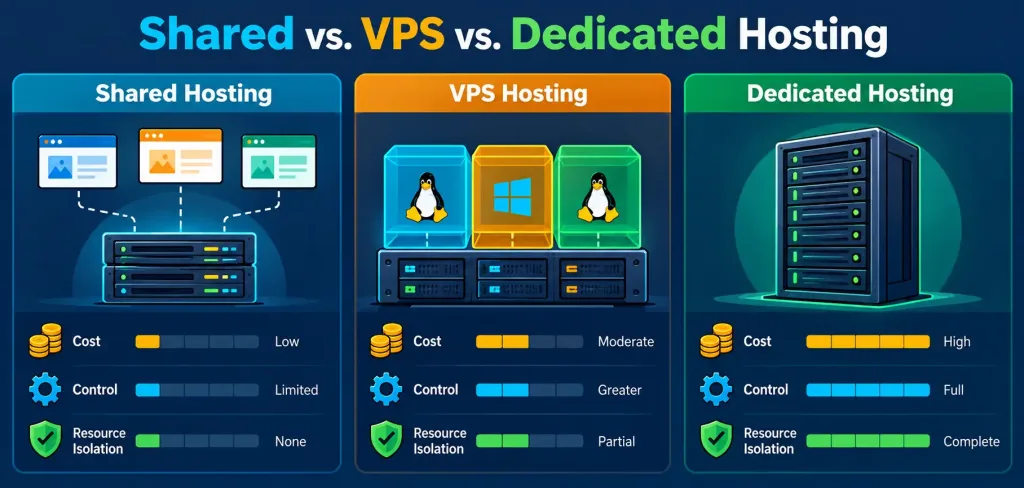
- Shared hosting is the cheapest option, suitable for a low-traffic blog or small brochure site, but it offers no resource guarantees and limited customization — you’re running software on infrastructure you don’t control.
- VPS hosting sits in the middle: dedicated resources and full administrative control, at a meaningfully lower cost than a dedicated server, because you’re still sharing the underlying physical hardware with other VPS tenants, just with real isolation between them.
- Dedicated hosting gives you an entire physical server to yourself — the most control and the most raw performance headroom, at the highest cost, and usually more management overhead than most small-to-mid-sized sites actually need.
A VPS is a genuinely good fit for sites with real but not massive traffic, applications with specific software or configuration requirements shared hosting can’t accommodate, and database-heavy or PHP-heavy workloads that benefit from guaranteed, consistent resources rather than whatever’s left over on a shared box.
Windows VPS vs. Linux VPS: An Honest Comparison
This is where a lot of hosting content gets muddled by picking a side without being upfront about it. Here’s the actual tradeoff:
Linux VPS is the dominant choice for web hosting generally — as of late 2026, roughly 63% of websites run on Linux servers compared to about 8% on Windows, according to W3Techs. Linux VPS plans are typically cheaper (no licensing fee, since most Linux distributions are free), and they’re the natural choice for the LAMP/LEMP stack (Linux, Apache or Nginx, MySQL, PHP) that a large share of websites, including most WordPress sites, run on.
Windows VPS makes sense in specific, genuine cases: if your application is built on the .NET framework, if you need native IIS (Internet Information Services) support, if you’re running software that specifically requires Windows Server, or if your team’s existing expertise and tooling is Windows-centric. It typically costs more due to Microsoft licensing, but for the right workload, that cost is justified rather than wasted.
The honest bottom line: there’s no universally “better” choice here. A business running a WordPress site or a standard PHP/MySQL application is almost always better served by Linux VPS, both on cost and on ecosystem fit. A business running a .NET application or Windows-specific enterprise software genuinely needs Windows VPS, and trying to force that workload onto Linux would cause real compatibility problems. The right answer depends entirely on what you’re actually running, not on a blanket recommendation either way.
What VPS Security Actually Looks Like
A VPS does offer real isolation benefits over shared hosting — your environment is walled off from other tenants in a way shared hosting’s single resource pool isn’t, which reduces (though doesn’t eliminate) certain cross-tenant risks. But a few common claims about VPS security deserve more precision than they usually get:
- A dedicated IP address mainly affects things like email deliverability reputation and the ability to get certain types of SSL certificates cleanly — it isn’t primarily a security feature, and framing it as something that “stops hackers” overstates what it actually does.
- Root/admin access is a double-edged sword. Full control means you’re also fully responsible for security configuration, firewall rules, and keeping the OS patched — a VPS with sloppy admin hygiene can be considerably less secure than well-managed shared hosting, since there’s no provider-level safety net catching misconfigurations the way there sometimes is on a fully managed shared plan.
- “Guaranteed” OS upgrades aren’t a universal feature. Whether and how your VPS provider handles OS upgrades is set by your specific plan and provider — managed VPS plans often include this, unmanaged ones typically don’t, and it’s worth confirming explicitly with any provider rather than assuming it.
The Bottom Line
A VPS genuinely earns its place between shared and dedicated hosting for sites that have outgrown shared hosting’s resource limits but don’t yet need (or want to pay for) a full dedicated server. The global VPS market reflects that real demand — valued at roughly $4.70 billion in 2025 and projected to reach about $13.81 billion by 2034 at a 12.72% compound annual growth rate. Choosing between Windows and Linux VPS isn’t about which one is objectively better; it’s about which one actually matches the software you’re running. For most standard web applications, that’s Linux. For .NET and Windows-specific enterprise software, it’s Windows — and any hosting advice that doesn’t ask that question first is skipping the part that actually matters.
Frequently Asked Questions
Is VPS hosting actually faster than shared hosting?
Usually yes, in practice, because a VPS gives you dedicated resources rather than sharing a pool with potentially many other sites — a traffic spike on another site hosted on the same shared server can’t slow yours down the way it could on shared hosting. The underlying hardware still sets the ceiling, though.
How common is Windows VPS compared to Linux VPS?
Linux is used by roughly 63% of websites compared to about 8% for Windows, according to W3Techs — making Linux VPS the dominant choice overall, though Windows VPS remains the right call for specific .NET and Windows-dependent workloads.
Does a VPS come with better security than shared hosting by default?
It offers real isolation from other tenants, which reduces certain cross-tenant risks, but a VPS also puts more security responsibility on you, since you typically have full root/admin access and are responsible for your own configuration and patching. An unmanaged VPS with poor security hygiene can end up less secure than well-managed shared hosting.
How big is the VPS hosting market?
The global VPS market was valued at approximately $4.70 billion in 2025 and is projected to reach about $13.81 billion by 2034, growing at a compound annual rate of roughly 12.72%.