
Most brands aren’t short on social media content — they’re short on content people actually want to engage with. The difference between a feed that builds an audience and one that gets scrolled past usually comes down to a handful of deliberate choices: what to share, how to involve your actual audience, who to partner with, and how not to overwhelm followers with pure promotion. Here’s what the evidence actually supports on each of those fronts.
Share Content People Genuinely Want to Pass Along
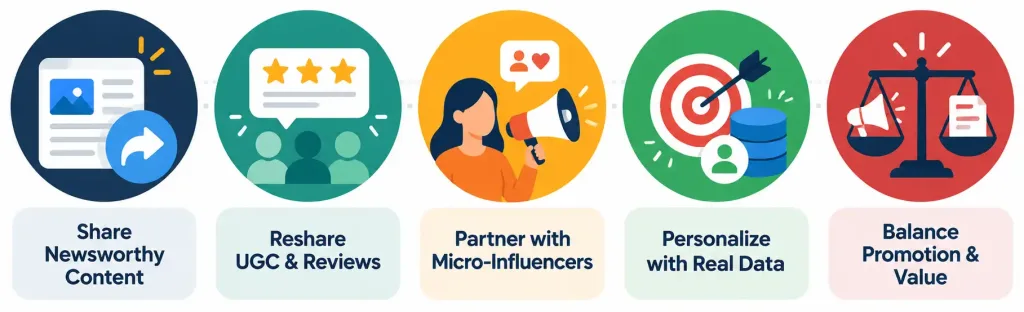
Content that gets shared organically tends to share one trait: it gives the reader something worth passing on, whether that’s useful information, a genuinely interesting development, or something that makes them look informed to their own network. This is different from purely promotional content, which people rarely share on your behalf — nobody forwards an ad to a friend the way they forward something that surprised or informed them.
The practical takeaway is to look for genuinely newsworthy, positive developments related to your industry or expertise — not necessarily about your own company — and frame them in a way that adds your own perspective rather than just reposting a headline. The goal is to be a source your audience associates with staying informed, not just a source of offers.
Repurpose User-Generated Content
Reviews, customer photos, testimonials, and unprompted social mentions are some of the most effective content a brand can share, precisely because they don’t read as marketing — they read as other people’s genuine experience. This matters more than it might seem: BrightLocal’s consumer research has consistently found that a large majority of people — 85% in its most recent widely-cited survey — trust online reviews about as much as a personal recommendation from someone they know, and 73% say positive reviews specifically make them trust a business more.
Practically, this means actively collecting and resharing real customer content (with permission) rather than only producing brand-created material. A single genuine customer photo or quote, framed well, often outperforms a professionally produced graphic making the same claim, simply because audiences discount brand-authored claims more than they discount a stranger’s.
Work With Influencers — Especially Smaller Ones
Influencer partnerships remain effective, but the data increasingly favors smaller, more engaged creators over the biggest names. Engagement rate — not follower count — is the metric that actually predicts whether a partnership drives real action, and smaller “micro-influencer” accounts (roughly 10,000 to 100,000 followers) consistently post higher engagement rates than accounts with a million or more followers. One widely cited Instagram-focused study found micro-influencer posts averaging around 3.86% engagement, compared to roughly 1.21% for posts from larger accounts — a gap significant enough to change which partnership actually reaches more genuinely interested people, even with a smaller raw audience.
The practical implication: rather than chasing the single largest influencer a budget can afford, it’s often more effective to work with several smaller, niche-relevant creators whose audiences are already specifically interested in your category. Their recommendations tend to read as more authentic, and the aggregate reach across several smaller partnerships can match or exceed one large one, often at a lower total cost.
This doesn’t mean larger influencer partnerships never make sense — a product launch aiming for broad awareness rather than niche-specific conversion may still benefit from scale over engagement rate. The point is that engagement rate and follower count answer different strategic questions, and conflating them (assuming the biggest account automatically delivers the best return) is where influencer budgets most often underperform expectations.
Know What Your Platform’s Audience Actually Does There
A technique that works well on one platform can fall flat on another, because audience behavior genuinely differs by platform. Facebook remains a useful example of why this matters: current research puts Facebook at over 3 billion monthly active users globally, with the average user spending roughly an hour a day on the platform.
But raw scale isn’t the most useful number for a content strategy — behavior is. Current data shows roughly 45% of Facebook users turn to the platform specifically when they need customer service help from a brand, more than any other social network, and close to 40% use it specifically to discover new products. That combination suggests Facebook content and community management should lean into responsiveness and product discoverability, not just broadcast-style posting.
The broader principle holds across platforms generally, even where the specific numbers differ: a platform’s engagement patterns (what people actually go there to do) should shape what kind of content you prioritize there, rather than cross-posting identical content everywhere and hoping it performs the same way across fundamentally different audience intents.
Personalize Content Using What You Actually Know About Your Audience
Generic content performs worse than content that reflects real knowledge of who’s actually seeing it. This doesn’t require anything exotic — audience research (what your existing followers engage with, what questions they actually ask, what content formats they respond to) and basic retargeting (showing follow-up content to people who’ve already engaged with related posts) both meaningfully improve relevance without requiring a large production budget.
The key distinction worth making explicitly: personalization based on genuine audience behavior and stated interests is different from content that merely feels targeted through demographic guesswork. The former tends to feel helpful; the latter can feel invasive if it’s too aggressive or too obviously automated. Audience research that actually listens to what your followers engage with — rather than assuming based on broad demographics — produces better results and fewer unsubscribes.
Balance Promotion With Genuinely Useful Content
A feed that’s purely promotional trains an audience to tune it out — or unfollow entirely. The content that keeps an audience engaged long-term mixes real promotional posts with content that’s useful on its own terms: how-to information, industry context, answers to questions your audience actually has, and content that would be worth following even for someone who never buys anything from you.
There’s no single universally “correct” ratio of promotional to non-promotional content — it depends heavily on platform, audience, and industry — but the underlying principle holds across all of them: content that only ever asks for something eventually stops earning attention at all.
The AI Content Creation Shift
This is worth addressing directly, since it’s changed meaningfully even in the past couple of years: AI-assisted content creation has moved from a novelty to mainstream practice. Current industry research from HubSpot found that roughly 80% of marketers already use AI tools somewhere in their content creation process, with a large majority planning to expand that usage further.
For a brand building a social content workflow now, the realistic question isn’t whether to use AI tools at all, but where they genuinely speed up the process (first drafts, repurposing existing content into new formats, generating variations for testing) versus where human judgment and a distinctly human voice still matter most — particularly for the user-generated and influencer content discussed above, where authenticity is the entire point.
This distinction matters more than it might initially seem, given everything covered above about why user-generated content and reviews perform so well: that performance is specifically tied to audiences perceiving the content as genuine and unscripted.
Content that’s obviously AI-generated and runs in that same “authentic voice” slot — a testimonial-style post, a reply that’s supposed to read as personal customer service — risks undermining the exact trust mechanism that makes those content types work in the first place. AI tools are genuinely useful for speeding up brand-authored content (captions, scheduling variations, repurposing a long post into shorter platform-specific versions), but substituting them into the slots where authenticity is the entire value proposition tends to work against the goal rather than toward it.
Why Content Marketing Is Worth the Investment
For brands weighing whether a deliberate content strategy is worth the resources against simply running paid ads, the comparative data is worth knowing: content marketing has been found to cost roughly 62% less than traditional outbound marketing while generating about three times as many leads, according to research frequently cited from Demand Metric. That gap is exactly why a deliberate, audience-aware content approach — built on real engagement data rather than guesswork — tends to outperform a purely promotional posting schedule over time.
Measuring What’s Actually Working
None of the techniques above are worth much without a way to check whether they’re actually moving the needle for your specific audience, rather than just assuming they work because they’re commonly recommended. A few practical habits make this tractable without requiring an elaborate analytics setup:
- Track engagement rate, not just reach or follower count, since a smaller, more engaged audience consistently outperforms a larger, passive one for actual business outcomes like leads and conversions.
- Compare content types against each other directly, rather than against an industry benchmark that may not reflect your specific audience — a how-to post that underperforms your own account’s average is a more useful signal than one that merely underperforms a generic “good” engagement rate cited elsewhere.
- Give user-generated content and influencer partnerships their own tracking, separate from brand-authored posts, since the earlier data suggests they tend to perform differently and deserve to be evaluated on their own terms rather than lumped into a single average.
- Revisit platform-specific strategy periodically, since platform usage patterns genuinely shift over time — a strategy built around last year’s audience behavior on a given platform can quietly stop matching how that platform’s users actually behave today.
The Bottom Line
The through-line across all of these techniques is the same: content that treats the audience as people with genuine interests and genuine trust in other people’s opinions outperforms content that only ever talks at them. Share things worth sharing, let real customers speak for the brand, partner with creators whose engagement (not just reach) is genuine, personalize based on real behavior rather than guesswork, and keep the promotional-to-useful ratio honest. None of this requires a massive budget — it requires paying attention to what the actual data says works, rather than what simply feels like “doing social media.”
Frequently Asked Questions
Why do people trust online reviews so much?
BrightLocal’s consumer research has repeatedly found that a large majority of people — around 85% in its most recent widely-cited survey — trust online reviews about as much as a personal recommendation from someone they know, with 73% saying positive reviews specifically increase their trust in a business. That’s why resharing genuine customer content tends to outperform brand-authored claims.
Are micro-influencers really more effective than larger influencers?
By engagement rate, often yes. Smaller creator accounts (roughly 10,000–100,000 followers) consistently show higher engagement rates than accounts with a million or more followers — one widely cited study found roughly 3.86% engagement for micro-influencer posts versus about 1.21% for larger accounts. Reach is lower per partnership, but the audience is typically more genuinely engaged.
How many marketers are currently using AI for content creation?
Current industry research from HubSpot puts the figure at roughly 80% of marketers already using AI tools somewhere in their content process, with a large majority planning to expand that usage — making it close to standard practice rather than a niche tactic at this point.
Is content marketing actually cheaper than paid advertising?
Research frequently cited from Demand Metric puts content marketing at roughly 62% less expensive than traditional outbound marketing, while generating about three times as many leads — though results vary significantly by industry and execution quality.
Should every platform get the same content?
No. Platform usage patterns genuinely differ — Facebook users, for instance, are especially likely to turn to the platform for customer service and product discovery compared to other networks — so content and community management strategy should reflect what a given platform’s audience actually goes there to do, rather than cross-posting identical content everywhere.