A $500 budget buys a genuinely good TV today — the question isn’t whether you can get a solid picture at this price anymore, it’s which tradeoffs matter most for how you’ll actually use it. Gaming, movie-watching in a dark room, sports in a bright living room, and simple everyday streaming all point toward slightly different picks, even within the same budget. Here’s what currently holds up under independent testing, organized by what you’re actually optimizing for.
It’s worth saying upfront why this matters more than it might seem: TV recommendations age quickly. A model praised as a top budget pick two or three years ago is often discontinued, replaced by a newer version with meaningfully different specs, or simply no longer competitively priced against what’s launched since. A “best TV under $500” list is only useful if it reflects what’s actually available and actually tested right now — which is the standard every pick below is held to.
Best Overall: Hisense QD7
The Hisense QD7 is a 65-inch quantum-dot LED TV with local dimming, and it’s the pick that balances picture quality and value most consistently across independent reviews. It delivers accurate, vibrant color and strong dark-scene detail thanks to its local dimming zones, supports both Dolby Vision and HDR10+ for a wide range of streaming content, and has surprisingly capable built-in audio for a budget TV — not something to rely on over a dedicated soundbar, but good enough for casual viewing without one.
Its real limitations are worth knowing before buying: the built-in Amazon Fire TV interface is frequently described as slow and ad-heavy, pushing Amazon’s own content prominently rather than staying out of the way. It also struggles in well-lit rooms, so it’s a better fit for a space where you can control glare and ambient light. The 60Hz refresh rate handles fast motion acceptably with motion smoothing enabled, but isn’t suited to competitive gaming — which is exactly where the next pick comes in.
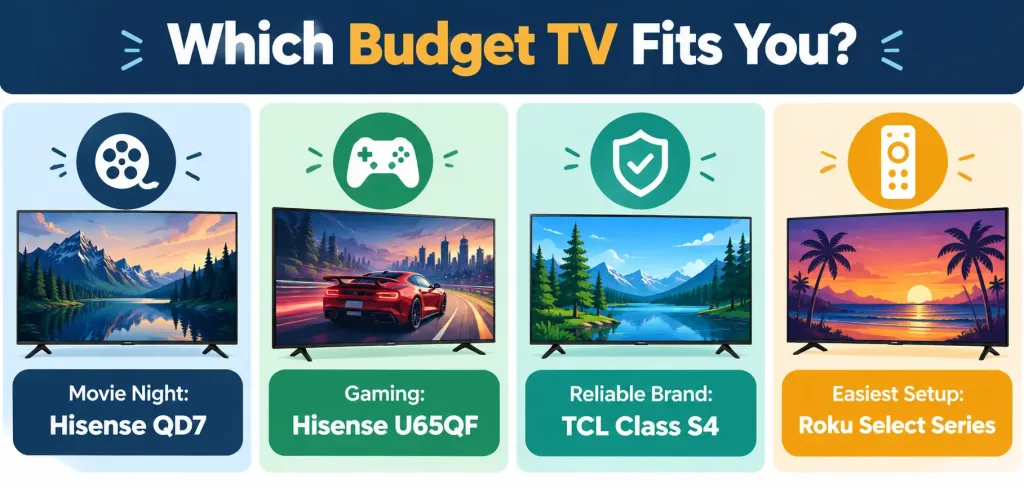
Best for Gaming: Hisense U65QF
For anyone prioritizing gaming over movie-night picture quality, the Hisense U65QF (55-inch model lands under $500; the 65-inch version runs slightly over) is the stronger pick specifically because of its ports and refresh rate. It supports a 144Hz refresh rate alongside two HDMI 2.1 ports, which together enable smoother, more responsive gameplay than the QD7’s 60Hz panel can offer — and its Auto Low-Latency Mode automatically switches the TV into a lower-lag state when it detects a connected game console, reducing input delay without manual menu-diving.
It’s also brighter than the QD7, particularly in HDR content, and handles sports broadcasts well as a result. The tradeoffs: some reviewers note light bloom around bright objects on dark backgrounds (a common limitation of edge-lit and lower-zone-count local dimming), occasional softness during very fast action, and viewing angles that narrow the TV’s sweet spot if you’re not sitting roughly centered. Like the QD7, it runs Fire TV, which reviewers consistently describe as unremarkable software even when the hardware underneath performs well.
Best From a Widely Trusted Brand: TCL Class S4
The TCL Class S4, available in both 43-inch and 55-inch sizes under $500, is a reasonable pick for buyers who specifically want a long-established TV brand with a solid value reputation rather than one of the newer budget lines. It supports Dolby Vision and HDR10 for expanded dynamic range content and includes Dolby Atmos audio support, plus an automatic game mode that activates when it detects a connected console — a convenience feature that saves a trip into the settings menu.
Some buyers report occasional Wi-Fi connectivity drops during streaming, which is worth testing early in your return window if you buy one, so you have time to exchange it if your network setup triggers the issue. Overall picture and sound quality are described as decent rather than exceptional, which fits its positioning as a dependable, no-surprises option rather than a top performance pick.
Simplest Setup and Interface: Roku Select Series
For buyers who most want to just plug it in and start streaming without fighting a sluggish or ad-heavy interface, a 55-inch Roku Select Series 4K HDR Smart TV is worth specific consideration. Roku’s own TV operating system has a longstanding reputation for being faster and less cluttered than some of the ad-forward systems increasingly common at this price point, and the remote’s dedicated streaming-app buttons make day-to-day use straightforward for less tech-comfortable household members. Some users report occasional Wi-Fi connection hiccups, which is a recurring theme across several budget TVs at this price tier and worth testing early regardless of which model you choose.
A Smaller, Cheaper Option: Hisense 43-Inch E6 Cinema Series
For a smaller room or a secondary TV, the 43-inch Hisense E6 Cinema Series (marketed under Hisense’s “Hi-QLED” branding) adds Wi-Fi 6 support, a dedicated game mode, and variable refresh rate at a smaller screen size and lower price point than the picks above. Ambient light sensing automatically adjusts picture settings based on room lighting, a genuinely useful feature at this price. The tradeoffs are a reportedly laggy menu system and a 60Hz refresh rate that, like the QD7, isn’t built for serious competitive gaming.
What Actually Matters When Comparing Budget TVs
A few specs are worth paying more attention to than the marketing copy usually emphasizes:
- Local dimming (present on the QD7 and U65QF) meaningfully improves contrast and dark-scene detail compared to TVs without it, since it allows different parts of the screen to dim independently rather than lighting the whole panel uniformly.
- HDMI version matters for gaming specifically. HDMI 2.1 ports (found on the U65QF) support higher refresh rates and features like variable refresh rate that HDMI 2.0 ports can’t, which is the real reason the U65QF outperforms the QD7 for gaming despite similar picture-quality fundamentals.
- The smart TV software is part of the product, not an afterthought. Several of these TVs share genuinely strong picture hardware but noticeably different day-to-day usability, depending on whether they run Fire TV, Roku’s own OS, or another platform — and reviewers consistently flag ad-heavy or sluggish interfaces as the most common complaint across this entire price tier, regardless of brand.
- Viewing angle and brightness in your actual room matter more than lab numbers alone. A TV that tests well in a dark review room can still struggle in a bright living room with large windows — if possible, check a model’s specific published brightness and viewing-angle performance against your actual room conditions before buying.
Screen Size: Matching It to the Room, Not Just the Budget
Screen size has a bigger effect on how “worth it” a TV feels than most buyers initially expect, and it’s worth thinking through deliberately rather than just buying the largest size available at the price point. A common rule of thumb among display reviewers is to divide your typical viewing distance (in inches) by roughly 1.5 to 2.5 to find a reasonable screen size range — closer viewing distances and 4K content support a proportionally larger screen without the image looking soft or oversized for the room, since 4K’s higher pixel density holds up better at close range than older resolutions did.
For a primary living room TV viewed from a typical couch distance, the 55-inch and 65-inch options covered above (the QD7, U65QF, and larger TCL Class S4 configuration) are reasonable choices. For a bedroom, home office, or secondary TV viewed from closer range, the 43-inch options (the smaller TCL Class S4 configuration, or the Hisense E6 Cinema Series) avoid the oversized, hard-to-look-away-from feeling a large screen can create in a small room.
When to Buy for the Best Value
Budget TV pricing fluctuates meaningfully around a few predictable points in the year, and timing a purchase around them can meaningfully change what’s available at a given price:
Major retail sale events (particularly in late November and around other seasonal sales periods) regularly bring additional discounts to models already positioned at this price tier, and new TV lineups typically launch in early spring, which tends to push the previous year’s models — functionally identical in most cases — toward deeper discounts as retailers clear inventory. Buying a TV that’s one model-year old, rather than the newest release, is one of the most reliable ways to get meaningfully better specs for the same $500 budget, since the underlying panel technology doesn’t change dramatically year to year at this price tier.
A Note on How These Picks Were Chosen
Every model in this guide is cross-referenced against current, independently published testing and reviews rather than manufacturer marketing copy or sponsored placements, and pricing reflects what’s realistically available at the time of writing — budget TV pricing shifts often enough that it’s worth checking current pricing on a specific model before buying rather than treating any figure here as fixed. None of the picks above are included because of a vendor relationship or paid placement; they reflect what independent testing currently supports as the strongest options in this price tier.
The Bottom Line
At $500, you’re genuinely choosing between legitimate options rather than compromising on basic picture quality — the real decision is which weaknesses you’re willing to live with. The Hisense QD7 offers the best overall balance for general viewing in a controlled-light room; the Hisense U65QF trades some HDR brightness and panel refinement for meaningfully better gaming performance; the TCL Class S4 and Roku Select Series both prioritize a more dependable, less ad-heavy day-to-day experience over outright picture-quality benchmarks. None of these are wrong choices — they’re optimized for different living rooms and different priorities.
Frequently Asked Questions
What’s the single best TV under $500 right now?
The Hisense QD7 currently offers the strongest overall balance of picture quality and value under $500, according to independent testing, thanks to its local dimming and accurate color — though its Fire TV interface and dim-room performance are worth considering before buying.
Which budget TV is best for gaming?
The Hisense U65QF, thanks to its 144Hz refresh rate, HDMI 2.1 ports, and Auto Low-Latency Mode — all of which meaningfully reduce input lag and support smoother motion compared to the more common 60Hz panels at this price.
Do cheap TVs under $500 support 4K and HDR?
Yes — 4K resolution and some form of HDR (HDR10, HDR10+, or Dolby Vision) are now standard across nearly every TV in this price range, including every model discussed here. The meaningful differences are in how well each panel actually renders that content (brightness, contrast, color accuracy), not whether the specs are present on paper.
Why do so many budget TVs have complaints about their smart TV software?
Fire TV and some other budget-tier smart TV platforms are frequently criticized by reviewers for pushing advertising content and running sluggishly compared to dedicated streaming devices or Roku’s own TV operating system. This is a software and licensing issue separate from the TV’s actual picture-quality hardware, which is why two TVs with similar panels can feel very different to use day to day.
What screen size should I buy for a $500 budget?
It depends more on your viewing distance and room size than on maximizing size for the price. A common guideline is to divide your typical viewing distance in inches by roughly 1.5 to 2.5 to estimate a comfortable screen size — closer seating and 4K content support a proportionally larger screen without looking oversized, while a smaller room or closer viewing distance (a bedroom or office) is usually better served by a 43-inch option.
Is it better to buy the newest TV model or a slightly older one at this price?
A model that’s one year old often delivers better specs for the same $500 budget than the newest release, since new lineups typically arrive in early spring and push the prior year’s models toward deeper discounts, while the underlying panel technology doesn’t change dramatically year to year at this price tier.