
Music that responds to your heartbeat sounds like something out of a wellness-app marketing pitch, and a lot of what’s written about it leans heavily into that pitch — dramatic percentages, confident claims, impressive-sounding studies. The real research is more modest than the marketing, but it’s also genuinely interesting, and worth understanding on its own terms rather than through inflated statistics.
This guide covers what heartbeat-synced and biofeedback-based music actually is, what legitimate research has found, and how to try it without chasing numbers that don’t hold up.
What Heartbeat-Synced Music Actually Is
The core idea is straightforward: a sensor (commonly a smartwatch, chest strap, or phone camera using photoplethysmography) detects your pulse, and software adjusts music — tempo, intensity, sometimes instrumentation — in response, either synced closely to your current rate or designed to guide it toward a calmer one. This sits within a broader field called biofeedback, where real-time physiological data (heart rate, heart rate variability, skin conductance) is fed back to a person, often paired with a relaxation technique, to help them learn to influence their own physiological state.
Heart rate variability (HRV) — the natural variation in time between heartbeats — is the specific metric most relevant here. Higher HRV is generally associated with better stress resilience and autonomic nervous system flexibility, which is why HRV biofeedback has become a genuine, researched area within music therapy and broader behavioral health.
What the Actual Research Shows
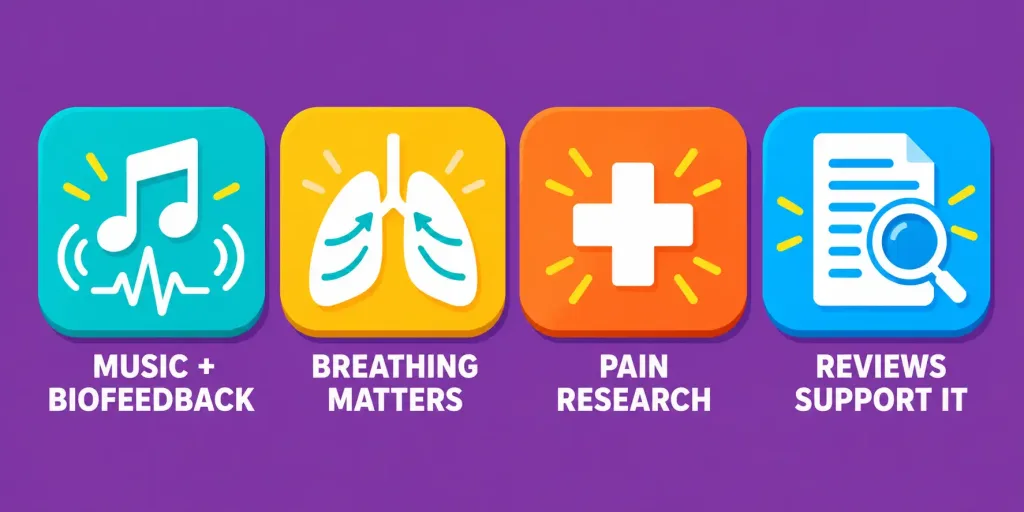
HRV biofeedback has real, if sometimes nuanced, research support. Systematic reviews and meta-analyses have examined heart rate variability biofeedback across a range of applications — stress, anxiety, and broader emotional and physical health outcomes — generally finding meaningful positive effects, though the size of those effects varies by study population and protocol.
Adding music to biofeedback can enhance the effect, though the picture isn’t uniform. A 2018 study published in Behaviour & Information Technology (on a system called “Unwind,” combining nature sounds and biofeedback-responsive music) found a genuine interaction effect: the combination of music and biofeedback improved heart rate variability and reduced self-reported anxiety more than either element alone. That’s a real, specific, peer-reviewed finding worth citing accurately.
Not every study finds music or biofeedback adds something beyond simpler techniques. A randomized controlled trial of musicians dealing with performance anxiety found that a single session of slow breathing significantly reduced anxiety and improved HRV — but adding biofeedback on top of the breathing protocol didn’t produce a measurably better result than slow breathing alone. This is a genuinely useful finding, not a failure: it suggests the breathing component itself may be doing much of the work in some biofeedback interventions, which is worth knowing if you’re deciding how much specialized technology you actually need.
Music therapy’s effect on HRV shows up in clinical contexts too. Research published in the Journal of Pain Research examining music intervention in chronic pain patients found measurable effects on pain scores, mood, sleep, and HRV — evidence that music’s physiological effects extend beyond simple relaxation into genuine clinical relevance.
The honest summary: heartbeat-synced and biofeedback-responsive music has real research behind it, generally supporting modest-to-meaningful improvements in relaxation, HRV, and anxiety in various contexts — but the field doesn’t support dramatic, precise claims like “65% anxiety reduction” or “10 mmHg blood pressure drops” from a specific named study, because no study I could verify makes those exact claims. Be skeptical of any source citing hyper-precise percentages without a traceable, checkable source.
Real Apps and Tools in This Space
Endel is a real, actively used app that generates adaptive soundscapes responding to inputs like time of day, weather, and in some configurations, biometric data from a connected wearable. It’s a legitimate, well-known product in the adaptive-audio wellness space.
Brain.fm is another real product, offering music designed around neuroscience research principles aimed at supporting focus, relaxation, or sleep states. It doesn’t require a heart rate sensor to function, functioning more as a general neuroscience-informed audio tool than a strict biofeedback system.
Both are worth exploring directly rather than taking third-party performance statistics about them at face value — check their own published research pages and independent app reviews for the most current, accurate picture of what they claim and what’s actually been studied.
How to Try This Yourself
Start simple. You don’t need specialized biofeedback hardware to begin — a basic wearable (many fitness trackers and smartwatches already measure heart rate) paired with an app like Endel is enough to experiment with the concept.
Pay attention to the breathing component. Given the research suggesting slow breathing alone drives much of the relaxation benefit in some biofeedback contexts, deliberately slow, paced breathing (roughly 5-6 breaths per minute is a commonly used target in HRV biofeedback research) alongside whatever music or app you’re using may matter as much as the technology itself.
Track your own response rather than assuming a universal effect. Individual responses to this kind of intervention vary meaningfully between studies and people — if you have access to your own HRV data through a wearable, comparing sessions over a few weeks gives you a more honest picture than any single statistic from an article (including this one).
Treat it as a complementary tool, not a replacement for professional care. For significant anxiety, depression, or other mental health concerns, biofeedback and music-based approaches are worth discussing with a healthcare provider as a potential complement to established treatment, not a substitute for it.
Frequently Asked Questions
Does heartbeat-synced music actually reduce anxiety?
Research on music combined with HRV biofeedback shows real, generally positive effects on relaxation and anxiety measures in several studies, though the size of the effect varies by study and population. Be cautious of any source citing a single dramatic percentage without a traceable source.
Do I need special equipment to try this?
No. A standard fitness tracker or smartwatch that measures heart rate, paired with an app like Endel, is enough to start experimenting with the concept without specialized biofeedback hardware.
Is the heart rate sync itself what matters, or is it mostly the relaxation technique?
Research findings are mixed on this specific question — some studies find music and biofeedback together outperform either alone, while others find a core relaxation technique (like slow breathing) drives most of the benefit regardless of added biofeedback. Both elements appear to matter, but not always in the same proportion.
Can this replace therapy or medication for anxiety?
No. It’s reasonable to use as a complementary tool, but significant anxiety or other mental health concerns are worth discussing with a healthcare provider rather than addressing solely through a wellness app.
Are Endel and Brain.fm backed by real research?
Both are real, established products in the adaptive-audio and neuroscience-informed music space. For the most accurate picture of their specific research claims, checking their own published materials and independent reviews directly is more reliable than secondhand statistics.
The Bottom Line
Heartbeat-synced and biofeedback-responsive music is a genuinely interesting, research-backed area — just not to the dramatic degree some coverage suggests. Real studies show meaningful effects on relaxation, HRV, and anxiety in various contexts, with an important nuance: simple techniques like slow breathing may account for much of the benefit in some cases, with added biofeedback contributing less consistently than marketing often implies. Approached with realistic expectations, it’s worth trying — approached expecting a precisely quantified transformation, it’s likely to disappoint.