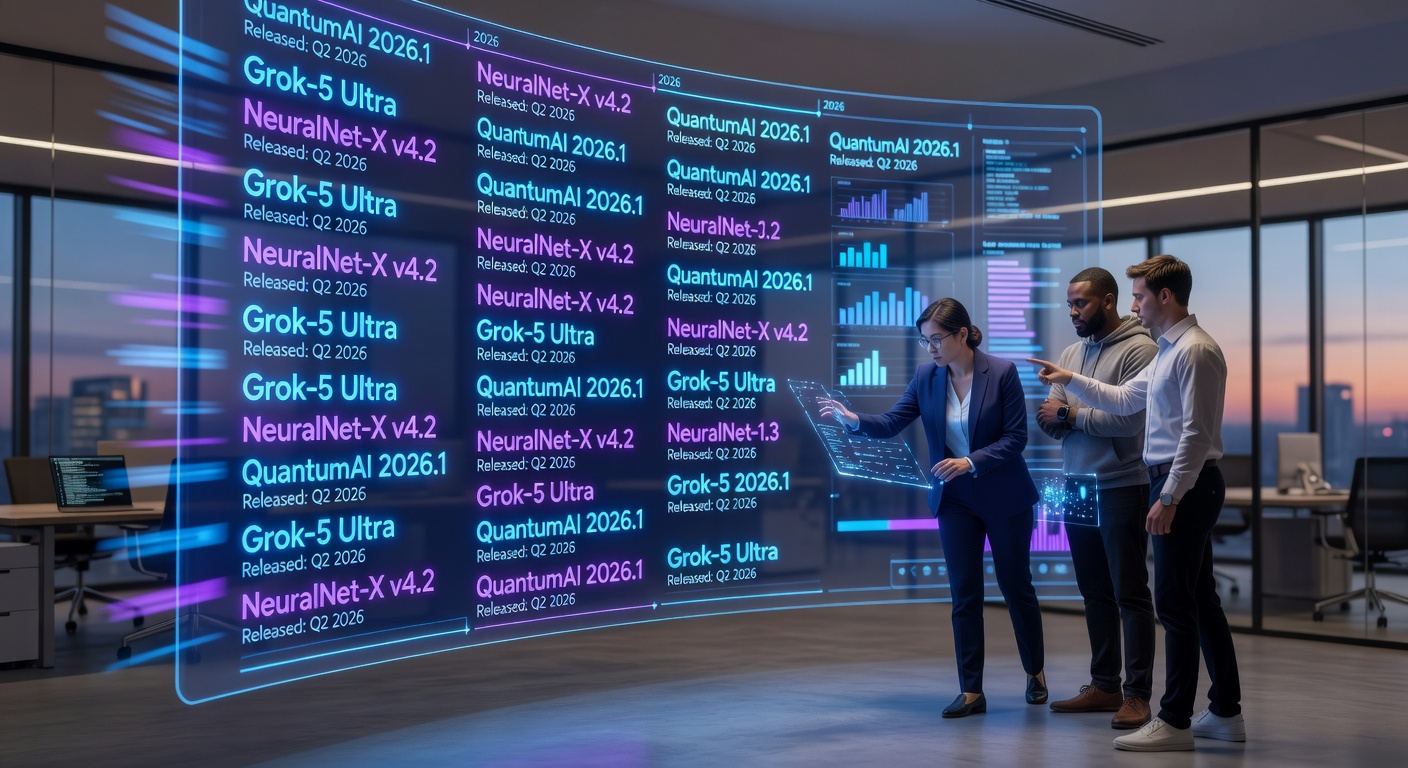
The pace of AI development in 2026 is unlike anything the technology industry has experienced before. New models are not just releasing annually or quarterly. They are releasing continuously, with updates, fine-tunes, and entirely new architectures appearing every few weeks across multiple competing labs. For tech professionals, staying current is no longer a nice-to-have skill. It is a professional necessity.
The challenge is not access to information. There is more AI news, model documentation, benchmark data, and technical commentary available than any individual can meaningfully consume. The real challenge is knowing how to filter, prioritize, and understand that information efficiently without it consuming your entire workday.
This guide covers the strategies, habits, and tools that tech professionals are actually using to stay on top of AI model releases in 2026.
Why Keeping Up With AI Models Matters for Tech Professionals
The practical impact of AI model releases extends far beyond the AI research community. Network engineers, cybersecurity professionals, IT administrators, software developers, and system architects all have direct professional reasons to stay informed about what new models can do.
Here is why it matters across different roles:
IT administrators need to evaluate which AI tools are reliable enough to deploy in enterprise environments and which models introduce new security or compliance considerations
Cybersecurity professionals need to understand how new models are being weaponized by threat actors as well as how defenders can use them for threat detection and analysis
Software developers need to know which models offer the best performance for their specific use cases, from code generation to documentation summarization
Network engineers are increasingly working with AI-assisted monitoring and anomaly detection tools that are built on top of foundation models
IT managers and decision-makers need to make informed procurement decisions about AI tools without having a dedicated research team
When a major new model releases and you have no context for what it does or how it compares to what came before, you are at a disadvantage in every conversation about it, whether that conversation is with a vendor, a colleague, or a client.
The Information Problem: Too Much, Too Fast
The volume of AI news is staggering. On any given week in 2026, you might see announcements from OpenAI, Anthropic, Google DeepMind, Meta AI, Mistral, and several smaller labs simultaneously. Each announcement comes with benchmark scores, technical papers, blog posts, YouTube explainers, Twitter threads, and Reddit discussions, all offering different levels of accuracy and depth.
For most tech professionals who are not working in AI research full time, filtering this volume of information down to what is actually relevant and accurate is the primary challenge.
The Most Common Pitfalls
Reading hype instead of substance: Many AI announcements are written for marketing audiences, not technical ones. The benchmark numbers look impressive but the context needed to evaluate them is buried or missing entirely
Getting information too late: By the time a major release is covered thoroughly in mainstream tech media, weeks may have passed since the announcement and early adopters have already formed their opinions
Trusting secondary sources without verification: A lot of AI commentary is written by people summarizing other summaries, which means errors and mischaracterizations compound quickly
Spending too long on a single release: With releases happening constantly, spending three hours researching one model means falling behind on everything else that released in the same window.
Strategies That Actually Work in 2026
Build a Tiered Information Diet
The most effective approach tech professionals use is a tiered system that separates real-time signals from deeper dives.
Tier 1: Real-time signals (daily, five minutes) Follow the official channels of the major labs directly. OpenAI, Anthropic, Google DeepMind, and Meta AI all publish release announcements on their own blogs and social channels before anywhere else. Subscribing to these directly cuts out the intermediary noise and gives you first-hand information as soon as it is available.
Tier 2: Technical summaries (a few times per week) Find two or three sources that consistently produce accurate, technically grounded summaries of new releases. These should be written by people with real technical backgrounds who can contextualize benchmark scores and architectural changes, not just repeat press release language.
Tier 3: Deep dives (as needed) When a release is directly relevant to your work, go deep. Read the technical paper if one is available, test the model yourself if access permits, and look for honest critical assessments rather than just promotional coverage.
Use Conversational Research Tools for Instant Context
One of the most practical shifts in how tech professionals research new AI releases is the move toward conversational research rather than search-based browsing. Instead of opening ten tabs and piecing together a picture of what a new model does, professionals are asking direct questions and getting structured answers in seconds.
Platforms like Ask AI are built exactly for this workflow. You can type a specific technical question about a new model release and receive a clear, organized answer immediately rather than scanning through multiple articles to extract the same information. Chatly gives you access to multiple leading AI models at once, which means when you want to understand a new release quickly, accurately, and without wading through promotional noise, Chatly delivers the technical context you need in a format that is immediately useful.
For example, when details around the upcoming GPT 5.3 release started circulating, tech professionals using conversational research tools were able to get a structured breakdown of the expected architecture changes, capability improvements, and comparison with predecessor models in minutes rather than hours of manual reading.
Set Up Automated Alerts for Specific Topics
Google Alerts, newsletter subscriptions from major labs, and RSS feeds from trusted technical sources can deliver relevant release news directly without requiring active searching. The key is being specific about what you set alerts for. Broad terms like “AI news” return too much. Specific terms like model names, benchmark names, or architectural terms return exactly what you need.
Building a Sustainable Research Habit
Staying current on AI releases is not a one-time effort. It requires a sustainable habit that fits inside a professional workday without consuming it. For busy professionals, this structured approach ensures efficiency.
The most effective habits tech professionals have built in 2026 share these characteristics:
Time-boxed: A fixed fifteen to twenty minutes per day dedicated to scanning new releases, rather than open-ended browsing that expands to fill available time
Tool-assisted: Using conversational research tools to compress the time needed to understand any single release
Selective: Accepting that you cannot follow every release in depth and prioritizing the ones most relevant to your specific role and stack
Community-connected: Participating in professional communities like networking forums, cybersecurity subreddits, and IT Slack groups where practitioners share honest assessments of new tools as they emerge
Final Thoughts
Keeping up with fast-moving AI model releases in 2026 is a genuine professional skill, not just casual interest. The tech professionals who stay most current are not the ones reading the most. They are the ones who have built the smartest systems for filtering, prioritizing, and understanding new information quickly.
The combination of direct source monitoring, tiered information habits, conversational research tools, and community connection is what separates professionals who always seem informed from those who are perpetually catching up. Start with the simplest change: replace one hour of scattered reading with fifteen focused minutes and a direct question to a research tool. The difference in what you actually retain and understand will be immediate.