
Facebook still has more monthly active users than any other social platform on earth, but “biggest” and “best fit for you” aren’t the same thing — which is exactly why looking seriously at alternatives to Facebook is worth doing even if you never fully leave the platform. Whether the pull is privacy, a different content style, or just wanting somewhere Facebook’s algorithm and ad load aren’t the whole experience, there’s a real range of alternatives to Facebook worth knowing about — and what each one actually offers has shifted enough in the past few years that an old list of “Facebook alternatives” is likely to be out of date in at least one major way.
Why People Look for Alternatives to Facebook
The reasons vary by person, but a few come up consistently: wanting less algorithmic feed curation and more chronological control, wanting stronger privacy defaults than Facebook’s ad-driven model offers, wanting a different content format entirely (short video, ephemeral posts, or large public channels rather than a friend-based feed), or simply wanting to spread personal and professional presence across more than one platform. None of the five alternatives below are a one-to-one replacement for everything Facebook does — each is a genuinely different product with its own tradeoffs, which is exactly why it’s worth knowing what each one is actually good at rather than treating them as interchangeable.
1. X (Formerly Twitter)
Twitter rebranded to X in July 2023 under Elon Musk’s ownership, and the platform itself has changed substantially since then — it’s no longer accurate to describe it as the “Twitter” many people remember. X is now owned by xAI, which acquired X Corp in March 2025, and the platform has added long-form text posts, account monetization, audio and video calling, a jobs section, and deep integration with xAI’s Grok chatbot. Contrary to older claims, X does support live video broadcasting directly from the app — that’s been a feature in some form since the Twitter era and continues under X’s current branding.
X works best for real-time public conversation: breaking news, commentary, and following specific topics or communities through hashtags and lists. Its verification and subscription system (Basic, Premium, and Premium+ tiers) now ties certain features — including reply visibility and algorithmic boosting — to paid status, which is a meaningful difference from the largely free-to-use platform Twitter used to be.
2. Instagram
Instagram remains owned by Meta, the same company behind Facebook, so anyone looking for genuine distance from Meta’s ecosystem specifically should know this going in — it’s not an independent alternative in the way the others on this list are. Where it does differ meaningfully from Facebook is content format and audience: Instagram is built around photos, short-form video (Reels), and Stories, with a younger-skewing user base and a much heavier visual-content culture than Facebook’s text-and-link-heavy feed.
For anyone whose main issue with Facebook is the content format rather than Meta’s business model generally, Instagram is a genuinely different day-to-day experience even while sharing the same parent company and much of the same ad-targeting infrastructure.
3. Telegram
Telegram has grown substantially — founder Pavel Durov said in 2024 that the platform had passed 950 million monthly active users and was on track to cross a billion within the following year. It’s built around fast, lightweight messaging, large public channels and groups (some with hundreds of thousands of members), and a bot ecosystem that supports everything from news aggregation to customer service automation.
Telegram’s privacy reputation is specific, not absolute: regular chats aren’t end-to-end encrypted by default — only “Secret Chats” are — so anyone choosing Telegram specifically for message privacy needs to actively use that feature rather than assume standard chats carry the same protection. Its large public channels and permissive bot ecosystem are genuinely useful for following communities and automating simple tasks, though the same openness means it’s also been associated with less moderated content than more tightly managed platforms — worth knowing going in rather than discovering later.
4. MeWe
MeWe markets itself directly as a privacy-focused “anti-Facebook,” with an ad-free model, a stated “Privacy Bill of Rights,” and no tracking-based data sales. It’s a genuinely different business model from Facebook’s advertising-funded approach, and that’s the core of its appeal for anyone whose primary complaint about Facebook is data collection rather than features or content format.
It’s worth being direct about a tradeoff, though: MeWe’s comparatively light content moderation has made it a landing spot for some communities that stricter platforms have cracked down on, and its overall user base skews toward audiences and viewpoints that more heavily moderated platforms have pushed out. That’s a relevant consideration alongside the genuine privacy benefits, not a reason to dismiss the platform outright — it depends entirely on what kind of community experience someone is actually looking for.
5. Snapchat
Snapchat reported 971 million monthly active users and 493 million daily active users globally in its second-quarter 2026 results, continuing modest year-over-year growth. Unlike the other platforms on this list, Snapchat’s core identity is still built around ephemeral, disappearing content and its Stories format, supplemented by a large augmented-reality lens ecosystem — Snap reports AR lenses are used roughly 9 billion times a day across its user base, with the large majority of Snapchatters engaging with some AR feature daily.
Snapchat skews toward a younger demographic than Facebook and functions less as a public broadcast platform and more as a private, close-friends communication tool, which makes it a genuinely different experience from Facebook’s public-feed model rather than a direct substitute for it.
How to Pick the Right One for You
With five genuinely different platforms, the more useful question isn’t “which is the single best Facebook alternative” — it’s which specific thing about Facebook you’re actually trying to move away from:
- Want real-time public discussion and news? X is built for that specifically, though its paid-tier feature gating is worth factoring in.
- Want to stay loosely connected to Meta’s ecosystem but with a different content format? Instagram offers that, with the caveat that it’s not independent of Facebook’s parent company.
- Want large public communities and lightweight messaging? Telegram’s channel and bot ecosystem is strong here, provided you understand its default (non-Secret-Chat) privacy limits.
- Want the strongest privacy-first alternative? MeWe’s ad-free, no-tracking model is the most direct answer, with the moderation tradeoff noted above worth weighing honestly.
- Want ephemeral, close-friends-focused sharing rather than a public feed? Snapchat is built specifically around that use case rather than Facebook’s broader, more public model.
A Word on Trusting “Top Alternatives” Lists Generally
Social platforms change features, ownership, and moderation policies often enough that a list like this one needs periodic revisiting rather than being treated as permanently accurate — the Twitter-to-X transition alone is a clear example of how quickly a platform’s defining characteristics can shift. Checking a platform’s current privacy policy and recent news directly, rather than relying solely on any single list (including this one), is worth doing before making data-privacy decisions that matter to you specifically.
Privacy and Data Practices Worth Comparing Directly
Anyone choosing between alternatives to Facebook specifically because of privacy concerns should know that “privacy-focused” means genuinely different things across these five platforms, not a single shared standard. X and Instagram both run on advertising-funded business models broadly similar to Facebook’s own, meaning user activity and interests still feed targeted-ad systems even though the content experience looks different.
Telegram’s privacy story is conditional — strong for Secret Chats specifically, ordinary for everything else by default. MeWe is the one platform among these five built around an explicitly different, non-ad-funded model, which is the clearest structural difference from Facebook rather than just a different feed design. Snapchat sits somewhere in between: its ephemeral-content design limits how long specific posts persist, but the platform still runs on an advertising business model like X and Instagram.
That spread matters because someone leaving Facebook specifically over data-collection concerns and landing on an equally ad-funded platform hasn’t actually solved the underlying issue — they’ve just changed which company is collecting the data. Reading a platform’s actual privacy policy, not just its marketing language, is the only reliable way to know which of these alternatives to Facebook genuinely changes the privacy equation versus which ones simply look different on the surface.
Moving Your Content and Contacts Off Facebook
Switching to any of these alternatives to Facebook rarely means an instant, clean break — most people maintain a presence on Facebook alongside a new platform for a while, since contacts and groups don’t migrate automatically between unrelated services. Facebook’s own “Download Your Information” tool lets you export posts, photos, and contact lists in a portable format, which is worth doing before stepping back from the platform even if you’re not deleting the account outright. From there, rebuilding a contact list on a new platform is mostly manual — none of these five alternatives to Facebook offer a direct contact-import tool from Facebook specifically, partly because Facebook’s own data-portability settings restrict that kind of transfer to protect its own user base.
For anyone weighing alternatives to Facebook seriously rather than just browsing options, a more realistic transition than an abrupt switch is running both platforms in parallel for a few weeks: posting to the new platform while keeping Facebook active, gauging which contacts actually follow you over, and then scaling back Facebook use once enough of your relevant network has made the move too. Expecting an entire contact list to migrate instantly to any single alternative is the most common reason these transitions stall out before they really start.
The Bottom Line
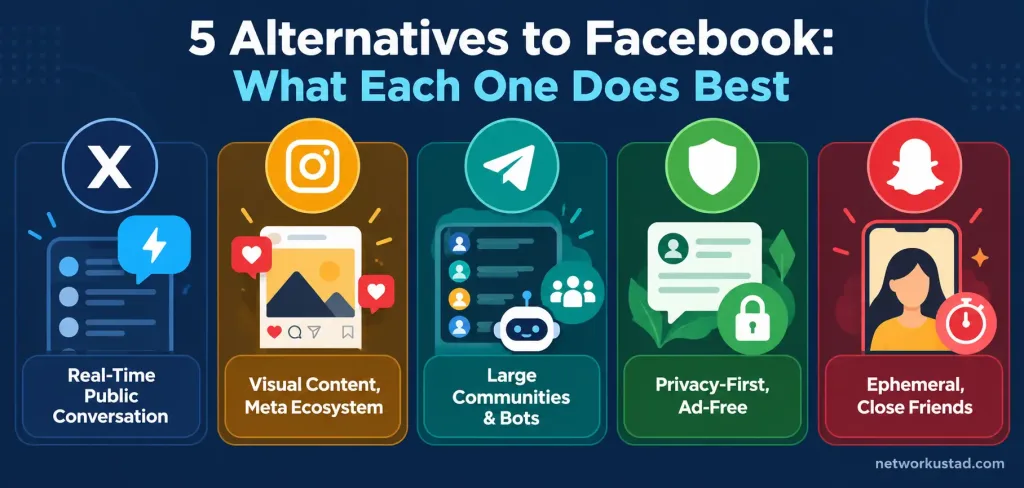
None of these five platforms — the alternatives to Facebook covered above — replace everything it does, and that’s arguably the point — each one is a genuinely different tool suited to a different reason for wanting an alternative in the first place. X for real-time public conversation, Instagram for visual content within Meta’s ecosystem, Telegram for large communities and lightweight messaging, MeWe for privacy-first browsing with a real moderation tradeoff, and Snapchat for ephemeral, close-friends sharing — picking based on which specific Facebook frustration you’re solving for will get you a better fit than picking whichever platform is simply the most talked about.
Frequently Asked Questions
Is Twitter still called Twitter, or is it X now?
It’s X. The platform rebranded from Twitter to X in July 2023 under Elon Musk’s ownership, and is now owned by xAI following its March 2025 acquisition of X Corp. The core real-time, public-conversation function is similar to the old Twitter, but features, ownership, and the business model have all changed substantially since the rebrand.
Does X allow live video streaming?
Yes — live broadcasting has been part of the platform in some form since the Twitter era and continues to be available under X’s current branding, contrary to older claims that it lacked the feature.
Is Telegram actually private and encrypted?
Only partially by default. Telegram’s standard chats are not end-to-end encrypted; only its separate “Secret Chats” feature provides that level of encryption. Anyone choosing Telegram specifically for message privacy needs to actively use Secret Chats rather than assume regular chats carry the same protection.
What makes MeWe different from Facebook?
MeWe’s core difference is its business model: it’s ad-free, doesn’t sell user data for targeted advertising, and markets a stated privacy commitment. The tradeoff worth knowing about is that its lighter content moderation has attracted some communities that more heavily moderated platforms have restricted.
How many people actually use Snapchat compared to Facebook?
Snapchat reported 971 million monthly active users in its most recent quarterly results, which is substantial but still well below Facebook’s more than 3 billion monthly active users. Snapchat’s appeal isn’t scale — it’s the ephemeral, close-friends-focused format that’s genuinely different from Facebook’s public-feed model.