
Deciding whether to adopt an analytics app for your SMB is a question that usually doesn’t feel urgent until the moment it is one — a vendor whose costs quietly crept up over a year, a product line that’s been losing money for two quarters, a competitor who’s been picking off your customers one by one. An analytics app for your SMB doesn’t eliminate those risks, but it makes them visible early enough to actually do something about them, which is the entire point of adopting one in the first place.
Why an Analytics App for Your SMB Matters Right Now
The business intelligence market itself is a reasonable proxy for how seriously companies of every size are taking this: global spending on BI and analytics software was valued at roughly $29.42 billion in 2023 and is projected to reach $54.27 billion by 2030, a 9.1% annual growth rate, according to Fortune Business Insights. That growth isn’t being driven primarily by enterprise software budgets anymore — a meaningful share of it is SMBs and midmarket companies adopting tools that used to be priced and built only for large corporations.
A 2025 Citizens Bank survey of US business owners found a clear pattern among companies that lean on financial data and expert advice regularly: 49% cite better decision-making as the top benefit, and 48% cite increased profitability directly. The same survey found that businesses which prioritize data and financial insight are more likely to expect growth over the next five years than those that don’t, and 53% of them prioritize cash-flow visibility specifically, compared with 38% of other companies surveyed.
None of this proves a data-driven approach single-handedly causes better outcomes — it’s a correlation from self-reported survey data, not a controlled experiment — but it’s a consistent enough pattern across multiple studies to take seriously rather than dismiss as a sales pitch.
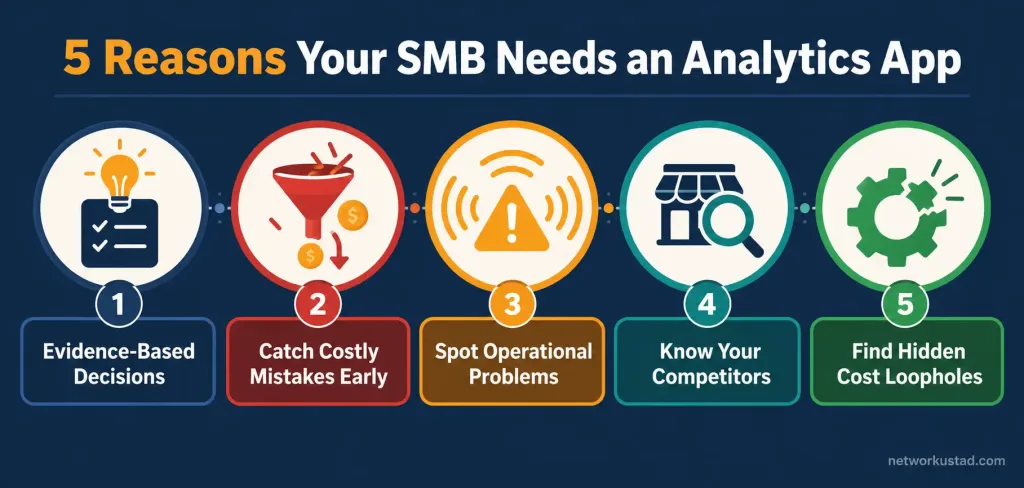
Reason 1: You Make Decisions on Evidence, Not Instinct
Every SMB owner makes decisions on gut feeling some of the time — that’s not a failure, it’s often necessary when data is incomplete or a decision is genuinely urgent. The problem is when gut feeling is the only input available, because it means every choice carries the full weight of one person’s blind spots. An analytics app for your SMB consolidates vendor performance, sales trends, and operational data into a single view, so a decision about which supplier to renew with, or which product line to expand, is informed by what’s actually happened rather than by whichever recent experience is freshest in memory.
This matters most for decisions that are genuinely close calls — where two options look roughly equally good from instinct alone, but one of them has a measurably better track record once the numbers are actually compared side by side.
Reason 2: You Catch Expensive Mistakes Before They Compound
Small inefficiencies rarely announce themselves. A shipping rate that crept up 4% over a year, a subscription tool nobody’s used in three months, a marketing channel whose cost-per-lead has quietly doubled — none of these show up as a single alarming event. They show up as a slow erosion of margin that’s only obvious in hindsight, once it’s already cost real money. An analytics app that tracks spending and performance trends over time surfaces these patterns while they’re still small enough to fix cheaply, rather than after they’ve become a line item worth arguing about in a budget review.
Reason 3: You Spot Operational Problems Before They Disrupt the Business
Beyond cost, analytics tools are useful for flagging operational risk early — a supplier whose delivery times have been slipping for two consecutive months, a customer segment whose support tickets have spiked, a seasonal demand pattern that’s arriving earlier than usual this year. Catching these signals while there’s still time to adjust staffing, inventory, or vendor relationships is meaningfully different from discovering the problem only once it’s already caused a missed deadline or a frustrated customer.
Reason 4: You Understand Where You Actually Stand Against Competitors
Competitive awareness is one of the areas where small businesses are often working with the least information, simply because competitor data isn’t handed to anyone — it has to be deliberately gathered and tracked. An analytics app that incorporates market and competitor data (pricing changes, public reviews, market share estimates where available) gives a business a genuine basis for a SWOT analysis, rather than one built mostly on assumption. Knowing specifically where a competitor is winning — price, speed, product breadth, customer service reputation — is more useful than a general sense that “they’re doing well,” because it points directly at what’s actually worth responding to.
Reason 5: You Find the Operational Loopholes Quietly Raising Your Costs
The least glamorous benefit of analytics is often the most financially significant: finding the small operational gaps that raise costs without anyone noticing day to day. A pattern of overtime that’s become routine rather than exceptional, a return rate on one product category that’s meaningfully higher than the rest of the catalog, a scheduling inefficiency that’s been quietly costing labor hours for months. None of these are dramatic on their own, but added together they’re frequently a larger drain on margin than the more visible costs a business tends to focus on first.
What to Actually Look For in an Analytics App for Your SMB
Rather than chasing a single “best” analytics tool — the right fit genuinely depends on business size, industry, and which of the five reasons above matters most to you — it’s more useful to evaluate any candidate against a specific set of questions:
- Does it actually integrate with the systems you already use? An analytics tool that can’t pull data directly from your accounting software, point-of-sale system, or CRM creates manual data entry work that undermines the entire point of automating insight. Integration quality matters more than feature count.
- Can it be read by the people who’ll actually use it, not just a data specialist? Dashboards built for data analysts rather than business owners or managers tend to go unused. A tool that presents clear, plain-language summaries alongside the detailed data is more likely to get looked at regularly.
- Does it support the specific reason you’re adopting it for? A tool strong on sales forecasting isn’t necessarily strong on competitor tracking or operational-cost analysis. Match the tool’s actual strengths to whichever of the five reasons above is your primary motivation, rather than assuming a general-purpose analytics platform covers all of them equally well.
- What does it actually cost at your scale, including the learning curve? Many analytics platforms price per user or per data source in ways that scale poorly for a small team, and the real cost of adoption includes the time spent learning and maintaining the tool, not just the subscription price.
- Is there a genuine trial period? Running a short trial against your own real data, rather than a demo dataset, is the most reliable way to find out whether a tool’s reporting actually matches how your business operates before committing to a longer contract.
Common Mistakes Businesses Make When Adopting Analytics
A few patterns show up repeatedly in businesses that adopt an analytics tool and then don’t get real value from it. Buying a platform before deciding which specific business question it needs to answer is the most common one — the tool ends up generating reports nobody asked for while the actual decision-relevant question goes untracked. Treating analytics as a one-time setup rather than an ongoing habit is another: a dashboard that’s checked once at launch and then ignored provides essentially no ongoing value, regardless of how good the underlying data is. And assuming more data automatically means better decisions, without first establishing which metrics genuinely matter for the business’s specific goals, tends to produce information overload rather than clarity.
The Bottom Line
An analytics app for your SMB isn’t a guarantee of better outcomes on its own — the research is a correlation, not a controlled experiment, and the tool is only as useful as the questions it’s actually pointed at. But the pattern across the five reasons above is consistent: businesses that can see their vendor costs, operational trends, competitive position, and quiet cost leaks in one place are making decisions with meaningfully more information than those relying on instinct and periodic spreadsheet reviews alone.
For a small or mid-size business weighing whether the investment is worth it, the more useful question isn’t “do we need analytics in general” — it’s which of these five specific problems is actually costing the business the most right now.
When It Makes Sense to Wait Before Adopting an Analytics App for Your SMB
Not every SMB is at the right point to adopt an analytics app immediately, and it’s worth being honest about that rather than treating analytics as something every business needs on day one. A business with fewer than a handful of employees and genuinely simple operations — one product line, one sales channel, a small and stable customer base — may get limited practical benefit from a dedicated analytics app for your SMB beyond what a well-maintained spreadsheet already provides.
The clearer signal that it’s time to adopt one is complexity: multiple vendors or suppliers to compare, several sales channels generating data that’s hard to reconcile by hand, or a team large enough that no single person has visibility into the whole operation anymore.
Waiting until that complexity actually arrives, rather than adopting an analytics app for your SMB preemptively because it seems like the responsible thing to do, avoids a common failure mode: paying for and maintaining a tool that mostly sits unused because the business genuinely didn’t have enough data complexity yet to need it. Revisiting the question every six to twelve months as the business grows is a more reliable approach than deciding once and never reconsidering either direction.
Getting Buy-In From a Team That’s Used to Working on Instinct
Adopting an analytics app for your SMB is as much a change-management question as a technology one, particularly for a team that’s grown comfortable making calls based on experience and instinct. Introducing a new dashboard without first explaining what specific decisions it’s meant to improve tends to produce quiet resistance — team members keep making calls the old way and treat the new tool as an extra reporting chore rather than something that actually helps them.
Framing the rollout around a specific, concrete win (catching the vendor cost creep described above, for example) tends to land better than a general pitch about “becoming more data-driven,” because it gives the team a tangible reason to actually open the dashboard regularly rather than letting it go stale after the first month.
FAQs
Is an analytics app worth it for a very small business, or only for larger companies?
It can be worth it at small scale too, provided it’s matched to a specific need — vendor cost tracking, competitor awareness, or operational efficiency, for example — rather than adopted generally. The BI and analytics market’s continued growth reflects tools increasingly built and priced for smaller businesses, not just enterprise budgets.
What’s the single biggest mistake businesses make when adopting an analytics tool?
Buying a platform before deciding which specific business question it needs to answer. Without that clarity, the tool tends to generate generic reports that don’t get used, while the actual decision that prompted the purchase remains unanswered.
Does using analytics actually prove a business will make better decisions?
Not on its own — the research connecting data-driven practices to better outcomes is correlational, from self-reported surveys, not controlled experiments. It’s a consistent pattern worth taking seriously, but adopting a tool doesn’t automatically produce better judgment; it provides better information to apply judgment to.
How do I know which of the five reasons matters most for my business?
Start with whichever area currently causes the most uncertainty or recent frustration — unexplained cost creep, a competitor gaining ground, or operational surprises, for example — and look specifically for a tool strong in that area rather than a general-purpose platform that claims to do everything equally well.
Should I pick a tool based on price or features first?
Neither alone — start with whether it integrates with the systems you already use and whether it supports your primary reason for adopting it. A cheaper tool that doesn’t connect to your existing accounting or sales data will cost more in manual work than a pricier one that does.