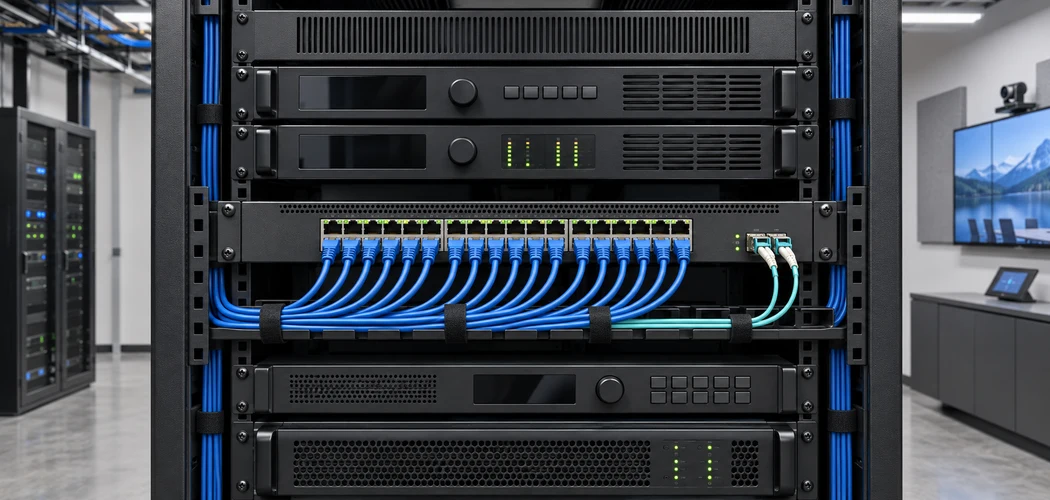
Cabling, Multicast, Bandwidth, and Power on One Switch
Audio Visual-over-Internet (AV-over-IP) Protocol changes where the complexity of an audiovisual installation lives. Rather than requiring that a dedicated point-to-point cable be run from every source to every display, the system sends audio and video as network traffic across standard Ethernet infrastructure. This makes it easier to add endpoints, move sources, and manage equipment remotely.
The network does not make engineering requirements disappear, it simply takes over more of the job. The switch becomes the path through which video, audio, control data, and sometimes endpoint power all have to move, making switch capacity and behavior part of the AV system itself. As a result, switch bandwidth, port configuration, multicast handling, PoE capacity, and management capabilities become fundamental parts of the AV system itself.
AV Over IP Moves the Problem, Not Eliminate It
Traditional AV distribution relies heavily on dedicated hardware and long runs of proprietary cabling, such as direct HDMI, VGA, or HDBaseT. When these legacy systems fail or need to be overhauled, the process typically involves running entirely new cables or replacing core infrastructure altogether.
AV-over-IP changes this architecture by packetizing audio, video, and control signals, transmitting them over standard Ethernet networks and Cat5e or Cat6 cables. The operational benefits include:
- Flexible endpoint placement
- Scalable port counts
- Centralized remote management
Moving signal distribution to standard IT infrastructure does not eliminate complexity; it relocates it. The network is now required to carry continuous, high-bandwidth media traffic that is exceptionally intolerant of packet loss, packet reordering, and excessive jitter. On an IP network, operational issues like dropped frames, lip-sync errors, audio dropouts, and complete blackouts are almost never encoder problems; they are network switch failure points. The network switch effectively becomes the backplane of the matrix.
The power budget, port mix, multicast defaults, and management interface of theAVS-4210-23HP4X PoE Managed AV Switch from Planet Technology make it specifically designed for the evolving needs of the Professional AV industry, allowing for easy redistribution of the day-to-day deployment work.
What the AV Over IP Switch is Actually Built to Carry
Hardware specifications dictate what an AV-over-IP network can sustain. The AVS-4210-23HP4X is a Layer2/4 switch equipped with:
- Sixteen 802.3at PoE+ ports
- Eight 802.3bt PoE++ ports
- Four 10G SFP+ slots
With a throughput rate of 95.23 Mpps at 64-byte frames, data streams are sustained rather than bursty. This ensures that multiple access ports can run near line rate simultaneously without overfilling internal buffers or dropping frames. Silent/fanless mode operation is ideal for recording rooms, houses of worship, and live rooms, where switch noise becomes part of the audio path.
Power is Infrastructure, Not an Accessory
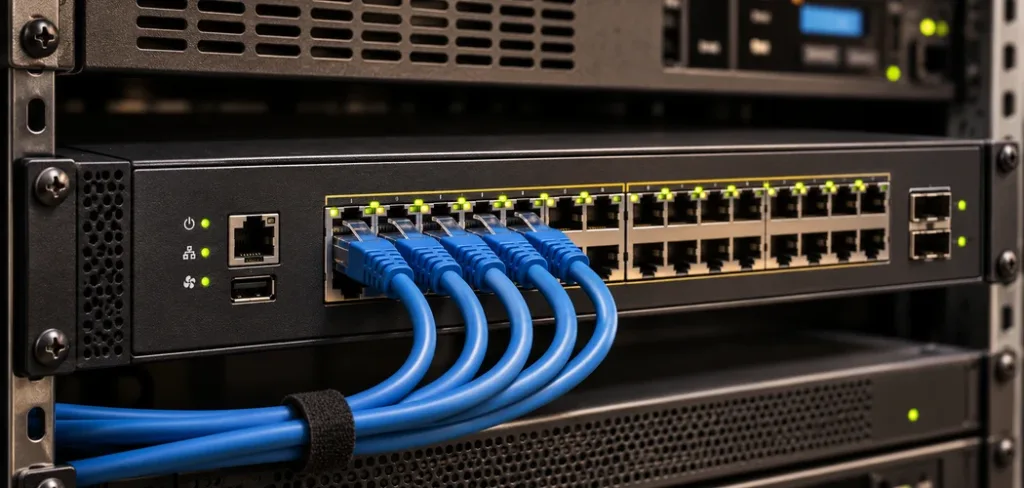
Modern AV networks require consistent network connectivity and operational power delivered over a single cable.
- Pan-Tilt-Zoom (PTZ) cameras
- Networked speakers
- Touch panels
- AV-over-IP encoders and decoders
- Digital signage
Evaluating PoE functionality requires calculating total power budgets rather than relying on max-per-port ratings. With a maximum budget of 450 Watts, the AVS-4210-24HP4X delivers up to 95 Watts per PoE++ port and up to 32 Watts per PoE+ port. Internal switch electronics consume approximately 15.1 Watts.
The main benefits include fewer local power supplies, fewer ceiling and wall outlets, and a single cable pull rather than signal plus power cables. The 450 Watt power pool has to be planned against device draw, however, to prevent port power-limit. Adding midspan injectors restores power, but adds additional devices, failure points, and needed rack space.
Why Multicast Management Matters for AV Over IP
Multicast is another area where switch behavior directly affects an AV installation.
Unmanaged and lightly configured switches flood multicast to every port forcing AV streams to contend with non-AV devices. This can saturate links that were never meant to carry continuous video streams. The AVS-4210-25HP4X enables IGMP (Internet Group Management Protocol) snooping and MLD (Multicast Listener Discovery) snooping by default at power-up, so group membership limits where streams are copied. This configuration removes a time-consuming step, but it does not guarantee correct VLAN or QoS design.
Support for Dante (audio) and NDI (video) shortens the path for those two popular IP media protocols with pre-set profiles that align internal switch timing, packet queuing, and frame prioritization. Third-party codecs, proprietary control systems, and custom media streams still require manual IP addressing, VLAN segmentation, and controller setup. Factory set profiles lessen steps at first boot, but do not eliminate basic network design.
Management Load and Who Has to Do the Work
Another challenge arises when AV teams inherit enterprise switches designed primarily for network engineers. The networking capabilities may be powerful, but everyday tasks can require extensive familiarity with a command-line interface or enterprise networking terminology.
AV teams frequently inherit enterprise managed switches that assume a network engineer. A user-friendly web management interface tailored to common AV parameters lowers that labor dependency for port, PoE, and stream-related adjustments.
This approach reduces labor costs by minimizing Command Line Interface (CLI) setup time during initial deployment and speeding up troubleshooting when adding new endpoints like a PTZ camera or touchpanel to an existing network drop. Automatic port detection and controller integration help with rapid deployment, but they do not replace bandwidth planning or multicast scoping on a shared corporate LAN.
Cost Efficiency of AV Over IP
Evaluating the economics of AV-over-IP requires the examination of core hardware categories rather than product price comparisons. Expansion costs are incremental, but hidden costs remain.
- Endpoint encoder and decoder hardware and software licensing
- High-speed 10G SFP+ optical transceivers and interconnect cables
- Fiber runs between remote telecom closets
Professional installation time may be required if the switch is dropped onto a flat network with no IGMP querier or QoS policies.
What AV Over IP Improves, and What Still Has to Be Designed
Transitioning to an AV-over-IP architecture brings clear operational improvements:
- Streamlined Cabling: Bulky proprietary cables are replaced with standardized Ethernet cables.
- Integrated Power: High-power PoE++ and PoE+ are delivered over data drops, removing external power supplies.
- Out-of-the-Box Multicast Handling: Default IGMP snooping is used to keep video streams from flooding non-AV ports.
- Accessible Management: To simplify daily provisioning, AV-focused configuration screens are featured alongside traditional enterprise tools.
The switch does not remove the need to size streams against 1G access ports and 10G uplinks or to keep the PoE budget inside 450 Watts. Picture quality in AV-over-IP is mostly a property of the path the packet takes, and that path is the switch.
Contact Planet Technology today to learn more about PoE managed AV solutions.