
Linguistics isn’t one subject. It’s five or six smaller ones stacked on top of each other, each handling a different layer of how language actually works. Sound comes first. Then the patterns sound follows. Then word structure. Then sentence structure. Then meaning. Learn them in that order, and each module makes the next one easier to understand.
This guide walks through the core modules of linguistics — phonetics, phonology, morphology, syntax, and semantics with pragmatics — in the order they build on each other, with real examples at each step and the terminology explained plainly rather than assumed. Think of it as a map of the modules of linguistics you’ll actually use, not a list of vocabulary to memorize.
Why the Modules of Linguistics Build on Each Other
Here’s the logic. Phonetics studies the raw physical sounds a language uses. Phonology studies how those sounds function as a system within one specific language — which sound differences actually matter to a speaker, and which don’t. Morphology moves up a level, looking at how sounds combine into meaningful word parts. Syntax moves up again, looking at how words combine into sentences. Semantics and pragmatics sit on top, covering what sentences mean and how that meaning shifts depending on who’s talking to whom.
Skipping a module and jumping straight to syntax, for example, leaves gaps that show up later — you can diagram a sentence without understanding why certain sound combinations are even possible in the first place. Working through the modules in order avoids that.
Module 1: Phonetics — The Physical Sounds of Language
Phonetics is the study of speech sounds themselves, independent of any specific language’s rules. It splits into three angles on the same thing.
Articulatory phonetics looks at how the mouth, tongue, and vocal tract physically produce a sound. A sound gets classified by three features: where in the mouth it’s made (place of articulation — lips, teeth, the ridge behind the teeth, the soft palate, and so on), what the vocal folds are doing (voicing — vibrating for a voiced sound like [b], not vibrating for a voiceless sound like [p]), and how the airflow is shaped (manner of articulation — fully blocked and released for a stop like [t], partially blocked for a fricative like [s], and so on).
Acoustic phonetics looks at the sound wave itself once it leaves the mouth — frequency, duration, and the resonant frequencies called formants that give vowels their distinct character. Software like Praat is widely used in linguistics research and teaching to visualize these properties directly from a recorded sample, turning an abstract sound into a readable spectrogram.
Auditory phonetics looks at how a listener’s ear and brain perceive and process those sound waves, which isn’t a simple one-to-one mapping of acoustic signal to perceived sound — the same acoustic signal can be heard differently depending on the surrounding sounds and the listener’s own language background.
A Note on Nasal Sounds
Nasal sounds happen when the soft palate (the velum) lowers, letting air flow through the nose as well as the mouth. English nasal consonants include [m], [n], and [ŋ] (the sound at the end of “sing”). Vowels can also pick up a lighter nasal quality when they sit next to a nasal consonant — the vowel in “bean,” for instance, is lightly nasalized in casual speech because of the following [n], though English doesn’t treat that nasalization as a separate, meaningful sound the way some languages do.
Module 2: Phonology — How Sounds Function as a System
Phonology takes the raw sounds phonetics catalogs and asks a narrower question: which sound differences actually matter within one particular language’s system?
A phoneme is the smallest sound unit that can change a word’s meaning. In English, swapping [p] for [b] turns “pat” into “bat” — different phonemes, different words. A minimal pair like “pat” and “bat” is exactly this: two words differing by only one sound, used to prove that the two sounds are functioning as separate phonemes in that language.
An allophone is a variant pronunciation of the same phoneme that doesn’t change meaning. The English /p/ sound is pronounced with a small puff of air (aspirated, written [pʰ]) at the start of “pin,” but without that puff (unaspirated, [p]) after an [s] in “spin.” Both are the same phoneme /p/ to an English speaker’s ear, even though they’re physically different sounds — that’s the core distinction phonology is built to explain.
Consonant Classes, Correctly Grouped
Consonants are grouped by manner of articulation. Stops (also called plosives) fully block airflow before releasing it: [p], [b], [t], [d], [k], [g]. Fricatives create a narrow channel that makes a continuous hissing or buzzing sound: [f], [v], [s], [z], [ʃ] (the “sh” sound). Affricates combine a stop and a fricative in one sound, like the “ch” in “church” ([tʃ]) or the “j” in “judge” ([dʒ]). Nasals ([m], [n], [ŋ]) route airflow through the nose. The glottal stop — the brief catch in the throat you make before “uh-oh” — is written [ʔ] in standard phonetic notation.
Click consonants are a separate category worth knowing about by name, even if they don’t appear in English. Several Southern African languages, including Xhosa and Zulu, use clicks as full, meaningful consonants, produced by creating suction with the tongue against different parts of the mouth. This is a different phenomenon from the informal “tsk” sound English speakers sometimes make to express disapproval — that’s a non-linguistic vocal gesture in English, not a phoneme, while in Xhosa and Zulu the equivalent click sound functions as a real consonant inside real words.
Module 3: Morphology — How Words Are Built
Morphology studies morphemes, the smallest units of language that carry meaning on their own. “Unbreakable” contains three: “un-” (meaning “not”), “break” (the core meaning), and “-able” (meaning “capable of”).
Derivational morphemes change a word’s category or core meaning — adding “-ness” to “happy” makes the adjective “happy” into the noun “happiness.” Inflectional morphemes don’t change the word’s category, only grammatical details like tense, number, or possession — adding “-ed” to “walk” keeps it a verb, just shifts it into the past tense.
Morphological analysis matters practically, too. Natural-language-processing tools that handle spell-check, autocomplete, or search need to recognize that “running,” “runs,” and “ran” are all forms of the same underlying word “run” — a task called lemmatization, which depends directly on understanding morphology correctly.
Module 4: Syntax — How Words Build Sentences
Syntax studies how words combine into phrases and sentences according to a language’s rules. English syntax generally follows a Subject-Verb-Object order (“The cat chased the mouse”), while other languages follow different default orders — Japanese, for instance, typically places the verb at the end of the sentence.
Generative grammar, an influential framework in syntax, treats sentence structure as built from nested phrases rather than a flat sequence of words — a noun phrase inside a verb phrase inside a full sentence, each layer following its own internal rules. Syntactic parsing, the process of breaking a sentence down into this phrase structure, is a core task in both linguistic analysis and computational language tools, since a program has to correctly identify a sentence’s structure before it can reliably interpret what the sentence means.
Module 5: Semantics and Pragmatics — Meaning and Context
Semantics studies the literal meaning encoded in words and sentences, independent of who’s saying them or why. Pragmatics studies how actual context, speaker intent, and shared assumptions shift or add to that literal meaning in real use.
The classic illustration is implicature: if someone asks “Are you coming to the party?” and the answer is “I have to work late,” nothing in those words literally means “no” — but any listener sharing the same context understands it as a polite decline. That gap between literal meaning and intended meaning is exactly what pragmatics is built to study, and it’s a large part of why language understanding is harder for a machine than for a person who shares the speaker’s context.
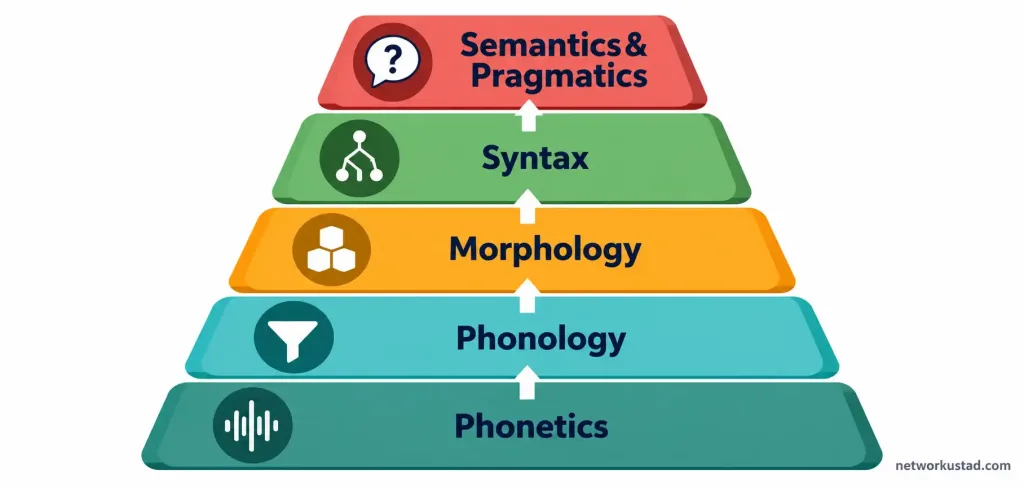
How the Modules of Linguistics Connect in Practice
A single real sentence touches every module at once. The word “unbreakable” needs phonetics and phonology to be pronounced and recognized correctly, morphology to be understood as three meaningful parts rather than one, syntax to be placed correctly as an adjective modifying a noun, and pragmatics to carry the right implied meaning depending on tone and context (“This phone case is unbreakable” said sarcastically means something different from the same words said as a genuine product claim).
This is also why linguistics shows up constantly in applied technology without most users noticing: speech recognition depends on phonetics and phonology, autocomplete and spell-check depend on morphology, grammar-checking tools depend on syntax, and chatbots or virtual assistants depend heavily on pragmatics to interpret what a user actually means rather than only what they literally typed.
Tools Worth Knowing About for Studying the Modules of Linguistics
For phonetics and phonology: Praat, a free, widely used acoustic analysis program, lets you record, visualize, and measure speech sounds directly — useful for actually seeing a spectrogram rather than only reading about formants in the abstract.
For corpus-based study across all modules: The Corpus of Contemporary American English (COCA) is a large, searchable collection of real English text and speech, useful for checking how a word, phrase, or grammatical pattern is actually used across different genres and time periods, rather than relying on intuition alone.
For morphology and syntax specifically: Many introductory linguistics courses use simple parsing exercises and morpheme-segmentation worksheets rather than software, since the skill being built is manual analysis, not tool operation — worth knowing if you’re learning this for a course rather than for NLP work specifically.
Common Mistakes When Learning the Modules of Linguistics
A few patterns trip up new learners repeatedly. Treating phonetics and phonology as the same thing is the most common one — phonetics studies raw sound, phonology studies which sound differences matter in one specific language’s system, and the distinction is the whole point of having two separate modules. Confusing morphemes with syllables is another; a word can have more syllables than morphemes, or more morphemes than syllables, since the two are counting entirely different things. And jumping into syntax trees before understanding basic word classes (noun, verb, adjective) tends to create more confusion than it resolves, since syntax assumes you already know what category a word belongs to before showing how it combines with others.
Frequently Asked Questions
What’s the difference between phonetics and phonology?
Phonetics studies the physical sounds of speech in general, regardless of language. Phonology studies how a specific language organizes those sounds into a meaningful system — which sound differences actually change meaning in that language, and which are just variation.
Do I need to learn the modules of linguistics in order, or can I skip around?
It’s not strictly required, but it makes each later module easier to understand, since morphology assumes you can recognize sounds and sound patterns, syntax assumes you understand word structure, and semantics/pragmatics assumes you understand how sentences are built.
Is linguistics the same as learning a language?
No. Linguistics studies how language works as a system — sounds, structure, and meaning — rather than teaching you to speak a specific language fluently. Someone can be a skilled linguist without being fluent in the language they’re studying, and fluent in several languages without ever having studied linguistics formally.
What’s a morpheme, in plain terms?
The smallest piece of a word that carries its own meaning. “Cats” has two: “cat” and the plural “-s.” Neither piece can be broken down further without losing its meaning.
Why does pragmatics matter for things like chatbots and voice assistants?
Because literal meaning often isn’t the actual intended meaning. A assistant that only parses the literal words in “can you turn the volume down a bit” without the pragmatic understanding that this is a polite request, not a literal question about ability, would respond incorrectly or unhelpfully.
The Bottom Line
The modules of linguistics aren’t separate, unrelated topics — they’re layers that build directly on each other, from the physical sound of speech up through meaning in real context. Phonetics gives you the raw sounds, phonology shows how those sounds function as a system, morphology shows how sounds become meaningful word parts, syntax shows how words become sentences, and semantics with pragmatics shows how sentences become actual communication.
Understanding each module on its own terms, in that order, makes the whole field click into place far faster than jumping straight to the parts that sound most interesting. Once the modules of linguistics stop feeling like separate subjects and start feeling like one connected system, the rest of the field gets noticeably easier to pick up.