Electrical problems rarely announce themselves clearly. A home’s wiring can develop a real issue years before anything visibly fails — no smoke, no dramatic spark, just a slowly worsening situation hiding behind the walls. That’s exactly why electrical maintenance deserves more attention than most homeowners give it: by the time a problem becomes obvious, it’s often already a safety risk rather than a minor inconvenience.
Here are five things worth knowing and checking, split clearly between what’s safe to handle yourself and what genuinely needs a licensed professional.
1. Install Outlet Covers Where Children Are Present
Tamper-resistant outlet covers are one of the simplest, cheapest safety upgrades a home can have, and they matter most in households with young children. Curious kids exploring with small fingers or objects are the primary reason these exist — inserting something into an uncovered outlet can cause a serious shock. Since 2008, the National Electrical Code has actually required tamper-resistant receptacles in new residential construction specifically because of this risk, which gives a sense of how seriously the industry treats it. For older homes without them built in, inexpensive outlet covers or swapping to tamper-resistant receptacles closes that gap easily — and this is a genuinely safe DIY task for any homeowner.
2. Don’t Overload Outlets, Extension Cords, or Power Strips
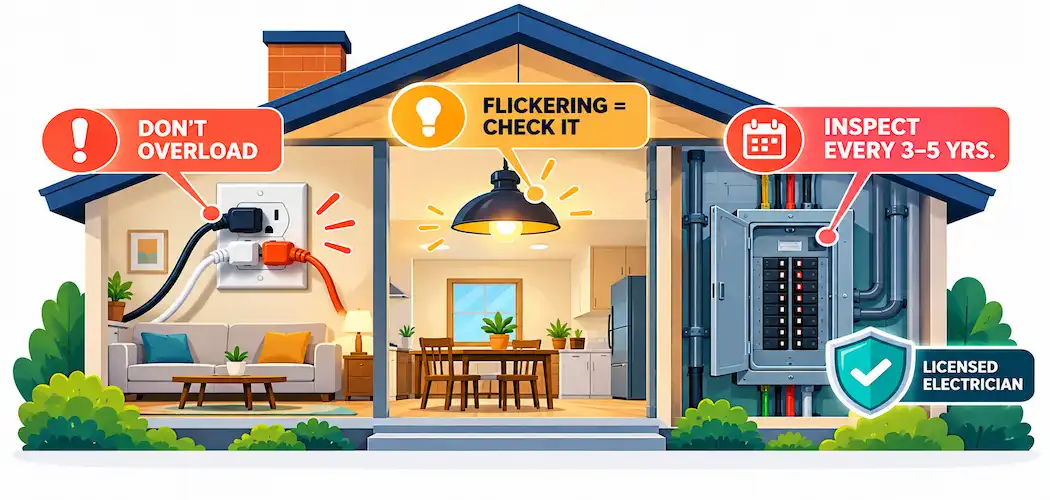
Every extension cord and power strip has an amperage (or wattage) rating printed on it, and that rating exists for a real reason: exceeding it generates heat in the cord itself, which is a genuine fire risk, not just a theoretical one. The practical rule is straightforward — add up the wattage of everything plugged into a single strip or cord, and keep the total comfortably under its rated capacity, leaving margin rather than running right up to the limit.
The other common mistake is daisy-chaining — plugging one power strip into another to create more outlets than a room actually has. This is explicitly discouraged by electricians and fire-safety guidance, because it’s easy to lose track of the cumulative load across chained strips, and because many power strips aren’t designed or rated to safely feed another strip downstream. If a room genuinely needs more outlets than it has, that’s a sign to call an electrician about adding proper wiring — not a reason to chain extension cords.
3. Treat Flickering or Dimming Lights as a Warning Sign, Not an Annoyance
Lights that flicker, dim when an appliance kicks on, or behave inconsistently are often dismissed as a minor quirk. They shouldn’t be. Flickering can point to several underlying issues — a loose connection somewhere in the circuit, a circuit that’s carrying more load than it’s rated for, or in older homes, aging wiring that’s starting to fail. None of these get better on their own, and some of them (loose connections especially) are genuine fire risks if left unaddressed. If lights are flickering consistently rather than during an obvious one-time power fluctuation, it’s worth having an electrician take a look sooner rather than later.
4. Replace Frayed or Damaged Wiring Immediately
Any wire — on an appliance, an extension cord, or exposed house wiring — that shows fraying, cracking, or exposed conductor should be treated as an immediate problem, not something to monitor. Damaged insulation removes the barrier that keeps electricity contained where it’s supposed to be, creating both shock and fire risk. For appliance cords and extension cords, replacement is a simple, safe DIY fix — just stop using the damaged one and get a new one. For anything involving a home’s actual wiring behind walls or in a panel, this is squarely professional territory, and it’s not a place to improvise.
5. Schedule Professional Inspections — and Know the Right Interval
Many licensed electricians recommend a full home electrical inspection roughly every three to five years for homes with wiring in reasonable condition, with more frequent inspections warranted for older homes — particularly anything with wiring from before the 1960s–70s, or homes that have never been inspected since purchase. An inspection checks things a homeowner typically can’t evaluate alone: panel condition, whether the system’s capacity still matches the home’s actual electrical load, grounding, and code compliance for areas like kitchens and bathrooms, which have had evolving GFCI (ground-fault circuit interrupter) requirements for decades specifically because those are higher-risk, moisture-prone areas.
This is also the point worth making plainly: hire a licensed electrician, not an unlicensed handyman, for anything beyond the simple DIY tasks above. A licensed electrician’s work is code-compliant and typically covered by insurance in a way that unlicensed work usually isn’t — which matters enormously if something goes wrong later, whether that’s a fire, an insurance claim, or a future home sale where uninspected or non-code wiring becomes a real liability. The cost difference upfront is rarely worth the risk difference down the line.
What’s Safe to DIY, and What Isn’t
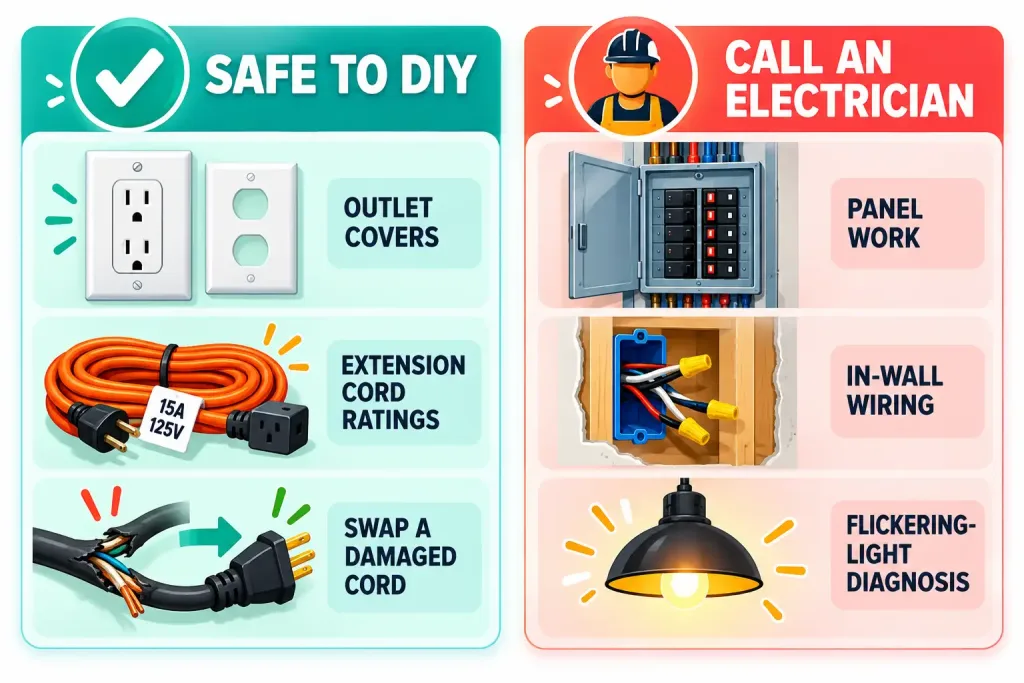
To make the split clear: installing outlet covers, respecting extension cord ratings, avoiding daisy-chained power strips, and replacing a damaged appliance cord are all reasonable for a homeowner to handle directly. Anything involving the electrical panel, wiring behind walls, adding circuits, or diagnosing the cause of flickering lights or recurring breaker trips belongs with a licensed electrician — not because homeowners can’t learn the skills, but because mistakes in this category carry real fire and shock risk, and licensing exists specifically to ensure the work meets a safety standard that’s hard to self-verify.
Frequently Asked Questions
How often should a home’s electrical system actually be inspected?
Roughly every three to five years is a commonly cited guideline from licensed electricians for homes in reasonable condition, with shorter intervals recommended for older homes or any home that hasn’t been inspected since it was purchased.
Is it ever safe to daisy-chain power strips?
No — this is consistently discouraged by electricians and fire-safety sources. It’s easy to exceed safe cumulative load without realizing it, and many power strips aren’t rated to safely feed another strip downstream. If a space needs more outlets, that’s a sign to have proper wiring added, not to chain cords.
What does flickering or dimming lighting usually mean?
It can indicate a loose connection, an overloaded circuit, or aging wiring, especially in older homes. It’s not something that resolves on its own, and consistent flickering (as opposed to a one-time fluctuation) is worth having checked by an electrician.
Why does it matter whether an electrician is licensed?
Licensed electricians’ work is code-compliant and typically backed by insurance, which protects a homeowner if something goes wrong later — during a fire, an insurance claim, or a future home sale. Unlicensed work can end up costing far more than it saved if a problem surfaces down the line.