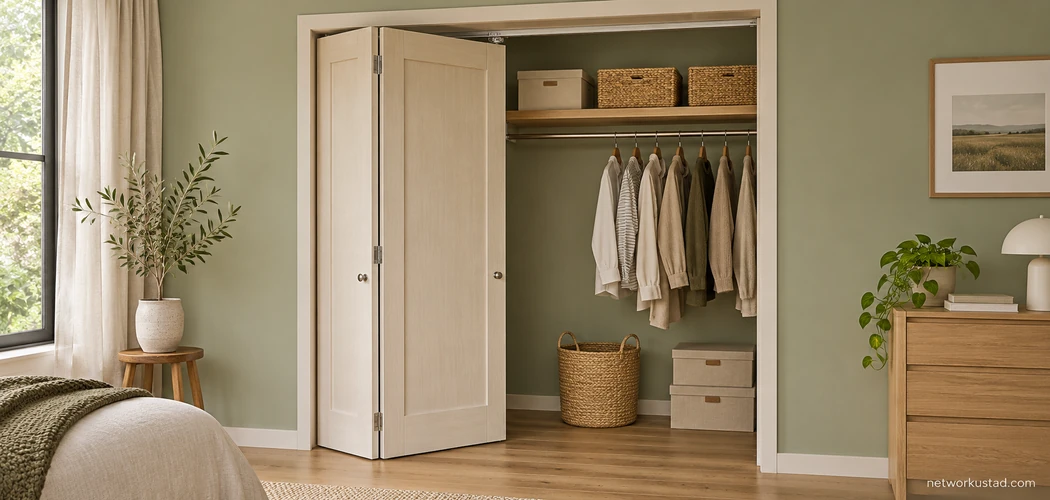
When you compare internal bifold door tracks, start with the fittings you can see. A bifold door can have a rail at the top even when the weight rests on rollers at the bottom. A small bracket near the floor can look like part of a bottom track even when the door is designed to hang from above. Those details are easy to confuse when you’re looking at a closed closet door or shopping from a photograph.
Start by identifying the hardware that carries the panels. Then work out which pieces guide the movement and which ones keep the panels aligned at the jamb. That distinction helps you compare new kits and avoid ordering a part that looks right but won’t fit the door you already have.
How Internal Bifold Door Tracks Carry and Guide the Panels
A bifold door usually has two or more panels linked by hinges. As the door opens, the panels fold together and move toward one side of the opening. The hinges let the panels fold. The track and associated hardware control how they travel. What you see from the room is often only the track cover or a narrow slot.
The rail with the load-bearing carrier supports the moving panels according to the design of that hardware system. A guide keeps the panels following their intended path. Pivots locate an end panel and let it turn as the door opens. A pivot may also support load in some designs, so check the manufacturer’s drawings before drawing conclusions from its position.
| Hardware arrangement | What to look for | What to verify |
|---|---|---|
| Top-hung system | A carrier that connects the moving panel to an overhead rail | How the top rail attaches and which lower guides or pivots the kit uses |
| Bottom-rolling system | A lower carrier that runs in a floor rail or threshold | How the lower rail is supported and how the upper guide fits |
| Pivot-and-guide closet hardware | A jamb-side pivot and a guide that travels in the top track | Which parts bear load, whether the hardware is adjustable, and which parts match your kit |
When shopping for internal bifold door tracks, a closed-door photo can hide the most important parts. You may find that two doors look the same from the hallway but use different hardware. Compare the drawings for the actual kit. If the manufacturer specifies a lower guide or pivot, keep it in the plan even if your preference is for a clear floor.
Top-Hung Internal Bifold Door Tracks
In a top-hung system, an upper rail and its carriers support the moving panels from above. The exact arrangement varies. The Johnson Hardware 1700 series, for example, is described as top-hung and includes an adjustable bottom pivot bracket. The presence of that bracket doesn’t make the system bottom-rolling.
An advantage of some top-hung designs is that they don’t use a continuous track across the floor. That can suit a closet opening or a room where you want the same flooring to run through both spaces. Check whether the kit still needs a small bracket or guide at the bottom. If you’re changing the flooring, include its finished height when you check the required clearance.
Pay particular attention to where the rail fastens. A straight piece of trim can conceal an uneven or unsuitable fixing surface. Use the manufacturer’s instructions to check what the track must attach to, which fixing locations are required, and what panel sizes the hardware supports. If you can’t identify the fixing surface or the project involves altering the opening, have it assessed before ordering the doors.
A top-hung track also needs room for the fittings above the panels. In a tight opening, the listed panel height alone won’t tell you whether the assembly fits. Check the fitting diagram for the space required above and below the panel and compare it with the finished opening.
Bottom-Rolling Internal Bifold Door Tracks
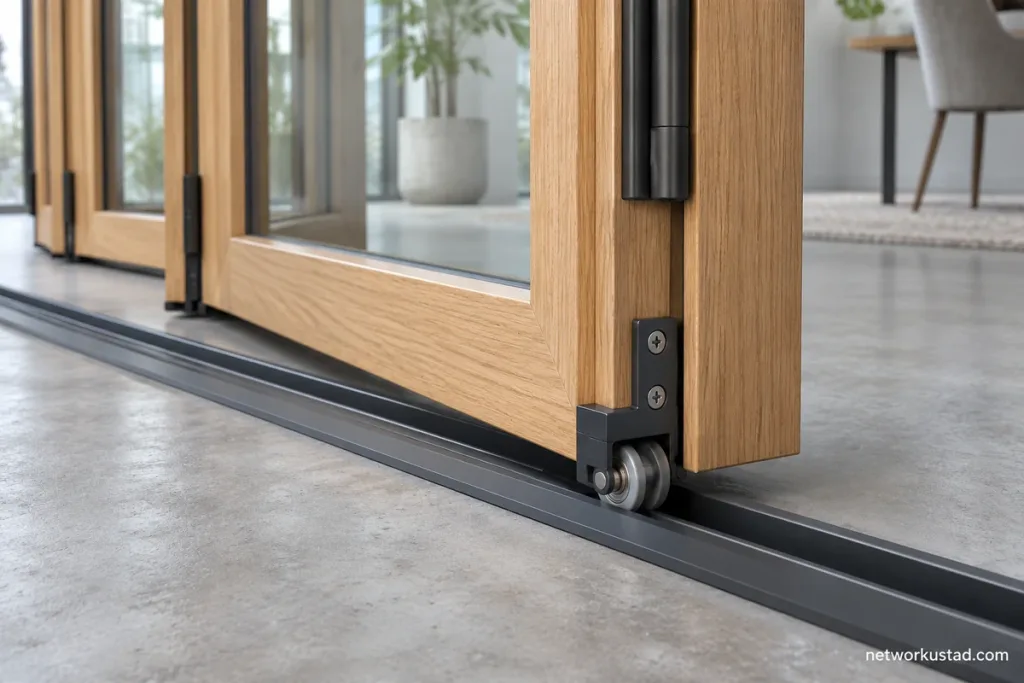
A bottom-rolling system uses a lower track and rollers to carry the moving panels. The upper guide helps keep the panels in alignment. The Centor F3 bottom-rolling hardware guide shows how a lower carrier and upper guide fit into one example of this arrangement. Use the drawings for the system you’re buying when checking your own opening.
For bottom-rolling internal bifold door tracks, the threshold drawing is as important as the panel dimensions. A floor track changes the details you need to measure. Think about the track’s position relative to carpet, tile, or timber flooring on either side. Check how much of it projects above the finished floor and whether it is compatible with the transitions you already have. That matters particularly where people pass through frequently or need a clear route between rooms.
Some systems place the lower channel into the threshold or floor detail. Others sit above the surface. The track profile in a product photograph doesn’t tell you which finished-floor details it needs. Ask for a drawing of the complete assembly and check whether the planned floor build-up leaves the hardware serviceable.
A bottom-rolling system still needs the upper guide fitted as specified. It also needs a suitable base for the lower track. If the floor is uneven, work out where the finished surface will sit before choosing the kit. Replacing a roller won’t fix a track that’s moving with a loose threshold.
How to Identify the Hardware You Already Have
Open the door only as far as it moves normally. Look along the top edge and near the bottom corner on the jamb side. The aim is to identify the moving parts and their position without taking the door apart. If a panel feels unstable or a carrier looks damaged, stop operating it and have someone familiar with the system inspect it.
Photograph the full opening with the door partly folded. Then take separate close-ups of the rail profile, pivots, guides, hinges, and any label you can read. Include a ruler beside a part if you can do so without putting your hands in the path of the panels. A clear photo of the edge of a rail often helps a supplier more than a photo of the front of a closed door.
Some internal bifold door tracks have an identifying mark near one end. Look for a name or part number on the fittings or the original paperwork. Model names sometimes cover several versions, so give the supplier the number on the part if you have it. When comparing replacements, check more than the wheel diameter. The shape of the wheel, its position on the bracket, the fixing holes, and the rail profile can all matter.
Also note when the problem occurs. A door that drags throughout its travel presents a different problem from one that catches only at the last few centimetres of closing. Mark where you see rubbing or hear the noise. If the top of the panel rubs on the frame, record which end does it and whether the gap changes as the door opens. These details help narrow down what needs inspection.
What to Measure Before Ordering Internal Bifold Door Tracks
Finished opening. Measure the width at the top, middle, and bottom. Measure the height at several points too. Write down the range. A single measurement can hide a taper that matters when two panels have to fold and close against a jamb. Use the kit’s measuring instructions to decide which measurement to order against.
Each panel. Record the width, height, thickness, material, and weight of each panel you intend to use. Use the door manufacturer’s weight data if available. Check whether the hardware rating applies per panel or to the whole set, and ask how to account for glazing, handles, or other fittings. A track of the right length can still be unsuitable for the panels.
Panel arrangement. Draw the doorway and show which way the panels fold. Label the side with the pivots, the side where the panels stack, and any panel that needs to open independently. Confirm how the kit defines left and right. The supplier may describe handing from a different side of the opening than you do.
Clearances. Check the space above and below the panels and the gap on the closing side. Also think about the space the folded stack will occupy. A door might clear the opening and still hit a shelf, skirting board, or light switch when it folds. Mark the likely stack position on the floor plan before you commit.
Fixing surfaces. Record what you know about the top of the opening, the jamb, and the floor. Match that information to the manufacturer’s mounting requirements. If the track is part of a larger remodel, include flooring, trim, and fitting work in your renovation budget. The hardware kit is only one line item.
A Simple Example for an Existing Closet
Suppose you’re keeping two painted timber panels but replacing the hardware. You measure the opening at three points and find the top is slightly narrower than the bottom. A kit listed for the nominal doorway width might still fit, but only if the manufacturer’s panel and clearance requirements match your measurements. Record the narrowest point, each panel’s thickness, and the position of the old fixing holes before speaking to the supplier.
Next, check whether the replacement includes the jamb pivot, moving guide, and mounting brackets. A listing described as a track can mean the rail alone. If your existing hardware has no readable model number and the seller cannot confirm that the new rail matches the old carriers, ask for a complete compatible set. Compare its installation requirements with your opening before paying for it.
When to Replace a Part and When to Replace the Set
A single replacement makes sense when you can identify the system and confirm that the rest of the hardware is serviceable. A missing guide or damaged pivot bracket may have an exact replacement. Compare its part number with the installation drawing and check whether there are different versions for the panel thickness or handing.
Consider a matched set when the rail is damaged, several parts are worn, or the old system is impossible to identify. Price the complete set before buying a series of parts that may still leave you with an unreliable fit. Ask whether it includes the pieces you expect, such as carriers, hinges, stops, pivots, and brackets. Handles and latches may be separate.
If the doors were recently painted or the floor covering was replaced, check whether the problem began at the same time. The edge may be rubbing against a new finish, or the available clearance may have changed. Make any adjustment only as the manufacturer directs. Avoid forcing a stiff panel or removing a carrier from a heavy door while it is still in place.
Questions to Ask Before Buying Internal Bifold Door Tracks
- What carries the panel weight? Ask for a diagram showing the load-bearing fittings and the guides.
- What panel sizes and weights does this kit accept? Confirm limits for each panel and any limits for the full set.
- What needs to be fixed to the floor or jamb? Check for brackets or guides even if there is no continuous floor rail.
- What is included? Compare the full parts list against the parts you need.
- Can I get replacement fittings later? Ask for model numbers and find out whether common wear parts are sold separately.
- Can the rail be shortened? Follow the kit’s instructions. Cutting a track may affect mounting positions or the space required for stops.
Take photos and your measurements to the supplier. Ask them to confirm compatibility in writing if you’re keeping existing panels or mixing old and new parts. The answer should identify the kit or replacement part. A general assurance that it fits most doors leaves the important details unresolved.
Frequently Asked Questions
Do All Internal Bifold Door Tracks Need a Bottom Rail?
No. Some top-hung designs use a small bottom pivot or guide instead of a continuous rail. Some pivot-and-guide closet systems also have visible hardware at the bottom. Check the diagram for the particular kit before deciding what the floor will need.
Can I use an old track with a new roller?
Only when the roller and track are confirmed to be compatible. Compare the manufacturer’s part numbers or ask the supplier to check the profile and measurements. A roller that slides into the track may still sit incorrectly or bind when the panels fold.
Is top-hung better than bottom-rolling?
Either can work when it suits the opening and the panels. Think about the fixing surfaces, floor transition, panel dimensions, and how you use the doorway. Start with the layout you need, then compare systems that can actually be fitted there.
Should I measure before or after the new flooring goes in?
Work from the intended finished-floor height. If flooring is still pending, confirm the build-up with the installer and include it in the measurements you send to the hardware supplier. Recheck the actual opening before fitting the panels.
When comparing internal bifold door tracks, ask the supplier for the fitting diagram before ordering. The simplest way to choose a system is to take the door, the opening, and the hardware together. Identify what carries the panels, measure the finished space, and use those details to choose a matched kit. If you’re replacing one part, get the part number first. It can save you from changing a track that didn’t need replacing.