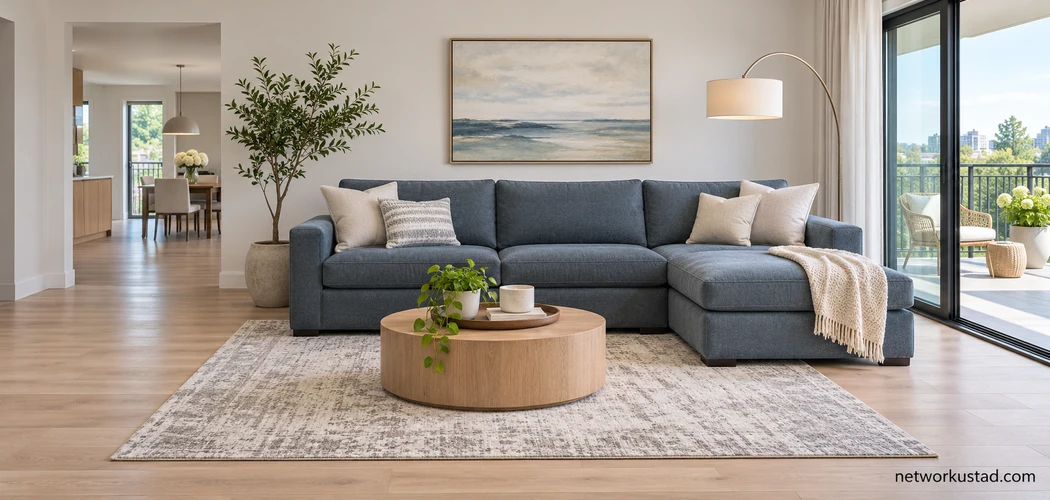
A sectional can bring seats together around a coffee table, fill a corner, or divide an open room into separate areas. It can also leave you squeezing past the chaise every time you open the balcony door. To choose a sectional sofa that works in your room, start by measuring the space you can use after accounting for the routes people need to walk. Then measure how the furniture will get there.
Keep two sets of measurements. One describes the assembled sofa and where you intend to place it. The other describes the largest piece the delivery team must carry through your building. A model can fit the first set and fail the second. Getting both right will narrow the field before you spend time comparing fabrics or prices.
Choose a Sectional Sofa Layout That Fits How You Sit
Count how many people use the room on a typical evening and where they prefer to sit. If two people stretch out to watch a film, a chaise might get more use than an extra upright seat. If you often host guests, a corner layout can bring people around a table. Think about the seats near the inside corner. Their usefulness depends on where people put their legs and whether they can get in and out easily.
| Layout | Where it can work | What to check |
|---|---|---|
| Sofa with a chaise | A room with space to extend one end of the sofa | The full chaise projection and the route around its foot |
| L-shaped sectional | A corner or an open room that needs a defined seating zone | The length and depth of both runs and access to the corner seat |
| U-shaped sectional | A room with enough open floor for two returns and a central area | How people enter the seating area and reach the table |
| Modular sectional | A room where the arrangement may change | Which modules are compatible, how they connect, and what configurations the seller supports |
| Straight sofa with a movable ottoman | A room where the extension needs to move out of the way | Where the ottoman can go when you need the floor clear |
Modular describes how the pieces go together. A modular sofa can form an L or a U, and some configurations can be rearranged. Ask whether the arms can switch sides and whether any pieces need dedicated connectors or finished sides. An armless seat can work in the middle of a run without being suitable as a finished end. Check the diagrams for the exact parts in your order.
If the seating group competes with a doorway, try drawing the room with a straight sofa and a separate chair as well. This gives you a useful reference when you choose a sectional sofa. Compare how many usable seats each arrangement offers, how much space it leaves for a table, and whether someone can get to a window or cabinet without asking another person to move.
Measure the Room Before You Choose a Sectional Sofa
Draw the walls and mark doors, windows, heaters, outlets, and anything else that affects placement. Measure between the actual obstructions rather than relying on the room’s overall width. A wall may look long enough until you account for a door swing, a radiator, or the depth of curtains. If you need access to a window or a cabinet, include that space in the drawing.
Use the seller’s dimension diagram to mark the sofa on the floor with removable tape suitable for your flooring. Mark the full width, the body depth, and the length of the chaise or return. Add the coffee table or ottoman footprint. For a reclining sectional, mark the space needed with the footrest extended and any clearance specified behind the sofa. A single rectangle can hide the part most likely to block the route.
Take a walk around the outline as if the sofa were already there. Open the doors you use most. Bring a basket through the room, pull out a dining chair nearby, or walk from the entry to the window. If two people often pass in opposite directions, try that too. Leave room for the people and equipment your household actually uses. A clearance that feels fine in a sketch can feel tight when someone is carrying a bag or needs a mobility aid.
For example, say a living room has 132 inches between the wall where you plan to place the sofa and the opposite side of the route. A chaise projecting 66 inches leaves 66 inches before accounting for anything opposite it. A 24-inch-deep cabinet across from the chaise brings that gap down to 42 inches. The coffee table, a door swing, or a corner you turn around can narrow a different part of the route. Measure each pinch point individually.
If you plan to change other parts of the room, compare what you can achieve by rearranging furniture before placing a custom order. You may be able to keep the pieces that already work and spend on the seat that solves the real problem.
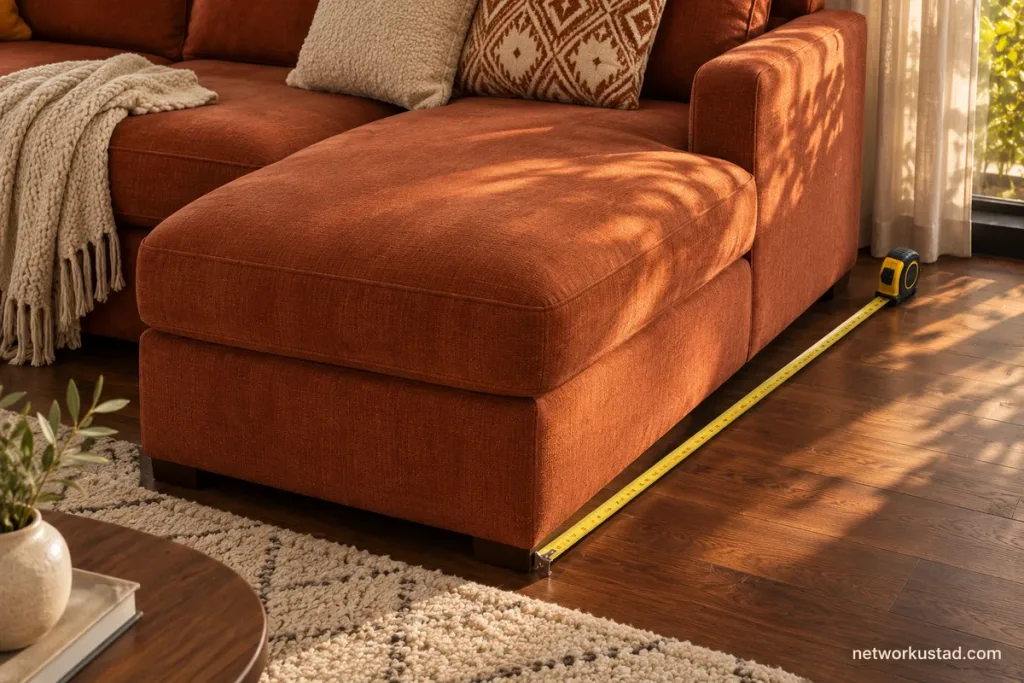
Check Chaise Orientation on the Actual Order
Retailers use labels such as left-facing and right-facing, but the wording can be easy to misread if you picture the sofa from a different position. Some diagrams show the view as you face the furniture. A product photo may show only one version of a model sold in several configurations. Use the retailer’s diagram for the selected version and confirm what its orientation labels mean.
Stand where you would face the sofa in your own room. Point to the side where you want the chaise to project. Mark that side on your drawing and compare it with the order diagram. If you are placing the order over the phone or arranging a custom build, describe where the chaise should sit in relation to a fixed feature, such as the balcony door or window, and ask for the corresponding diagram in writing.
A reversible chaise is useful if you might move the sofa. Ask what changes sides and what parts need to be removed or moved. With some designs, the chaise base is an ottoman and the cushion swaps direction. Other configurations require different arm or corner modules. Confirm what is included in the price and how you would set it up in both positions before counting on that flexibility.
Check the Delivery Route Before You Choose a Sectional Sofa
When you choose a sectional sofa, ask for the dimensions of the largest individual module and the dimensions of its packaging. Ask whether the delivery team can remove packaging or legs before bringing it inside, and whether the instructions permit that. An assembled width alone gives you little help with a narrow doorway or a tight stair landing.
Walk the route from the unloading point to the room. Measure the usable opening of gates, doors, and elevators. Take note of handles, railings, overhead lights, and tight turns. An opening may be wide enough for the module while the landing on the far side gives the team too little space to turn. If the route is close, send photos and measurements to the retailer or delivery company before booking. Ask whether they offer a fit check.
Check access rules for apartments and shared buildings. You may need to reserve an elevator or arrange a delivery slot. Ask whether the service covers carrying the pieces to the room, assembling them, connecting the modules, and taking away the packaging. Find out what happens if the furniture cannot be brought inside. Compare those terms before ordering, especially when the sectional is made to order.
Choose a Sectional Sofa You Can Live With
If you can sit on the model, try more than one position. Check how easily you can sit down and stand up. Notice whether the seat depth lets you rest your back comfortably and whether your feet can reach the floor. Try the inside corner and the chaise separately. A floor model may have softened with use, so ask whether it has the same cushion construction as the version you plan to order.
Ask what the seller can tell you about the frame, cushions, and module connectors. Check whether cushions can be turned, whether covers are removable, and whether the manufacturer allows washing or recommends a different cleaning method. A removable cover still needs to be cleaned according to its instructions. If you live with pets or children, ask for a fabric sample you can handle and view in the room’s usual light.
When you choose a sectional sofa online, check the warranty and return terms together. A frame warranty may have different coverage from the upholstery or cushions. Look for exclusions, who arranges collection, and any fees that apply to a return. Read the terms for your specific order if you select a custom fabric or a nonstandard configuration. Consider delivery and assembly charges as part of the purchase price.
Write down the total for each layout you are considering. Include every module you need, delivery, assembly, and any optional covers or accessories you intend to buy. A less expensive layout may serve you well if it has the right number of seats and fits the room. Spend extra only when you can identify what it buys, such as a useful module, a preferred fabric, or better service terms.
Test the Layout Before You Choose a Sectional Sofa
Leave the taped outline in place for an evening. Sit in the seats you already have and imagine using the new layout with the things you usually keep nearby. See whether the chaise would cover an outlet you use, whether a lamp would still light the page where you read, and whether you could open a drawer or cupboard without shifting a table. If you share the room, ask another person to walk through while you are seated. People often take different routes through the same space.
If the full layout feels tight, make one change at a time. Shorten the return, move the coffee table, or try a movable ottoman in place of a fixed chaise. Take a photo or sketch of each arrangement and note what improved. This gives you a way to compare the layouts later when the retailer’s photos make every configuration look equally spacious.
Frequently Asked Questions
Can I choose a sectional sofa for a small living room?
Yes, if the shape makes better use of the room than the alternatives. A compact L-shaped layout may work in a corner where a separate chair would block the route. In another room, the chaise may project into the only walkway. Tape both arrangements onto the floor and test them with the table and door swings marked.
Is a larger sectional always better for guests?
Count the seats guests can use comfortably. A wide chaise might be excellent for everyday lounging and awkward for two people who want separate seats. Try a drawing with an extra movable chair. It can add a place to sit when you need one and give the room more open space the rest of the time.
Should the sectional touch the wall?
That depends on the room and the product. Against a wall, the sectional may leave more floor space in a narrow room. Away from the wall, it can define a seating area in an open plan. Check the manufacturer’s clearance if the unit reclines. Also account for any curtain, heater, outlet, or cable you need to access.
What should I confirm just before ordering?
Compare your room drawing with the seller’s diagram for the exact configuration in your cart. Confirm the chaise side, module dimensions, delivery access, fabric, and return terms. Save that diagram with the order confirmation so you can refer to it on delivery day. If a measurement is still uncertain, resolve it before paying for a configuration you cannot easily return.