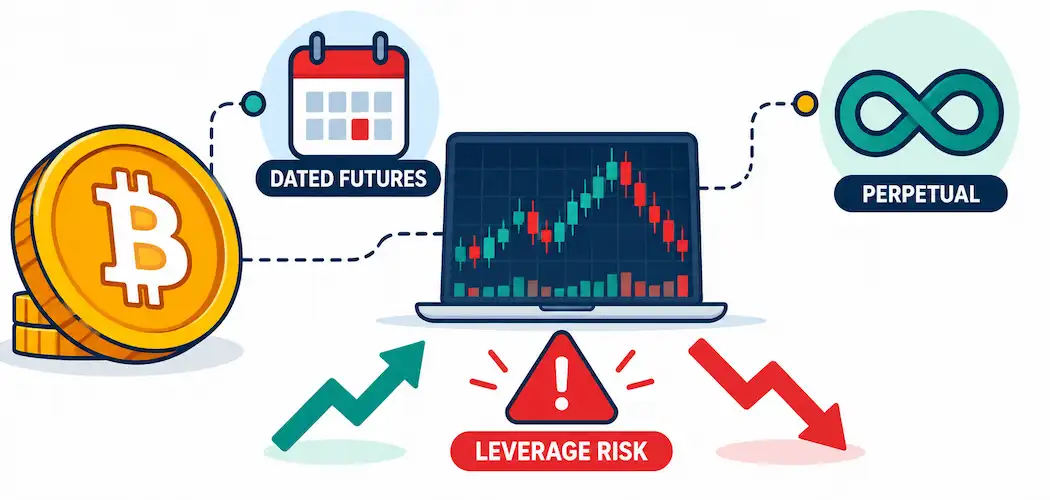
Bitcoin futures let someone take a position on bitcoin’s future price without ever holding the coin itself — no wallet, no exchange account holding actual BTC, no private keys to secure. That’s the whole appeal for a lot of traders and institutions, but it comes with a specific set of mechanics and risks that are easy to gloss over if you’ve only ever bought and held crypto directly. Here’s an accurate look at how these contracts actually work, the two very different types you’ll encounter, and what makes them considerably riskier than simply owning bitcoin.
What a Futures Contract Actually Is
A futures contract is an agreement between two parties to buy or sell an asset at a predetermined price on a specific future date (or, in crypto’s case, sometimes with no fixed date at all — more on that below). Futures markets have existed for over a century in commodities like oil, wheat, and gold, where producers and buyers use them to lock in prices ahead of time. Applying that same structure to bitcoin — an asset with no physical delivery and a lot more volatility than wheat — required some adaptation, which is why bitcoin futures come in two meaningfully different forms.
Type 1: Regulated, Dated Futures (CME-Style)
The CME Group — a major, regulated U.S. derivatives exchange — lists standardized Bitcoin futures contracts that work like this:
- Cash-settled, not physical delivery. Nobody exchanges actual bitcoin when the contract expires. Settlement happens in U.S. dollars, based on the CME CF Bitcoin Reference Rate, a once-daily price benchmark calculated from trades across major spot exchanges during a one-hour window.
- Fixed contract size. One standard contract represents five bitcoin (a smaller “Micro” contract representing one-tenth of a bitcoin also exists for traders wanting smaller exposure).
- Set expiration dates. Contracts expire on the last Friday of the month, with several months listed at any given time so traders can choose their time horizon.
- Regulatory oversight. As a CME product, these contracts operate under U.S. Commodity Futures Trading Commission oversight, with standardized rules and a clearinghouse that guarantees settlement — which meaningfully reduces counterparty risk compared to an unregulated venue.
This version of bitcoin futures is mostly used by institutions, hedge funds, and more sophisticated individual traders — it’s the version regulators and TradFi (traditional finance) desks engage with most directly.
Type 2: Crypto-Native Perpetual Futures (“Perps”)
This is the version most retail crypto traders actually encounter, offered by exchanges like Binance, Bybit, and others. Perpetual futures work differently from the CME model in one crucial way: they never expire. There’s no monthly settlement date — you can hold a position open indefinitely, as long as you maintain enough margin.
Since there’s no expiration date to naturally pull the contract’s price back in line with bitcoin’s actual spot price, perpetual futures use a mechanism called the funding rate: a periodic payment exchanged directly between traders holding long positions (betting the price rises) and short positions (betting it falls). When the perpetual contract trades above the real spot price, longs pay shorts; when it trades below, shorts pay longs. This creates a constant financial incentive pulling the two prices back toward each other.
Leverage: Where the Real Risk Lives
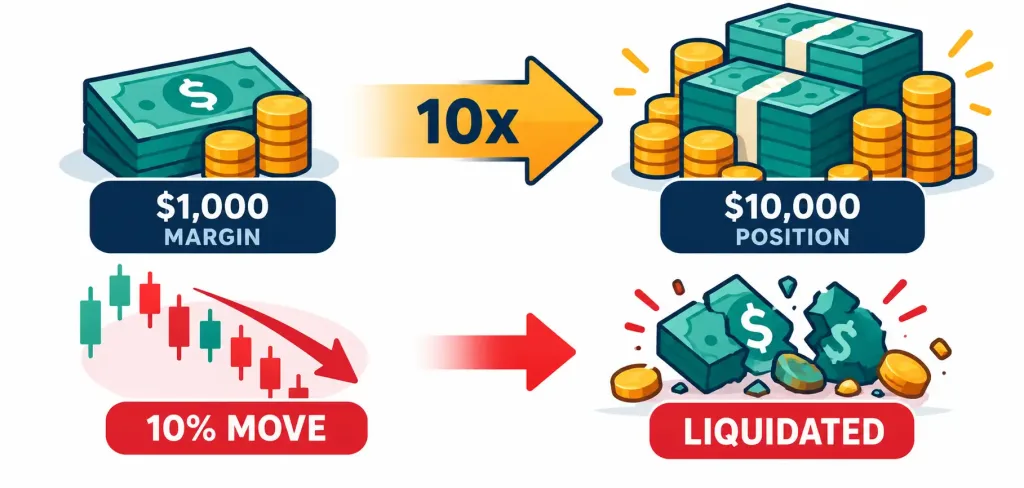
Both types of bitcoin futures typically allow leverage — borrowing to control a larger position than your actual capital would otherwise allow. A simple example: with 10x leverage, $1,000 of your own money (your margin) can control a $10,000 position.
Leverage is a double-edged sword in the most literal sense. It magnifies gains, but it magnifies losses by exactly the same factor. A 10% adverse price move against a 10x leveraged position doesn’t cost you 10% of your capital — it costs you all of it.
This is where liquidation comes in. If the market moves against your position and your margin balance drops below the exchange’s required maintenance level, the exchange automatically closes your position to prevent further losses — and you lose the margin you put up. In a market as volatile as bitcoin, where double-digit percentage swings within a single day aren’t unusual, highly leveraged perpetual futures positions get liquidated regularly, and retail traders using high leverage are disproportionately the ones it happens to.
Who Actually Uses Bitcoin Futures, and Why
- Hedgers — businesses or institutions with real bitcoin exposure (a mining company, an exchange, a corporate treasury holding BTC) use futures to lock in a future price and protect against adverse moves, the same way a wheat farmer might hedge against a bad harvest price.
- Speculators — traders betting on price direction without necessarily holding the underlying asset, using futures (often leveraged) purely to profit from anticipated price moves.
- Institutions and regulated funds — CME’s regulated contracts in particular give institutions a compliant way to gain bitcoin exposure, or short it, without custody complications or exchange counterparty risk.
- Arbitrageurs — traders exploiting price differences between the futures price and the spot price, or between different exchanges, which — as a side effect — helps keep prices aligned across markets.
The Honest Risk Picture
Futures trading, and crypto perpetual futures especially, carries meaningfully more risk than simply buying and holding bitcoin:
- Leverage risk is the big one. It’s entirely possible to lose your full margin deposit, and losing more than you intended is a real and common outcome for leveraged positions in a volatile asset.
- Funding costs add up. If you’re on the paying side of the funding rate for an extended period, that cost erodes returns even if your price prediction is eventually right.
- Liquidation can happen fast. Bitcoin’s volatility means a liquidation cascade — one that wipes out a position within minutes — is a realistic scenario, not a rare edge case.
- Unregulated venues carry counterparty risk. Offshore perpetual futures exchanges don’t all offer the same protections as a regulated venue like CME; it’s worth knowing what regulatory oversight (if any) applies to wherever you’re trading before putting money at risk.
The Bottom Line
Bitcoin futures give traders and institutions a way to gain price exposure, hedge existing holdings, or speculate on bitcoin’s direction without touching the underlying asset — but “without touching the underlying asset” doesn’t mean “lower risk.” Leverage, in particular, turns bitcoin’s already-significant volatility into something that can erase an account balance quickly. Anyone considering futures, and especially perpetual futures with leverage, should treat position sizing and stop-loss discipline as non-negotiable rather than optional.
Frequently Asked Questions
What’s the difference between regular bitcoin futures and perpetual futures?
Standard futures (like CME’s contracts) have a fixed expiration date and settle in cash based on a reference price. Perpetual futures, used on crypto-native exchanges, never expire and instead use a periodic “funding rate” payment between long and short traders to keep the contract price aligned with the real spot price.
Can you lose more than you invest in bitcoin futures?
With leverage, yes — it’s possible to lose your entire margin deposit, and depending on the exchange and leverage level used, losses beyond your initial margin are a real risk in fast-moving markets.
Are bitcoin futures regulated?
It depends entirely on the venue. CME’s Bitcoin futures are regulated by the U.S. Commodity Futures Trading Commission. Many crypto-native perpetual futures exchanges operate with less regulatory oversight, which is an important distinction to understand before trading on one.
Do you need to own bitcoin to trade bitcoin futures?
No — that’s the core feature of futures contracts. You’re trading a contract based on bitcoin’s price, not the asset itself, and most bitcoin futures (including CME’s) settle in cash rather than actual bitcoin.