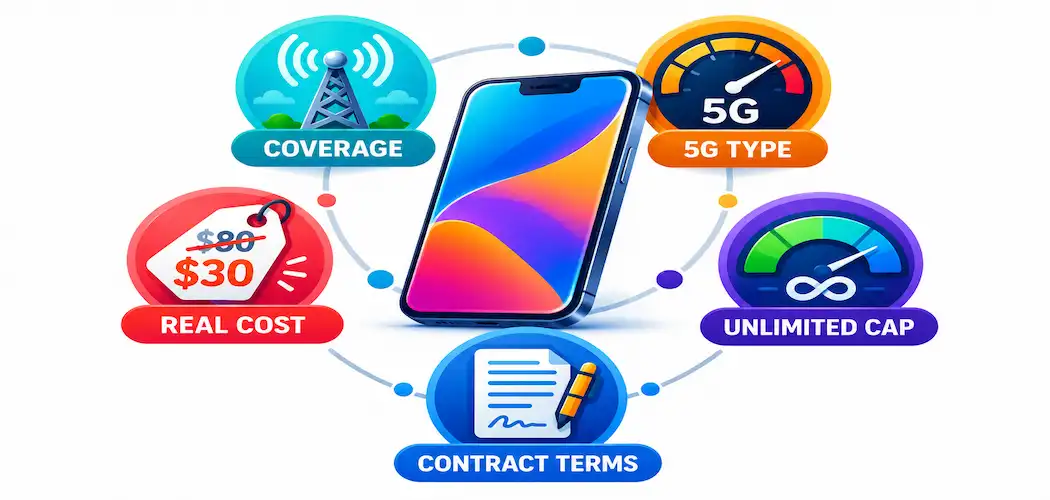
Shopping for a phone plan usually starts with a flashy ad: “Unlimited everything for $X a month!” It ends, more often than not, with someone paying for features they never use, discovering a coverage gap in the one place they actually need signal, or getting hit with a bill that looks nothing like the advertised price once taxes and fees land. None of that is inevitable. It just requires looking past the headline number and checking a short list of things that actually determine whether a plan works for your life.
Here’s what matters, in roughly the order it’s worth checking.
Start With How You Actually Use Your Phone
Before comparing a single plan, it helps to know your own habits. Someone who streams video on their commute, works from a laptop hotspot half the week, and FaceTimes family overseas needs a fundamentally different plan than someone who mostly texts and checks email over Wi-Fi. Most carriers publish data usage estimates in their account apps, so if you already have service, check your last few months of actual usage before assuming you need the biggest tier available. Overbuying data is one of the most common and avoidable ways people overpay.
Coverage Where You Actually Go
A plan is only as good as the network it rides on, and network quality varies block by block, not just carrier by carrier. The three major U.S. networks — Verizon, AT&T, and T-Mobile — each publish their own coverage maps, and independent crowdsourced tools like Ookla’s Speedtest coverage data and OpenSignal give a second opinion that isn’t marketing material. It’s worth checking coverage specifically at your home, your workplace, and anywhere else you spend regular time — not just the national coverage percentage a carrier advertises, which can look impressive while still leaving your actual neighborhood with weak signal.
This matters even more with 5G. Carriers mix low-band 5G (wide coverage, modest speed boost over 4G), mid-band 5G (a solid middle ground, the backbone of most “real” 5G experiences), and high-band/mmWave 5G (very fast, very short range, mostly useful in dense urban areas or stadiums). A plan’s “5G included” claim doesn’t tell you which kind of 5G you’ll actually get in your area.
Data Caps, Throttling, and What “Unlimited” Really Means
“Unlimited” plans very often aren’t unlimited in the way the word implies. Most carriers cap the amount of data you can use at full speed before throttling you down to slower speeds for the rest of the billing cycle — a detail that’s usually in the plan’s fine print, not its headline. If hotspot/tethering matters to you — using your phone’s data connection for a laptop or tablet — check that allowance separately, since it’s frequently capped far more tightly than the regular data allowance, or excluded from cheaper tiers entirely.
The Real Price, Not the Advertised Price
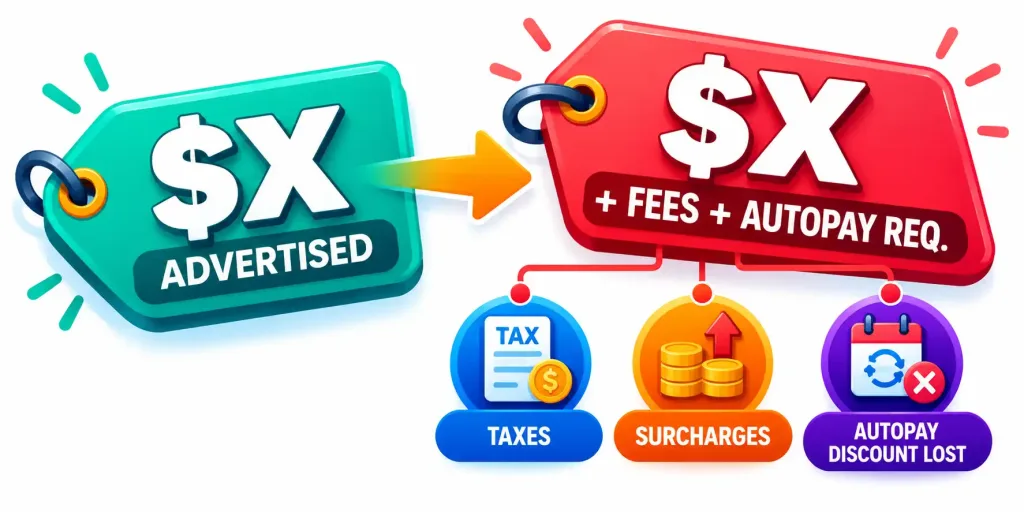
The number on the billboard is rarely the number on your bill. Taxes, regulatory fees, and surcharges add a real amount on top of the base price, and the exact figure varies by state and carrier. Many of the lowest advertised prices also require autopay enrollment or a specific number of lines on the same plan to actually apply — a single-line account sometimes pays noticeably more per line than the advertised multi-line rate implies. Before committing, it’s worth asking the carrier directly (or checking the plan’s full terms) what the actual first-month and ongoing total will look like, fees included.
Prepaid vs. Postpaid
Postpaid plans — the traditional monthly-bill model — typically offer more flexibility, device financing, and sometimes better customer support priority, but usually require a credit check and sometimes a contract commitment. Prepaid plans (including carrier-owned budget brands and resellers that run on the same networks, known as MVNOs) skip the credit check, often cost less, and can be cancelled anytime with no penalty — the tradeoff is usually fewer perks and lower priority on the network during congestion. For anyone without an established credit history, running a business on a tight budget, or simply wanting to avoid a long-term commitment, prepaid is worth serious consideration rather than an automatic downgrade.
Family and Multi-Line Discounts
If you’re shopping for more than one line — a family, a couple, a small team — per-line pricing usually drops as you add lines, sometimes substantially. It’s worth comparing the total multi-line price against buying separate single-line plans on a budget carrier, since the math doesn’t always favor staying on one big carrier plan. Shared data pools versus per-line allotments are also worth checking: a shared pool can be more efficient for uneven usage across family members, but it also means one heavy user can leave everyone else with less.
International Use
If you travel or need to stay in touch with people abroad, check what a plan actually includes before assuming “international” means what you’d expect. Some plans bundle a set amount of international data and texting at no extra charge; others charge a daily fee the moment your phone connects to a foreign network, regardless of whether you use it. If international calling or roaming is a regular need rather than an occasional one, it’s worth comparing plans specifically built around it rather than treating it as an afterthought on a domestic plan.
Contract Terms and Device Financing
If a new phone is part of the deal, understand what you’re actually signing up for. Device payment plans are typically financing agreements tied to staying with that carrier — leaving early can mean the remaining device balance becomes due immediately, on top of whatever the promotional discount was contingent on. Trade-in promotions, in particular, are often structured as bill credits spread over 24 months rather than an upfront discount, which matters if you plan to switch carriers again before that period is up.
Customer Support and Account Flexibility
It’s easy to overlook until something goes wrong, but how a carrier handles billing disputes, outages, or plan changes is worth a quick look before signing up — independent reviews and complaint patterns (the Better Business Bureau and FCC complaint data are both public) can be more informative than a carrier’s own marketing about what happens when things don’t go smoothly.
Putting It Together
None of this means every shopper needs to research for hours. It means knowing your own usage, checking coverage where you actually live and work, understanding what “unlimited” and “5G” really include, and calculating the real total price — fees and all — before comparing that number against alternatives. A plan that looks like a great deal in an ad can turn out to be mediocre once the fine print is accounted for, and a plan that looks unremarkable on the surface can turn out to be the better fit once your actual habits are factored in.
Frequently Asked Questions
Is a bigger data plan always a safer bet than a smaller one?
Not necessarily. Overbuying data is extremely common and is pure wasted spending if your actual usage doesn’t come close to the cap. Checking your real usage history before upgrading is usually more useful than defaulting to the largest tier out of caution.
Does “5G” mean the same thing on every plan?
No. 5G comes in several forms with very different real-world speeds and coverage — low-band, mid-band, and high-band/mmWave — and a plan’s “5G included” claim doesn’t specify which kind you’ll actually get in your area.
Is prepaid worse than postpaid?
Not inherently — it’s a different tradeoff. Prepaid typically skips the credit check, costs less, and has no cancellation penalty, while postpaid usually offers device financing and sometimes better network priority. Which one is “better” depends entirely on your situation, not a fixed hierarchy.
What’s the most commonly overlooked cost when comparing phone plans?
Taxes, fees, and conditions attached to the advertised price (such as requiring autopay or multiple lines) are the most frequent source of a mismatch between the advertised rate and the actual bill. Asking for the real total, fees included, before signing up avoids most surprises.