Chemistry is a science that studies the composition, structure, and properties of matter. This includes studying elements, compounds, and mixtures, whereas chemistry involves identifying the components and their interactions. Chemistry also covers the relationship between physical changes and chemical reactions in the material.
Chemistry is one of the oldest sciences, dating back to antiquity. Chemistry principles are used in many fields, including medicine, agriculture, and manufacturing. Chemistry can be applied to any matter or system that contains atoms.
In addition to its practical uses, chemistry has also served as a basic foundation for other disciplines, such as biology and physics.
Basic Elements Of Chemistry
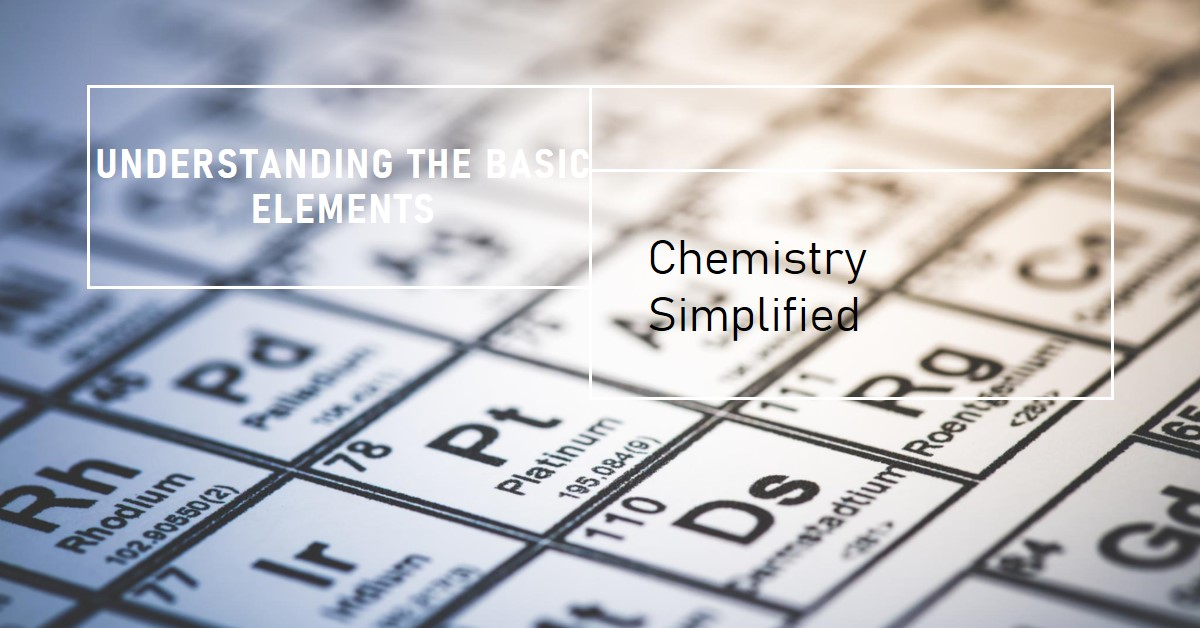
Chemistry has many branches, from organic to nuclear. The elements are the fundamental building blocks of all matter in the universe. These elements can be combined to create new elements with different properties. Chemists classify elements based on their properties, such as their atomic number, mass, and chemical behavior. An element is a fundamental chemical substance that chemical reactions cannot break down into simpler substances. Each element consists of its unique type of atom. Here are some key points about elements:
- Atomic Structure: The atom, the basic particle that constitutes an element, is at the heart of it. Elements are identified by the number of protons in their nucleus, known as the atomic number.
- Variety of Elements: There are approximately 100 known elements. Each element has distinct properties and behaves differently from others. The periodic table lists all these elements, grouping those with similar characteristics.
- Metals and Non-Metals:
- Metals: Most elements are metals. They are shiny, conduct electricity well, and are solid at room temperature. Examples include gold, aluminum, and iron.
- Non-Metals: Some elements are non-metals. Most non-metals are gases at room temperature and do not conduct electricity. Examples include oxygen, hydrogen, and chlorine. A few non-metals, like carbon and sulfur, exist as solids at room temperature2.
Remember, the periodic table is like a treasure map to the fascinating world of elements! If you have any more questions or need further details, feel free to ask. ??
Atomic Numbers
Atomic numbers identify an element’s location in the periodic table of elements. It plays a crucial role in organizing elements within the periodic table. Let’s dive into this fascinating topic:
- Atomic Number: The atomic number of an element represents the number of protons in its nucleus. It uniquely identifies each element. For example:
- Hydrogen (H) has an atomic number of 1, meaning it has one proton.
- Helium (He) has an atomic number of 2, indicating two protons.
- Periodic Table: The periodic table arranges elements based on their atomic numbers. Here are some key features:
- Periods: Rows in the periodic table are called “periods.” Each period corresponds to a different energy level (shell) for electrons.
- Groups (Families): Columns are known as “groups” or “families.” Elements within the same group share similar chemical properties.
- Trends: As you move across a period from left to right, atomic numbers increase, and properties change systematically.
- Example: Let’s consider the first few elements:
- Hydrogen (H) is in the first period (row) and the first group (column).
- Helium (He) is also in the first period but in the second group (noble gases).
Remember, the periodic table is like a roadmap to the elements, guiding us through their fascinating properties and relationships. If you have more questions or need further details, please ask! ??
Atomic mass is the total mass of an atom’s protons and neutrons — this number varies depending on the isotope of an element.
Isotopes are atoms with identical numbers of protons but different numbers of neutrons; they have different masses because they have different masses of neutrons.
Measurements Using Nanometer
A nanometer is a unit of length used in the physical sciences. It is one billionth of a meter, which is about 39 millionths of an inch. The prefix nano- is used to indicate quantities measured in nanometers, such as a molecule’s diameter or an atom’s radius.
International standards do not define meters as nanometers; they have different values in different disciplines. In chemistry, one nanometer equals 10-9 m or 1 Ångström (Å), which is 0.1 nm (10-10 m). One nanometer equals 1/10000000 millimeter or 1/10000000000 micrometer.
What a Nanometer is Used to Measure in Chemistry
A nanometer is a unit of length equal to 10-9 meters. Chemistry commonly uses it to measure the size of atoms, molecules, and other particles. For example, a carbon atom has a diameter of about 0.3 nanometers.
In addition to measuring the size of atoms and molecules, the nanometer can also describe the thickness of a material or how close two objects are together. For example, if you were asked how thick your shirt was or how far apart two planets are from each other, you could use the nanometer as your unit of measurement.
An Online Calculator Can Help
A chemist can use an online calculator to convert a meter to a nanometer in chemistry or to convert any other measurement.
Online calculators are essential tools for chemists and other scientists. They help us perform calculations quickly so we can focus on the question at hand instead of on arithmetic. Most calculators have built-in conversions for common measurements such as feet, yards, inches, pounds and ounces, and Celsius and Fahrenheit.
In Conclusion
A nanometer is an extremely small measurement commonly used in chemistry and physics. The metric system uses nanometers as one of its base units for length, so it’s easy to convert between them. An online calculator allows you to convert between nanometers and other common measurements, such as meters, millimeters, and micrometers. It can also convert between different angles and degrees.