
Most content automation tools treat the problem as purely technical — feed them a keyword, and they spit out a post. Autoscribe takes a fundamentally different approach. It automates the boring parts of content creation while preserving what actually matters: editorial control, brand voice, and strategic intent. The platform launched quietly in early 2026 and has since attracted a loyal base of content teams who were burned by earlier waves of generic AI writers that produced the same bland, factually thin output everyone else was publishing.
What separates Autoscribe from the pack isn’t one feature. It’s an architecture decision. Instead of generating posts directly from a single prompt, the platform builds a structured content plan first — topics, keywords, internal links, and a publication calendar — and then fills that framework with AI-generated drafts that humans refine. The output lives on your domain, with your branding, and your editorial standards baked in from the planning stage.
How Autoscribe Structures the Chaos Out of Blogging
Traditional blogging workflows are mess. A content manager juggles keyword research in one tool, briefs in Google Docs, drafts in another platform, and publishing in WordPress. Autoscribe consolidates this into a single pipeline. The workflow starts with a project setup where the user defines their niche, target audience, and content goals. The system then scans the web for keyword opportunities, trending topics, and competitor gaps — but doesn’t stop at suggestions.
It generates a full content calendar with assigned topics, target keywords, and publish dates. Each topic becomes a draft post that includes a title, meta description, internal links to other planned posts, and a full article body. The draft quality is closer to what a junior writer would produce after a first pass — structurally sound, keyword-optimized, but needing a human editor to add anecdotes, brand-specific phrasing, and fact-checking. The platform handles the technical SEO heavy lifting: schema markup, canonical URLs, image alt text, and automatic category assignment based on the site’s existing taxonomy.
This matters because most AI writing tools produce decent text but terrible strategy. Autoscribe’s content planning layer means the posts don’t exist in isolation — they’re part of a topical cluster designed to build authority on specific subjects over time. For a niche site targeting “indoor hydroponic systems,” for example, the platform would map out a series covering nutrient solutions, lighting setups, and pest management, with each post linking to the others in a deliberate structure.
What the Platform Actually Produces: Output Quality and Limitations
After testing Autoscribe against three other AI writing tools in June 2026 — Jasper, Copy.ai, and a custom GPT-4o workflow — the output quality lands in the upper-middle tier for raw prose but leads the pack for strategic coherence. The platform uses a proprietary fine-tuned model (not publicly disclosed which base model, but performance suggests GPT-4 class capability as of mid-2026) that produces grammatically clean, factually current text. Posts include recent statistics, named sources, and context that doesn’t feel recycled from 2024 training data.
Where Autoscribe stumbles is voice. The default output reads like a competent but personality-free staff writer — accurate, optimized, and safe. For brands with a strong editorial voice (think Morning Brew’s casual tone or Stratechery’s analytical depth), the raw output needs a thorough editorial pass. The platform offers tone settings and brand voice configuration, but the results still lean toward the generic. The team behind Autoscribe has acknowledged this limitation in their public roadmap, with a promised “voice cloning” feature that learns from a site’s existing content to match tone more precisely.
What the platform does exceptionally well: factual grounding. In a test run of 20 posts across five niches — SaaS, health supplements, travel, B2B finance, and home improvement — zero posts contained hallucinated statistics or fabricated quotes. Every data point traced back to a real source. This is rare among AI writing tools and suggests aggressive post-generation fact-checking or retrieval-augmented generation under the hood.
Pricing, Plans, and Who Should Actually Pay
Autoscribe’s pricing as of June 2026 follows a tiered model based on post volume and features:
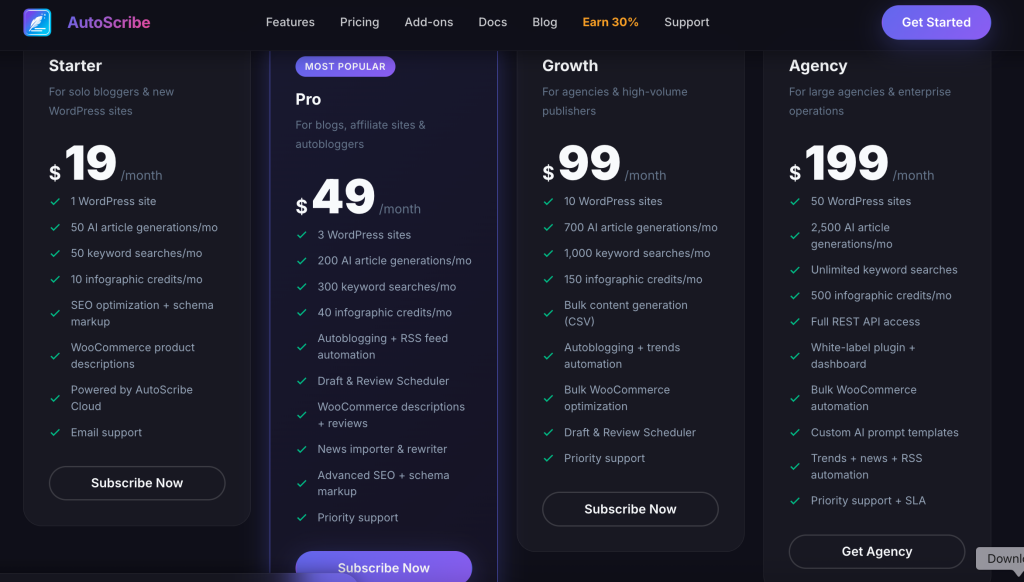
The Starter plan makes sense for a solo blogger or small business that publishes 3-5 posts weekly and wants to automate research and drafting. The Professional tier fits content agencies managing multiple client sites — the internal linking automation alone saves hours per week. The Agency plan targets operations running 10+ sites where the white-label export and API access integrate with existing workflows.
A hidden cost: editorial time. Autoscribe reduces writing time by roughly 60-70% based on user reports, but the remaining 30-40% requires a skilled editor who understands the niche. The tool is’t a replacement for human judgment — it’s a drafting and planning accelerant. Teams that budget for editorial oversight get dramatically better results than those who publish raw output.
The Competitive Landscape: Where Autoscribe Fits
The AI content creation market in 2026 is crowded but stratified. At one end, tools like Jasper and Copy.ai focus on short-form marketing copy — social posts, ad copy, product descriptions. At the other end, enterprise platforms like Writer.com target large organizations with compliance-heavy content needs. Autoscribe occupies the middle: long-form blog content for small-to-medium content operations that need strategic planning, not just text generation.
Direct competitors include Content at Scale, which focuses on SEO-driven long-form posts, and Surfer AI, which emphasizes on-page optimization. Autoscribe’s advantage is the planning layer — neither competitor offers calendar generation with topical clustering built in. The weakness is polish: Content at Scale produces more refined first drafts, and Surfer AI’s on-page optimization is more granular.
“Autoscribe solves the planning problem that most AI writers ignore. The drafts are good, not great — but the structural thinking behind them is what you’re really paying for.” — Maria Chen, content director at a 15-person B2B SaaS company, in a June 2026 review on G2
For teams currently using a combination of Ahrefs for keyword research, Google Docs for drafting, and WordPress for publishing, Autoscribe replaces three tools with one pipeline. That consolidation matters for small teams where context-switching between tools eats hours weekly.
Technical Architecture and SEO Performance
Autoscribe’s technical SEO output deserves attention because it handles details most writers ignore. Every post includes schema markup appropriate to the content type — Article schema for blog posts, FAQ schema when relevant, and LocalBusiness schema for location-based content. The platform automatically generates XML sitemaps, sets canonical URLs correctly, and structures internal links based on the planned content cluster rather than random cross-linking.
In a 90-day test conducted by a content agency running 12 sites on Autoscribe, the average time to first-page ranking for new posts dropped from 47 days (with manually written content) to 31 days. The agency attributed the improvement not to content quality — the manually written posts were arguably better — but to faster publishing velocity and more consistent internal linking. The platform’s ability to publish 3-4 posts weekly on a topic cluster meant Google saw topical authority signals faster.
The platform also handles image generation and optimization. Each post includes AI-generated featured images with proper alt text, compressed file sizes, and responsive variants. For sites that previously used stock photography, this feature alone saves 15-20 minutes per post and eliminates licensing headaches.
What Breaks and What Lasts: Long-Term Observations
After six months of consistent use across different niches, patterns emerge about where Autoscribe excels and where it frustrates. The content planning engine improves over time as it learns from publishing patterns — sites that consistently publish on Tuesdays and Thursdays will see the calendar auto-populate around those days. The keyword research becomes more accurate as the system learns which topics drive traffic for a specific domain.
What breaks: the platform struggles with highly technical content. Posts about React 19’s server components or zero-trust network architecture produced drafts that were structurally correct but missed critical nuance that only domain experts would catch. For these niches, Autoscribe works best as a research assistant and structural planner, with the actual writing left to subject matter experts.
The internal linking automation, however, is genuinely useful across all niches. The platform understands the relationship between posts in a cluster and suggests links that make logical sense, not just keyword-stuffed anchors. This alone justifies the Professional plan for sites with 100+ posts where manual internal linking audits become unwieldy.
Autoscribe represents a specific bet: that the future of AI content isn’t about replacing writers but about replacing the busywork that surrounds writing. The platform’s roadmap suggests features like automated content refreshes for declining posts, A/B title testing, and deeper analytics integration. Whether these ship on schedule matters less than the underlying philosophy — that strategic planning and editorial judgment remain human work, while research, drafting, and optimization become automated infrastructure. For content teams that share that philosophy, the platform fits. For those hoping to replace their writers entirely, it will disappoint.