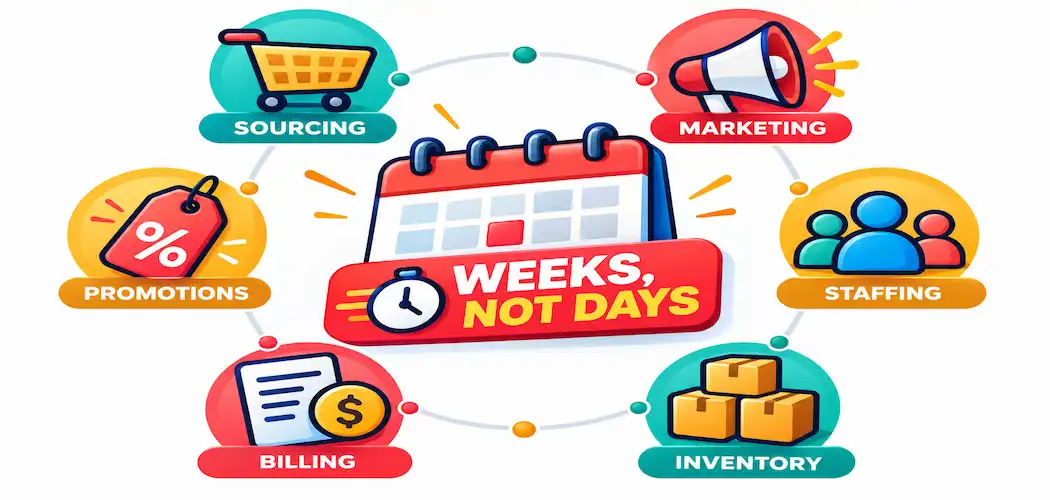
The holiday season has a way of arriving faster than any business plans for, no matter how early the calendar reminders start going off. By the time shoppers are actively looking for gifts, it’s already too late to fix a supply shortfall, train new seasonal staff, or figure out a marketing budget from scratch. The businesses that come out ahead each year are almost always the ones that started preparing weeks, not days, before the rush hit.
Here are six areas worth getting in order before the season actually starts.
1. Source Supplies Smartly, Not Just Quickly
Holiday prep often means restocking supplies, packaging materials, or seasonal inventory fast — and fast sourcing has a way of costing more than it needs to if price isn’t checked across options. Price-comparison and local-deals apps, such as Kimbino, let a business scan current catalog prices across multiple retailers before committing to a supplier, which can meaningfully reduce the cost of last-minute restocking compared to buying from whichever supplier is simply fastest to reach.
The goal here isn’t to chase the absolute lowest price on every single item — it’s to avoid overpaying out of pure time pressure, which is exactly what tends to happen when sourcing gets left until the last minute.
2. Build a Real Marketing Plan, Not Just a Few Posts
A holiday marketing push works best when it’s actually planned rather than improvised in the final weeks. That starts with identifying who the target audience actually is this season — returning customers, new local shoppers, a specific demographic tied to a particular product line — and setting a realistic budget before picking channels.
Email, social media, in-store promotions, and local partnerships all play different roles: email tends to work best for existing customers who’ve already opted in, social media is stronger for reaching new audiences and building urgency, in-store promotions capture people already walking through the door, and partnerships with complementary local businesses can extend reach without extending the ad budget. Brevo (the platform formerly known as Sendinblue) publishes a holiday marketing guide that walks through seasonal campaign timing in more depth, which is a reasonable starting point for shaping the actual calendar.
One detail that gets skipped surprisingly often: validating an email list before a major seasonal send. A list that’s accumulated bounces, typos, and inactive addresses over the year will quietly hurt deliverability right when inbox placement matters most. Tools like Email List Validation exist specifically to catch that before a holiday campaign goes out, rather than after open rates come back disappointing.
3. Plan Staffing Before the Rush, Not During It
Whether a business needs extra holiday staff depends heavily on its type and how much training new hires realistically need before they’re useful on the floor or on the phones. A business with a short, simple onboarding process has more flexibility to hire close to the season; one with a longer training curve needs to start that process well in advance, or risk having undertrained staff right when customer volume peaks.
Speeding up the hiring process itself is where tools like video screening interviews can help — platforms such as Playhunt let candidates record responses to screening questions on their own time, which can cut down the scheduling back-and-forth that slows down traditional phone or in-person first-round interviews. It’s one option worth evaluating among several similar video-screening tools on the market, not necessarily the only way to speed up seasonal hiring — the right fit depends on hiring volume and budget.
4. Forecast Inventory From Real Data, Not Guesswork
Inventory planning for the holidays benefits enormously from looking backward before looking forward. Past sales data — what sold well last season, what sat on shelves, what ran out too early — is a far more reliable planning input than instinct alone, especially for a business that’s been through at least one holiday cycle already.
Supplier lead times matter just as much as demand forecasting. A product that takes three weeks to restock needs to be ordered with that lead time built in, not based on when it looks like it might run low. Balancing popular, reliable sellers against specialty or seasonal items takes some judgment — popular items drive volume, but specialty items often carry better margins and differentiate a business from competitors stocking the same obvious bestsellers. And all of it needs to be weighed against actual storage capacity, since overordering creates its own costs in space, handling, and unsold inventory risk. Lightspeed, among other retail platforms, publishes general guidance on holiday inventory planning that’s worth reviewing as one input into this process.
5. Automate Invoicing Before Volume Picks Up
Higher holiday sales volume usually means a higher volume of invoices too, and manually generating them one by one is exactly the kind of repetitive task that starts producing errors under time pressure. A template-based invoicing workflow — whether through dedicated invoicing software or a template system built on tools a business already uses, like Portant‘s Google Sheets-based invoice templates — reduces that error rate and saves real time during the weeks when time is least available.
The cash-flow benefit matters too: invoices that go out faster and more accurately get paid faster, which matters more during a season when a business’s own supplier and staffing costs are often elevated at the same time.
6. Plan Holiday Promotions Early and Communicate Them Everywhere
The promotions that perform best during the holidays tend to be the ones planned weeks ahead rather than assembled the week they launch. Deciding in advance whether to center a promotion on specific popular items, free shipping thresholds, or bundled deals gives enough lead time to actually prepare inventory and messaging around it, rather than scrambling to make a last-minute offer work operationally.
Once a promotion is set, communicating it consistently across every channel a business uses — email, social, in-store signage, and any partner channels — matters more than any single channel performing perfectly. Customers who see the same offer reinforced in multiple places are more likely to act on it than customers who only catch it once.
Bringing It Together
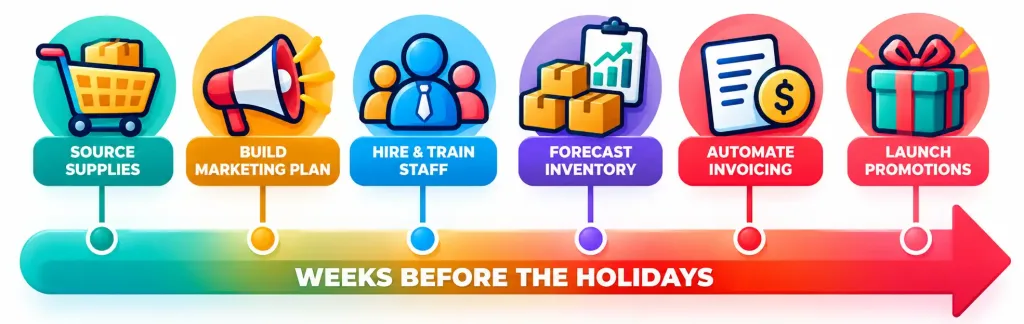
None of these six areas work in isolation — a marketing push without the inventory to back it up creates disappointed customers, and efficient invoicing doesn’t help much if staffing shortfalls mean orders ship late in the first place. The businesses that handle the holidays smoothly tend to be the ones treating all six as connected parts of the same seasonal plan, started early enough that none of them have to be rushed.
Frequently Asked Questions
How far in advance should a small business start holiday preparation?
Earlier than feels necessary — ideally several weeks before the season’s peak, especially for anything involving supplier lead times or staff training, both of which take real time to execute properly once started.
What’s the biggest inventory mistake businesses make during the holidays?
Relying on instinct instead of past sales data, and underestimating supplier lead times. Both lead to either running out of popular items at the worst possible time or overordering items that don’t move.
Is email marketing still worth it for holiday promotions?
Yes, particularly for existing customers who’ve already opted in — but only if the list is clean. Validating an email list before a major seasonal send protects deliverability right when inbox placement matters most.
Should every business hire seasonal staff for the holidays?
Not necessarily — it depends on business type and how long training realistically takes. A business with simple onboarding has more flexibility to hire later; one with complex processes needs to start staffing decisions well before the season begins.