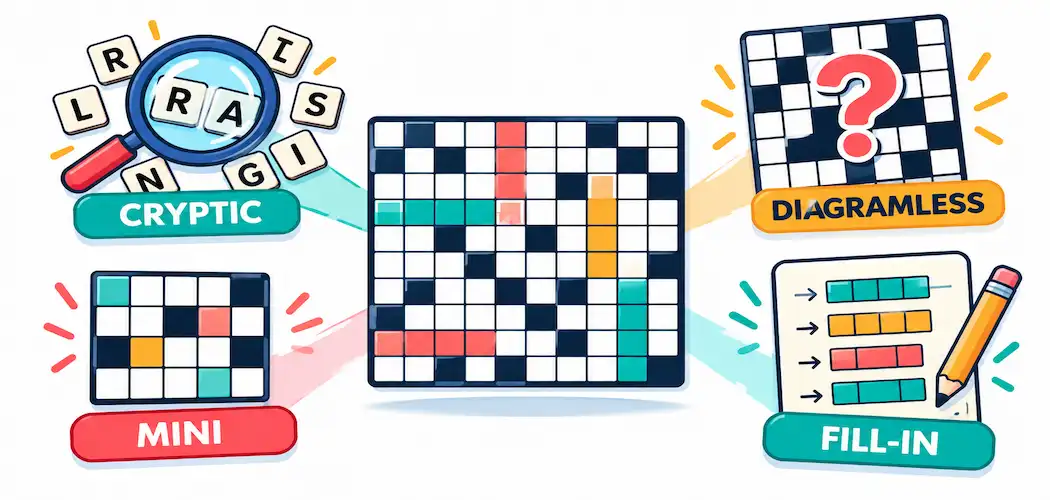
Most people picture one specific image when they hear the word “crossword” — a square grid of black and white boxes, numbered clues running down the side, a pencil hovering over 14-Across. That image isn’t wrong, but it only covers one branch of a much larger puzzle family. Crosswords have splintered into several genuinely different formats over the past century, each with its own rules, its own kind of difficulty, and its own community of solvers who swear it’s the only “real” version.
Knowing the differences matters for a practical reason: picking the wrong crossword type for your mood or skill level is the fastest way to get frustrated with a puzzle that was never going to feel fun. A cryptic crossword and a themed Sunday-size classic puzzle test completely different skills, even though they look similar on the page. Here’s an honest tour of the major types, what makes each one tick, and how to tell which one is worth your time on a given day.
Classic (American-Style) Crosswords
This is the format most newspapers run, and it’s the one most people learn first. The grid is a square or rectangle made up of white squares (where letters go) and black squares (which separate words), typically with rotational symmetry — meaning the pattern looks the same if you spin the grid 180 degrees.
Clues are split into “Across” and “Down,” each numbered to match a starting square in the grid. A clue might be a straightforward definition (“Capital of France” for ROME… or, correctly, PARIS), a fill-in-the-blank (“___ of a feather”), or a bit of wordplay using a question mark to signal a pun is involved. Difficulty in classic crosswords comes almost entirely from vocabulary breadth, cultural references, and how indirect the clue-writer decides to be — a Monday puzzle in most major papers is built to be approachable, while a Saturday puzzle leans into obscure trivia and tricky misdirection.
What makes classic crosswords endure is that they’re flexible enough to be either a five-minute coffee-break activity or a genuinely difficult challenge, depending on the publication and the day of the week. They also reward general knowledge more than any other crossword type — geography, pop culture, history, and language trivia all show up constantly.
Cryptic Crosswords
Cryptic crosswords look similar to classic ones on the grid, but the clues work on an entirely different system, and this is where a lot of newcomers get stuck without realizing they’re playing a different game.
Every cryptic clue contains two separate paths to the same answer: a straightforward definition (just like a classic clue) and a wordplay element that builds the answer through anagrams, hidden words, homophones, charades (combining smaller word-parts), or reversals. The trick is that the clue reads as one continuous sentence, so part of learning to solve cryptics is learning to spot where the definition ends and the wordplay begins.
As an example of the structure (not an actual published clue): “Crazy about silent vehicle (3)” might combine an anagram indicator (“crazy”) applied to a word meaning “about,” pointing to a three-letter word meaning “silent vehicle.” Cryptic solvers get very good at recognizing a small set of recurring wordplay indicators — “mixed up,” “in disorder,” and “jumbled” usually signal an anagram; “sounds like” signals a homophone; “part of” or “hidden in” signals a word hidden inside another word.
Cryptics are popular in British and Commonwealth newspapers especially, and they reward pattern recognition and linguistic cleverness more than general trivia knowledge. They’re also notoriously unforgiving for beginners — the learning curve is real, but most dedicated cryptic solvers describe the format as more satisfying once the wordplay patterns click.
Fill-In Crosswords (Word Fill Puzzles)
Fill-in crosswords get genuinely confused with classic crosswords online fairly often, which is worth clearing up properly. There are no numbered clues at all. Instead, solvers are given a complete list of words (sometimes scrambled, sometimes just listed out of order) and an empty grid with blank squares of varying lengths. The job is to figure out which word fits which empty slot, using word length and crossing letters as the only real clues.
This format strips out general-knowledge trivia entirely and replaces it with pure logical deduction — it plays more like a word-based Sudoku than a traditional crossword. Longer, more distinctive words are usually the easiest entry point, since there are fewer grid slots that could fit them; short, common words (three- and four-letter entries) tend to be the hardest, since several of them might fit the same blank until enough crossing letters are filled in.
Fill-in puzzles are a good fit for solvers who enjoy the grid-logic side of crosswords but don’t want to rely on trivia knowledge, and they’re commonly used in puzzle books aimed at a wide age range for exactly that reason.
Themed and Variety Crosswords
Many Sunday-size or specialty crosswords build the entire puzzle around a unifying theme — a pun pattern, a category of answers, or a visual trick embedded in the grid. A themed crossword might have five or six long answers that all relate to a single topic (say, types of weather, or a wordplay pattern like adding “ICE” into common phrases), with the rest of the grid filled in around them.
Variety crosswords push this further with mechanical gimmicks: diagonal answers, answers that have to be written backward, circled letters that spell out a bonus word or phrase once the grid is solved, or grids with unconventional shapes instead of a plain square. These puzzles tend to attract more experienced solvers specifically because figuring out the gimmick is often as much a part of the challenge as solving the clues themselves.
Diagramless Crosswords
Diagramless crosswords remove the one thing most solvers take for granted: the black-and-white grid pattern itself. Solvers are given only the clue list and a blank grid of squares with no pre-marked black squares, and have to work out both the answers and where the black squares go, using numbering cues and standard crossword-construction rules (symmetry, standard word-length conventions) as a guide.
This is a format aimed squarely at experienced solvers. It adds a layer of structural deduction on top of ordinary clue-solving, and it’s rare to see it outside of dedicated puzzle magazines and crossword-specialist publications.
Acrostic Puzzles
Acrostics are adjacent to crosswords rather than a pure subtype, but they’re frequently grouped with them in puzzle collections, so they’re worth knowing about. Solvers answer a list of clues, and each answer’s letters get transferred into a numbered grid. Once enough answers are filled in, the first letter of each answer (read top to bottom) spells out the author and title of a quotation, while the completed grid spells out the quotation itself.
Acrostics reward strong vocabulary and a bit of patience, since early progress often depends on confidently solving just a few of the harder clues to unlock crossing letters elsewhere.
Mini Crosswords
Mini crosswords have become especially popular as a quick daily habit, largely thanks to small 5×5 grids built for a two-to-five-minute solve. They use the same clue conventions as classic crosswords, just compressed into a tiny grid with far fewer entries. Because there’s so little room for misdirection, minis tend to favor snappy, current, and often pop-culture-adjacent clues over the denser trivia of a full-size puzzle.
They’re a good entry point for someone intimidated by a full crossword grid, and a good daily warm-up for experienced solvers who want something quick before tackling a longer puzzle.
Why People Keep Coming Back to Crosswords
Solving crosswords regularly is widely described by puzzle enthusiasts and cognitive-wellness writers as a pleasant way to exercise vocabulary recall, pattern recognition, and general knowledge retrieval — the kind of mental activity that feels more like play than practice. That’s a reasonable, defensible claim, and it’s one of the real reasons the format has stayed popular across generations and across such different styles of puzzle.
What’s worth being skeptical of is any claim that crosswords alone meaningfully prevent cognitive decline or function as a substitute for other healthy habits — that’s a much stronger claim than the research on puzzle-solving and brain health actually supports, and it shows up a lot in casual puzzle-app marketing. The more grounded version is simpler: crosswords are an enjoyable, low-stakes way to flex your vocabulary and pattern recognition, and different types of crosswords flex slightly different mental muscles.
Picking the Right Type for You
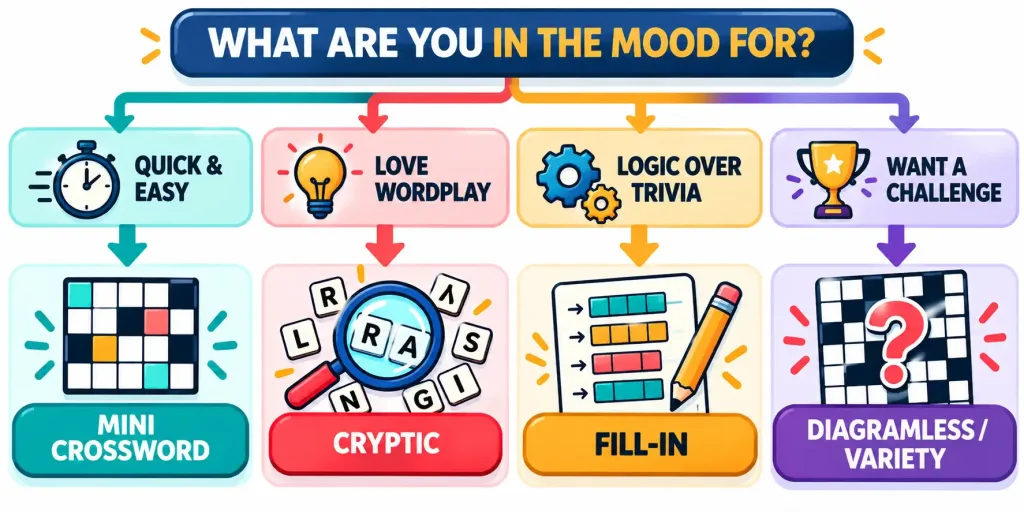
If you want something fast and low-pressure, a mini crossword or an easy-day classic puzzle is the right call. If you enjoy wordplay and don’t mind a real learning curve, cryptic crosswords are worth the investment of time it takes to learn the clue conventions — most solvers say the format becomes dramatically more enjoyable once the indicators start clicking. If trivia knowledge isn’t your strength but you like pure logical deduction, fill-in puzzles sidestep general knowledge almost entirely. And if you’ve already mastered the basics and want something that pushes further, diagramless and variety crosswords are where experienced solvers go looking for a real challenge.
There’s no single “best” crossword type — just the one that matches what you’re actually in the mood to solve.
Frequently Asked Questions
What’s the difference between a classic crossword and a cryptic crossword?
A classic crossword clue is usually a straightforward definition or fill-in-the-blank. A cryptic crossword clue contains both a definition and a separate wordplay element (anagram, hidden word, homophone, and so on) that independently builds the same answer, which means cryptic clues have to be parsed differently than classic ones.
Are fill-in crosswords easier than classic crosswords?
Not necessarily easier, just different. Fill-in puzzles remove trivia knowledge from the equation entirely and replace it with pure logical deduction based on word length and crossing letters, which some solvers find more approachable and others find more tedious without clue-based hints to lean on.
What is a diagramless crossword?
It’s a crossword where the black-and-white grid pattern isn’t given — solvers have to work out both the answers and the grid’s structure at the same time, using standard crossword-construction conventions as a guide. It’s generally considered an advanced format.
Do crosswords actually improve memory or prevent cognitive decline?
Crosswords are a reasonable, enjoyable way to exercise vocabulary and pattern recognition, and many solvers and wellness writers describe them that way. Be skeptical of stronger claims that crosswords alone meaningfully prevent cognitive decline — that’s a bigger claim than the evidence on puzzle-solving and brain health actually supports.