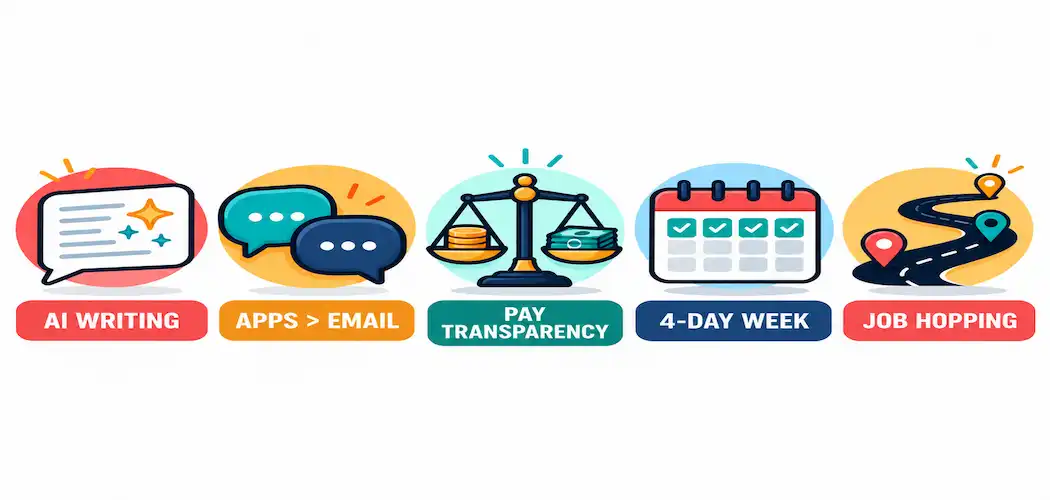
Workplace norms don’t shift all at once — they shift generationally, as new workers bring different expectations and older habits age out of practice. What counted as a “new trend” in business communication just a few years ago has, in several cases, already become the baseline. Here’s an honest look at five shifts that are genuinely reshaping how companies communicate internally and present themselves professionally right now, not a recycled list from a few years back.
1. AI Has Moved From Novelty to Default in Workplace Writing
The biggest actual shift in business communication since the early 2020s isn’t messaging-app casualness — it’s generative AI becoming a standard part of how people draft emails, summarize meetings, and polish documents. Tools built into platforms like Microsoft 365 (Copilot) and Google Workspace (Gemini), along with standalone writing assistants, are now commonly used for a first draft, a tone adjustment, or a quick summary of a long thread — often without anyone mentioning it was AI-assisted.
This has a real effect on professionalism expectations: the bar for basic polish (spelling, grammar, tone) has effectively been raised, since AI assistance removes most excuses for sloppy writing, while judgment about what to actually say — the substance, the relationship context, the right call to make — remains squarely a human responsibility that no tool replaces. The organizations handling this well are the ones setting clear norms about where AI assistance is fine (routine correspondence, internal notes) and where a fully human touch still matters (sensitive feedback, client-facing communication requiring real relationship context).
2. Messaging-Style Apps Have Fully Replaced Formal Email for Internal Communication
Slack, Microsoft Teams, and similar platforms didn’t just gain adoption during the remote-work shift — they’ve settled in as the default for internal day-to-day communication at a huge share of companies, with email increasingly reserved for external correspondence, formal records, and communication across organizations rather than internal chatter.
This has genuinely relaxed internal tone: emojis, GIFs, and a more conversational register are now normal in internal channels in a way that would have looked unprofessional in an email a decade ago. The tension this creates is real — employees comfortable with casual internal tone sometimes struggle to switch registers for client-facing or external writing, where the old formality standards still largely apply. Companies that handle this well train explicitly on the distinction between internal-channel tone and external-facing writing, rather than assuming the skill transfers automatically.
3. Pay Transparency Has Gone From Controversial to Legally Required in a Growing Number of Places
What was a politically charged workplace topic a few years ago has become, in a growing number of U.S. states and some cities, a legal requirement: employers in these jurisdictions must now disclose salary ranges in job postings. Colorado was an early mover with its Equal Pay for Equal Work Act, and several other states have followed with their own versions of pay-range disclosure requirements since, with more taking effect on a rolling basis — checking your specific state’s current requirements directly is worth doing, since this landscape keeps expanding.
The cultural shift underneath the legal one is real too: younger workers entering the workforce are generally more comfortable discussing compensation openly with colleagues than previous generations were, and that openness is part of what’s driven the legislative push, not just the other way around. For companies, this means job postings and internal pay-band documentation need to be genuinely consistent and defensible — a mismatch between posted ranges and actual offers creates real legal and reputational exposure now, not just an awkward conversation.
4. The Four-Day Workweek Conversation Has Real Data Behind It Now — in Both Directions
Four-day, reduced-hour workweek pilots have moved past “would this even work” into genuine, published trial data — and the honest answer is that results are mixed depending on the industry and how the pilot was structured, not uniformly positive. Several widely reported trials, including UK-based pilots run with coordination from 4 Day Week Global and researchers at Autonomy and Cambridge/Boston College, reported many participating companies maintaining or improving productivity with reduced hours and strong employee retention of the new schedule afterward. At the same time, other coverage of the same and similar trials has specifically highlighted companies and roles where a four-day structure didn’t work well — often in operations-heavy or client-coverage-dependent roles where reduced hours created real coverage gaps.
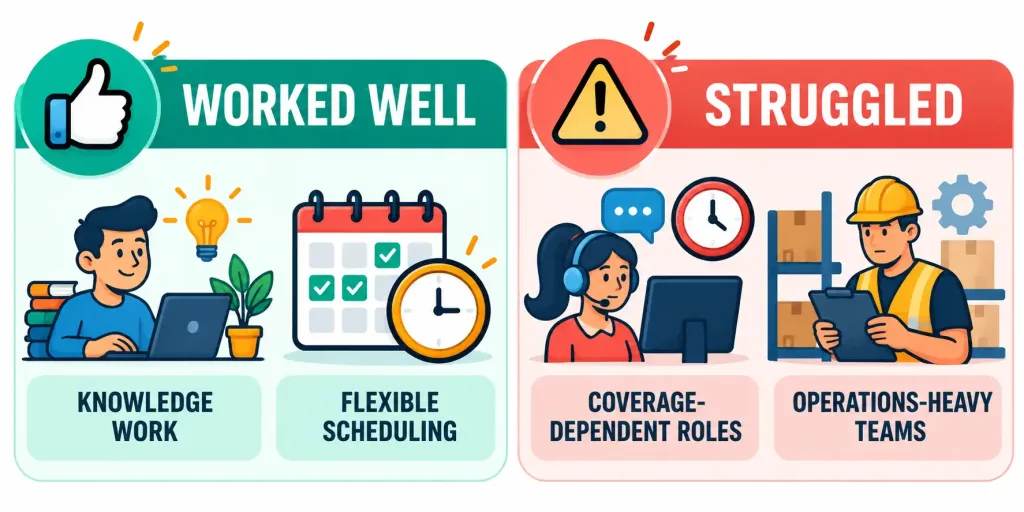
The honest takeaway: this isn’t a trend with a single verdict yet. It’s a genuinely useful model in some industries and roles, and a poor fit in others, and companies considering it should look at trial data from organizations similar to their own rather than treating any single pilot’s results as universal.
5. Job Hopping Has Lost Most of Its Stigma — But Context Still Matters
Changing jobs every few years for better pay, growth, or fit was once treated as a resume red flag signaling instability. That stigma has faded substantially, particularly among younger workers, as the job market has normalized more frequent moves and workers have become more vocal about leaving roles that don’t meet their expectations rather than staying out of loyalty alone.
What hasn’t changed as much: hiring managers still look at the story behind the moves, not just the frequency. A pattern of moves each tied to a clear reason (growth, acquisition, layoff, genuine mismatch) reads very differently than frequent moves with no discernible pattern or explanation. The stigma around job hopping itself has eased; the expectation of being able to explain your own career narrative hasn’t gone away.
What This Means for Companies
These five shifts share a common thread: each one raises the cost of treating communication and workplace policy as static. Companies that are explicit about where AI assistance is and isn’t appropriate, that train for the internal-versus-external tone switch rather than assuming it, that keep pay-band documentation genuinely consistent with legal requirements, that look at real industry-specific data before adopting a four-day model, and that focus hiring conversations on career narrative rather than resume-length anxiety are the ones actually adapting — rather than just reacting to each shift individually as it arrives.
Frequently Asked Questions
Is a four-day workweek actually proven to work?
The evidence is genuinely mixed rather than uniformly positive. Several well-publicized trials reported strong results in certain industries, while other reporting on the same broader wave of pilots has highlighted companies and roles where it didn’t work well, particularly in operations-heavy or coverage-dependent positions. It’s worth evaluating based on data from organizations similar to your own rather than any single trial’s headline result.
Do all states require salary ranges in job postings now?
No — it’s a growing but not universal list of states and some cities, not a nationwide requirement. Colorado was an early adopter, and more states have added similar requirements since, with the list continuing to expand. Check your specific state’s current law directly, since this changes.
Has job hopping really lost its stigma with employers?
Largely yes, especially compared to a decade ago, but hiring managers still generally want to understand the reasoning behind frequent moves rather than treating any pattern as automatically fine. A clear, coherent career narrative still matters more than the raw number of job changes.
Should companies worry about employees using AI to write internal communication?
Not inherently — it’s become a normal part of workplace writing. What matters more is having clear norms about where AI-assisted drafting is appropriate (routine correspondence) versus where genuinely human judgment and tone are still essential (sensitive feedback, high-stakes client communication).