
Every machine learning model is only as good as the data it learned from — and most of that data had to be labeled by a human or an automated system before the model ever saw it. Labeling sounds like a mechanical, almost clerical step. In practice, it’s one of the most consequential decisions in the entire machine learning pipeline, and getting it wrong produces failures that are much harder to diagnose than a bug in the model’s code.
What Data Labeling Actually Involves
“Labeling” covers a wider range of work than it sounds like, and the specific technique depends entirely on what the model needs to learn:
- Classification labels — assigning a category to an entire input (this email is “spam,” this image is a “cat”), the simplest and most common form.
- Bounding boxes — drawing a rectangle around an object within an image, used heavily in object-detection systems like those behind autonomous vehicle perception or retail inventory scanning.
- Semantic segmentation masks — labeling every individual pixel in an image with its category, a far more labor-intensive technique than bounding boxes, used where exact object boundaries matter (medical imaging, where the precise edge of a tumor matters, is a common application).
- Named entity recognition (NER) tags — marking specific words or phrases in text with a category (person, organization, location), foundational to NLP systems that extract structured information from unstructured text.
- Sentiment and intent labels — categorizing text by emotional tone or underlying intent, used in everything from customer service routing to social media monitoring.
The labeling method has to match the task — using simple classification labels for a task that actually needs pixel-level segmentation produces a model that technically trains but can’t perform the task it was meant for.
Why Label Quality Matters More Than Label Quantity
A larger labeled dataset with inconsistent or inaccurate labels usually performs worse than a smaller, carefully labeled one — a counterintuitive point that’s easy to underestimate when scaling a labeling effort quickly. Several specific failure modes show up repeatedly:
- Inter-annotator disagreement. When different human labelers interpret ambiguous cases differently (is this tweet “sarcastic” or “negative”?), the resulting dataset contains contradictory signal that confuses the model during training. Teams that take labeling seriously measure this directly using inter-annotator agreement metrics (Cohen’s kappa is the standard statistic for this), and treat persistently low agreement on a category as a sign that the labeling guidelines themselves need to be clarified, not just that annotators need more training.
- Systematic labeling bias. This is a more serious problem than random inconsistency, because it doesn’t average out with more data — it compounds. If a labeling process consistently underrepresents or mislabels certain groups or categories, the model learns that bias as if it were a real pattern. This isn’t a hypothetical risk: the 2018 Gender Shades research out of MIT Media Lab, led by Joy Buolamwini and Timnit Gebru, found that several commercial facial-recognition systems had error rates of up to roughly 35% when classifying darker-skinned women, compared to under 1% for lighter-skinned men — a gap traced substantially to training and benchmark datasets that underrepresented darker-skinned faces, meaning the systems had seen far fewer labeled examples to learn from for that group. The lesson generalizes well beyond facial recognition: whatever population or category is underrepresented or inconsistently labeled in training data, the resulting model performs measurably worse for it.
- Stale or drifted labels. A labeling scheme that made sense when a dataset was created can become outdated as the real-world categories it describes change — a spam-detection dataset labeled years ago won’t reflect current spam tactics, for instance. Periodic review of labeling guidelines against current real-world patterns is necessary, not optional, for any production system that keeps learning from new data.
Label quality is one half of what determines a model’s real-world performance — the other half is architecture choices inside the model itself, like how activation functions in neural networks shape what patterns a network can actually learn from well-labeled data in the first place.
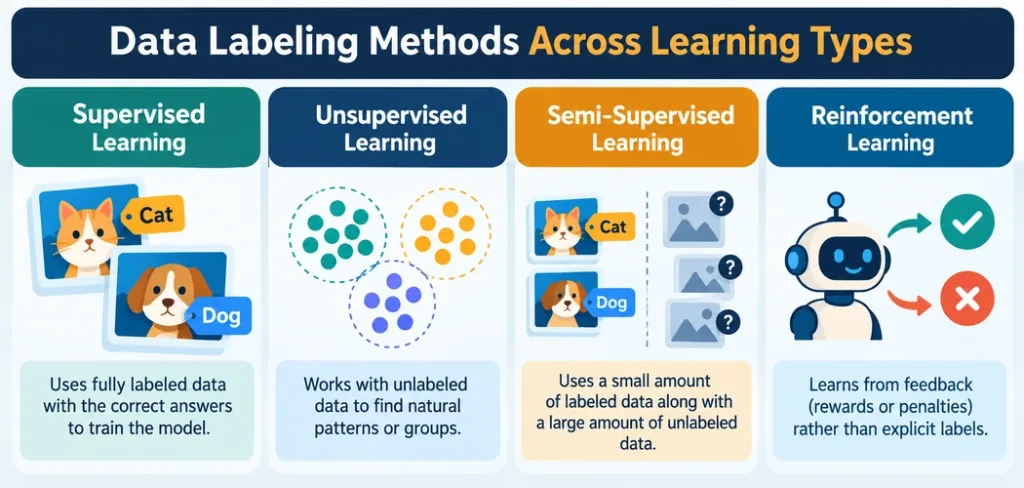
How Labeling Needs Differ by Learning Type
- Supervised learning depends entirely on labeled data — it’s the foundation the entire training process rests on, since the model is explicitly learning to map inputs to the labels it was given.
- Unsupervised learning doesn’t require labels to train (the model finds patterns in unlabeled data on its own), but labeled data is still valuable afterward, for evaluating whether the patterns the model found actually align with real-world categories.
- Semi-supervised learning combines a smaller set of labeled examples with a much larger pool of unlabeled data, using the labeled portion to guide how the model interprets the rest — a practical compromise when full labeling of a large dataset isn’t economically feasible.
- Reinforcement learning doesn’t use labels in the traditional sense at all; it learns from a reward signal generated by an environment rather than labeled examples, though labeled data can still play a role in evaluating a trained policy’s real-world performance afterward.
Quality-Control Practices That Actually Work
- Clear, example-rich labeling guidelines, built around the ambiguous edge cases annotators actually encounter rather than only the obvious ones — the edge cases are where most real disagreement happens.
- Multiple independent annotators per item, with disagreements resolved through a defined adjudication process rather than defaulting to whichever label was submitted first.
- Regular auditing against a gold-standard sample — a small, expert-labeled reference set that labeling output is periodically checked against, catching systemic drift before it propagates through an entire dataset.
- A documented escalation path for annotators who encounter genuinely ambiguous cases the guidelines don’t cover, rather than leaving that judgment call entirely to individual interpretation.
Where Automation Fits — and Where It Doesn’t
Automated and AI-assisted labeling tools (platforms like Labelbox, Amazon SageMaker Ground Truth, and Supervisely all offer some form of model-assisted pre-labeling) can meaningfully speed up the labeling process by having a model propose labels that a human then reviews and corrects, rather than starting from a blank slate for every item. This hybrid approach — sometimes called active learning, where the system specifically surfaces the examples it’s least confident about for human review rather than randomly sampling items to label — can cut labeling time substantially while keeping humans in the loop for the genuinely ambiguous cases that actually need judgment.
What automation doesn’t eliminate is the need for human oversight on quality. An AI-assisted pre-labeling system trained on biased or inconsistent prior labels will propose biased or inconsistent labels for new data, simply faster — automation accelerates whatever labeling quality already exists, for better or worse, rather than fixing it on its own.
The Bottom Line
Data labeling is frequently treated as the unglamorous, mechanical step before the “real” machine learning work begins. In practice, labeling errors and bias are among the hardest problems to detect after the fact, because a model trained on flawed labels doesn’t fail loudly — it just performs quietly worse for whatever was mislabeled or underrepresented, exactly the pattern documented in facial-recognition accuracy research. Treating labeling quality — consistency, documented guidelines, measured inter-annotator agreement, and genuine representation across categories — as a first-class part of the ML pipeline, rather than an afterthought to outsource and forget, is one of the highest-leverage things a team building any model can do.
Frequently Asked Questions
What’s the difference between labeling for supervised vs. unsupervised learning?
Supervised learning requires labeled data as its core training signal — the model explicitly learns to predict the labels it was shown. Unsupervised learning finds patterns in unlabeled data without needing labels during training, though labeled data is still useful afterward for evaluating whether those discovered patterns are meaningful.
How do teams measure whether their labels are actually good?
Inter-annotator agreement metrics like Cohen’s kappa measure how consistently different human labelers categorize the same items — persistently low agreement on a category signals that labeling guidelines need clarification. Auditing a sample of labeled data against an expert-labeled “gold standard” set is another common check for systemic errors.
Can biased training data labels really affect real-world outcomes?
Yes, measurably. The 2018 Gender Shades research found commercial facial-recognition systems had error rates up to roughly 35% for darker-skinned women versus under 1% for lighter-skinned men, a gap linked substantially to underrepresentation in the training and benchmark data those systems learned from.
Does AI-assisted labeling remove the need for human review?
No. AI-assisted pre-labeling tools speed up the process by proposing labels for humans to review and correct, but a system trained on biased or inconsistent prior labels will simply propose those same errors faster. Human oversight on quality remains necessary regardless of how much of the initial labeling is automated.