A Gartner 2026 Unified Communications & Quality Report found that while 74% of enterprises now route customer interactions through internet-based voice platforms, only 18% feed that real-time call data into their quality management systems. The other 82% are treating voice as a disconnected channel — missing defect signals that their existing QMS is designed to catch, if only it could hear them. The cost of that gap is not theoretical. A mid-sized insurance firm in Ohio discovered last year that 31% of its compliance failures originated in unrecorded verbal promises made during support calls — promises that never made it into any audit trail.
The Convergence Imperative: Why a QMS Needs Voice Data
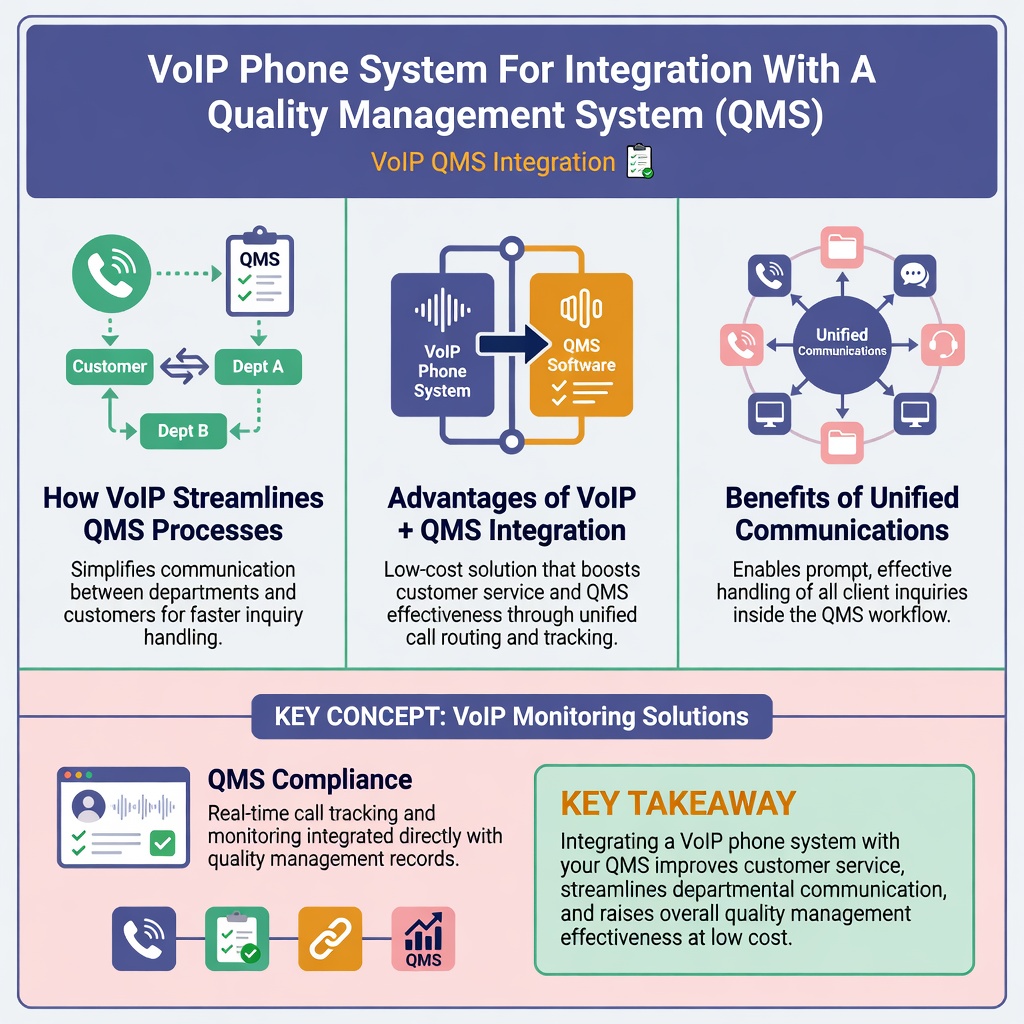
A QMS typically consumes structured data from manufacturing sensors, inspection forms, and ERP modules. Voice interactions with customers, suppliers, and regulators generate a parallel stream of unstructured quality intelligence — product complaints, procedural shortcuts, misinterpreted specifications — that traditional QMS architectures ignore entirely. The 2026 Frost & Sullivan CCaaS-Quality Integration Survey quantified the problem: companies that connected their VoIP phone system directly to their QMS identified 2.3 times more actionable quality events than those relying on manual agent post-call logging.
What has changed is the availability of affordable speech-to-text engines and API-first telephony platforms. Five years ago, integrating a VoIP phone with a QMS required brittle, hardware-dependent middleware that cost six figures to deploy. Today, cloud-native telephony platforms from Twilio, Cisco Webex, and Microsoft Teams Voice expose every call event — recording metadata, transcription streams, sentiment scores — through RESTful endpoints that a QMS can subscribe to directly.
The implication is straightforward: any quality team that still treats phone calls as invisible to their management system is operating with one eye closed. Voice is not a peripheral channel. It is the richest source of unfiltered feedback about how products, processes, and policies perform in the real world.
Technical Architecture That Makes VoIP-QMS Integration Work
The plumbing that connects a VoIP phone system to a QMS follows a consistent pattern, though the specific components vary by vendor. The core flow starts with Session Initiation Protocol (SIP) trunking or WebRTC for call signaling, which the VoIP platform translates into call detail records (CDRs). When a QMS requests call data, the integration layer — usually an iPaaS middleware like Workato or a native connector — pulls CDRs, recording files, and real-time transcription streams via API. From there, the QMS maps specific call attributes (agent ID, caller ANI, queue, outcome code) to quality records, nonconformance reports, or CAPA workflows.
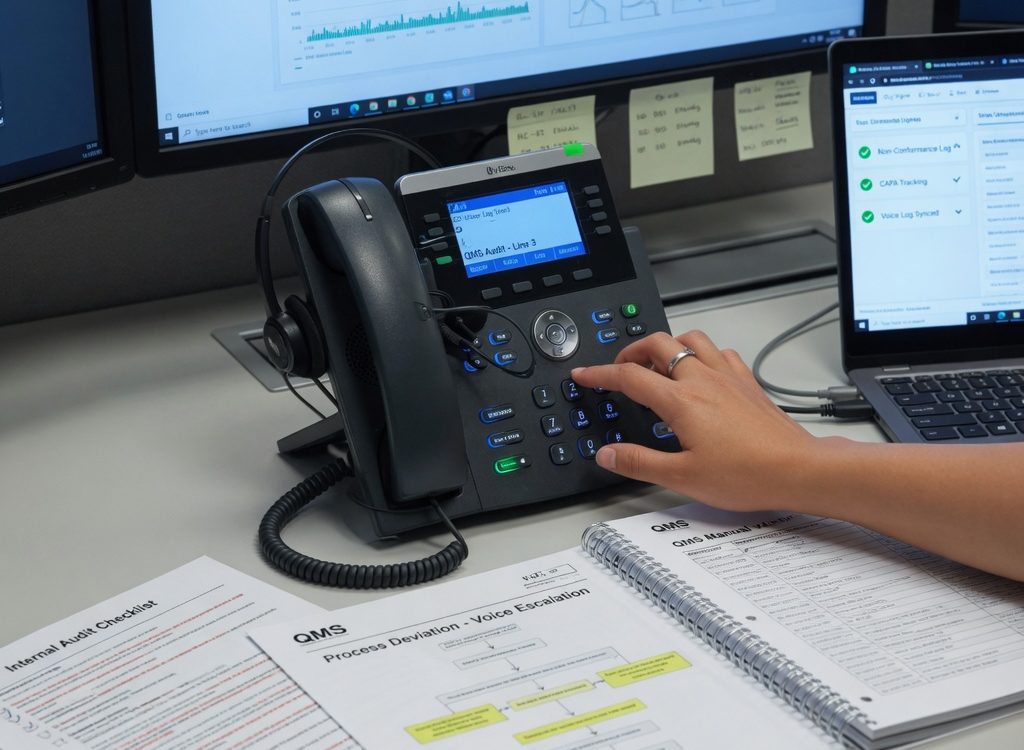
This matters because the integration must be bidirectional. A QMS that only ingests recordings for retrospective audit is missing the point. Modern architectures push quality alerts back into the telephony environment. If a QMS detects a pattern of noncompliant handling during a live call — for example, an agent skipping a mandatory disclosure — it can trigger an in-ear whisper coaching prompt or automatically escalate to a supervisor. Cisco’s 2026 Webex Contact Center API now supports exactly this, allowing a QMS to inject real-time guidance events into active call sessions.
A critical but often overlooked layer is call metadata enrichment. Before a VoIP interaction reaches the QMS, an intermediary service should append caller identity, CRM history, and product serial numbers. Without this context, a recording is just noise. Companies that have successfully integrated VoIP and QMS, such as a German automotive supplier profiled in a 2026 McKinsey operations brief, attribute 40% of their early detection of part defects to enriched call data flowing directly into their QMS analytics module.
Finally, VoIP monitoring solutions that provide network performance metrics — jitter, packet loss, MOS scores — should feed into the QMS as well. A degraded call can indicate infrastructure problems that affect not just customer experience but also data integrity. If the QMS logs a garbled recording as evidence in a compliance audit, the organization has a liability problem.
Compliance Automation: When Voice Becomes an Audit-Ready Asset
Regulatory frameworks like PCI-DSS 4.0, HIPAA, and the EU’s updated GDPR enforcement guidelines now treat recorded voice interactions as personal data requiring strict retention and access controls. A VoIP phone system integrated with a QMS can automate the entire chain of custody. When a call ends, the QMS tags the recording with metadata that includes call outcome, compliance checks passed or flagged, and automatic redaction of sensitive payment data based on DTMF detection. The result is an immutable record that satisfies auditors without manual intervention.
In 2025, a large U.S. health plan faced a $2.4 million fine after auditors discovered that its stand-alone call recording system had retained 14,000 calls beyond the required deletion window. The plan’s QMS had no visibility into those voice files. By the first quarter of 2026, after integrating its VoIP infrastructure with a QMS that enforced automated retention policies, the same organization achieved a 97% reduction in compliance exceptions during a follow-up review. This is not just a technology improvement; it is a risk management transformation.
The architectural principle is that the QMS becomes the system of record for voice quality events, not the telephony platform. When every call is indexed, searchable, and subject to defined business rules, the quality team can answer an auditor’s question in minutes rather than days. And since the integration is real-time, the system can block noncompliant calls from being archived as evidence — preventing problems before they become citations.
Real-Time Intervention: Moving from Retrospective Review to Live Quality Coaching
The traditional model of quality assurance samples 4–6% of calls, grades them days later, and then coaches agents on mistakes they barely remember. A VoIP phone system integrated with a QMS flips that model to immediate, data-driven intervention. Speech analytics engines running on the VoIP platform can monitor for specific triggers — profanity, competitor mentions, failure to verify identity — and fire events to the QMS. The QMS, acting as a real-time decision engine, can then either log the event for later review or push an alert to the agent’s screen and supervisor’s dashboard within seconds.
Five9’s 2026 Spring Release introduced exactly this capability with its QMS Connector, enabling what they call “active call steering.” If the QMS detects that a call is likely to result in a quality failure based on early linguistic markers, it can reroute the call to a senior agent or offer a retention discount. Early adopters in the e-commerce sector reported a 19% reduction in escalations and a measurable improvement in first-call resolution scores. These outcomes are not about technology; they are about preventing quality failures rather than documenting them afterward.
The cultural resistance is real. Agents accustomed to periodic scorecards can feel surveilled. Companies that succeed with live quality intervention treat transparency as a design requirement, not an afterthought. The VoIP-QMS integration must include agent-facing dashboards that show real-time quality scores, so the system becomes a coach, not a cop. As Caitlin O’Rourke, VP of Quality Transformation at Genesys, noted at the 2026 Enterprise Connect conference, “If agents see the QMS as a partner that helps them succeed, compliance lifts naturally. If they see it as a threat, they’ll find ways around it.”
Case Study: Cutting Defect Rates by Linking Calls to Production Data
A Canadian medical device manufacturer illustrates what a fully integrated VoIP phone system and QMS can deliver. The company produces sterile surgical kits with a zero-tolerance defect policy. In early 2026, after three customer complaints about incorrect component counts in shipped kits, the quality team traced all three cases back to verbal order clarifications made over the phone. The customer service team had manually noted changes, but the notes never reached the production QMS.
The fix involved deploying a Twilio Flex-based VoIP phone system and integrating it with the company’s existing Greenlight Guru QMS via API. Now, when a customer changes an order by phone, the agent enters the modification into a CRM integration overlay during the call. The VoIP platform captures the call recording, transcribes it automatically, and pushes a structured quality event to the QMS if the transcription detects keywords like “change,” “modify,” or “different count.” The QMS automatically generates a deviation record and holds the production batch until the change is verified.
Within four months, the company reduced defect-related returns by 22% and cut its average complaint resolution time from 18 days to four. More importantly, the audit trail was complete. When a regulator requested evidence of change control for a specific batch, the quality manager could produce the original call recording, the transcription, the agent’s CRM entry, and the QMS deviation record — all linked by a single call ID. That is the power of convergence.
Selecting a VoIP Platform That Actually Plays Well with QMS
Not all VoIP phone systems are designed for deep quality integration. The market splits roughly into two tiers: platforms that treat QMS connectivity as a checkbox feature (basic CDR export, maybe a prebuilt connector for Salesforce) and platforms that offer granular event streams, real-time transcription APIs, and developer-friendly documentation. The difference is the gap between collecting calls and managing quality.
| Criterion | Enterprise-Grade (Twilio, Cisco) | SMB-Oriented (RingCentral, 8×8) |
|---|---|---|
| API Openness | Full REST/WebSocket with per-call event hooks | Limited; often relies on third-party integrators |
| Real-Time Transcription | Built-in, with customizable language models | Add-on; may introduce latency >3 seconds |
| QMS Prebuilt Connectors | Multiple (Greenlight Guru, MasterControl, Qualio) | Salesforce only in most cases |
| Compliance Certifications | SOC 2, HIPAA, ISO 27001 | Varies; often lacks HITRUST |
| Pricing Model | Per-minute or per-session, plus API calls | Per-seat with bundled minutes |
The decision should center on the quality team’s actual workflow, not the IT department’s preference. If the QMS requires structured data fields — lot numbers, procedure codes, product identifiers — the VoIP platform must be able to extract and pass those from the call context. If it can’t, the integration will be a glorified recording archive, not a quality tool. The most successful implementations, according to a 2026 Aberdeen Strategy & Research survey, involve the quality manager co-writing the statement of work alongside the telephony architect to ensure the QMS’s data model is reflected in the voice event schema.
The Hidden Costs of Keeping Voice and Quality Separate
Organizations that choose not to integrate incur a set of predictable, measurable costs. The first is manual labor: a mid-sized contact center with 200 agents typically employs three to five full-time QA analysts whose sole job is listening to calls and scoring them. With integration, the QMS automatically scores 100% of calls on rule-based criteria, freeing analysts to handle exceptions. The second cost is regulatory risk. Disconnected systems create gaps in the audit trail that regulators increasingly penalize. The previously mentioned health plan fine is one example; the average penalty for voice-related compliance violations in the financial services sector reached $1.7 million in 2025, per the Thomson Reuters Regulatory Intelligence database.
The third cost is harder to quantify but arguably more damaging: lost quality intelligence. When a QMS cannot hear what customers are saying, it misses early warning signals. A pattern of calls about a specific product batch that the warehouse system thinks is fine will not trigger a corrective action if the calls and the batch records live in separate silos. Businesses that adopt a VoIP telephone system without connecting it to their quality infrastructure are essentially installing sensors and then ignoring their output. The irony is that the same companies often spend heavily on IoT sensors for their production lines while leaving their most direct customer feedback channel unmonitored.
What Comes Next: AI, Voice Biometrics, and Predictive Quality
The 2026 trajectory points toward predictive quality models that fuse voice data with production and supply chain data in real time. AI models trained on integrated VoIP-QMS datasets can now detect that a specific tone of voice, combined with certain keywords and an abnormal pause pattern, predicts a defect report 72 hours before it arrives. A beta study by Verint in partnership with a major electronics manufacturer showed that such models flagged 61% of future quality issues when applied to live calls, giving the QMS enough lead time to adjust production parameters.
Voice biometrics adds another layer. Instead of relying solely on an agent ID for audit trails, the integrated system can verify the speaker’s identity through voiceprint matching, reducing the risk of fraudulent call handling. And as ambient computing evolves, the line between a VoIP phone system and a full environmental quality sensor will blur. A factory floor manager’s voice call from the production line could automatically log an observation into the QMS without any screen interaction.
The practical takeaway for 2026 is that integration is no longer a competitive differentiator; it is baseline hygiene. The quality teams that move now to close the voice-data gap will not just catch more defects — they will build the foundation for autonomous quality management in the coming decade. Those that wait will find themselves defending audit findings that could have been prevented, and explaining to customers why their voices went unheard.
The infrastructure exists. The APIs are documented. The case studies are public. The only remaining variable is the decision to connect the two systems that were always meant to work together.