A solar array without storage only works while the sun’s actually shining. The moment it gets cloudy or the sun goes down, you’re back on grid power — unless you’ve paired your panels with a battery that can bank the extra energy for later. Choosing the right solar battery storage is what turns a solar setup from “cheaper electricity during the day” into genuine backup power and energy independence, but the spec sheets on solar batteries are dense enough to make comparison shopping genuinely confusing. Here’s what the numbers actually mean and how to use them to pick the right solar battery storage for your own home.
Why Pair Solar With a Battery at All
Without storage, any solar energy your panels generate that you don’t use immediately either gets sent back to the grid (if your utility offers net metering) or is simply wasted. A battery captures that surplus and makes it available after sunset, during a grid outage, or whenever demand on your home spikes past what the panels are currently producing. For anyone in an area with frequent outages, time-of-use electricity rates, or a utility that’s scaled back net metering credits, a battery often does more for the household budget and resilience than the panels alone — which is exactly why finding the right solar battery storage setup for your specific situation matters more than just buying the biggest battery on the shelf.
This also matters differently depending on whether your home stays connected to the grid or runs independently of it. If you’re still weighing that bigger decision, our comparison of on-grid vs. off-grid solar for Indian homes is worth reading first, since it affects how much storage you actually need.
Battery Capacity: What kWh Actually Measures
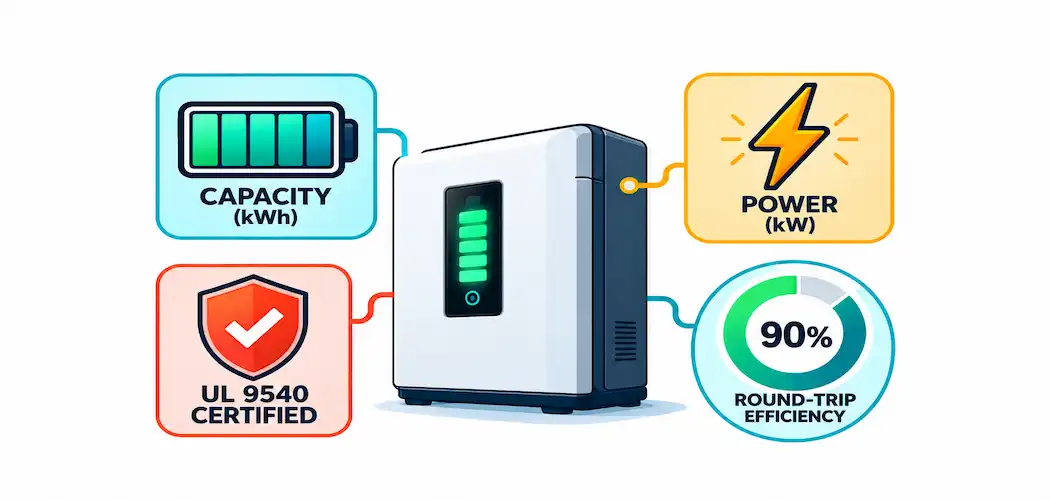
Capacity is measured in kilowatt-hours (kWh), which is a unit of energy — specifically, how much power a device uses sustained over time. A 1 kW load running for one hour consumes 1 kWh. A battery’s capacity tells you how much total energy it can store and later discharge, which is the number that determines how long it can run your home’s loads during an outage or overnight.
A useful way to think about it: a 10 kWh battery could run a 1,000-watt appliance for 10 hours, or several smaller loads for longer, depending on your actual household draw. There’s no universal “minimum” capacity that makes sense for every home — it depends entirely on which loads you want backed up (just critical circuits like a refrigerator and some lighting, or the whole house) and how many hours of backup you actually want. Sizing this properly usually means having an installer calculate your home’s actual load profile rather than applying a blanket capacity cutoff.
One point worth correcting from common advice: adding multiple batteries increases your total capacity and power roughly proportionally (two identical batteries roughly double both), not exponentially. There’s no multiplier effect from stacking battery units.
Power Rating: The Other Half of the Spec Sheet
Capacity tells you how much energy a battery holds; power rating (measured in kilowatts, kW — not amps, which measure current rather than power) tells you how much of that energy it can deliver at once. A battery can have a large capacity but a modest power rating, meaning it can run small loads for a long time but can’t handle a big simultaneous demand spike (like an AC unit and an electric range running together).
Batteries typically list both a continuous power rating (what it can sustain) and a peak rating (a higher burst it can handle briefly). To size this correctly, add up the wattage of everything you’d want running simultaneously during an outage — a few dedicated circuits versus the whole house makes a real difference here, and this is where a proper home energy assessment from an installer is worth more than any blanket “most homeowners need X kW” rule of thumb, since actual household loads vary enormously.
Round-Trip Efficiency
Round-trip efficiency measures how much of the energy you put into a battery you actually get back out. If you put in 5 kWh and get 4.5 kWh back out, that’s 90% round-trip efficiency — the other 10% is lost as heat during charging and discharging. A reasonable minimum to look for is somewhere around 80-90%, though the exact figure varies by battery chemistry and will typically be listed on a manufacturer’s spec sheet rather than needing to be estimated.
Battery Chemistry: Lithium Isn’t Just One Thing
Most current residential solar batteries use some form of lithium-ion chemistry, but “lithium” isn’t a single answer — the two most common chemistries for home storage have real differences worth knowing:
- Lithium iron phosphate (LFP/LiFePO4) is now the dominant choice for home solar storage, valued for its strong safety profile (lower risk of thermal runaway than other lithium chemistries) and typically very long cycle life, often rated well beyond 3,000-4,000 cycles by manufacturers, though exact figures vary by product and depth of discharge used in testing.
- Lithium nickel manganese cobalt oxide (NMC) offers higher energy density (more storage in a smaller/lighter package) but has historically carried a somewhat higher thermal runaway risk than LFP, which is part of why LFP has become the more common choice specifically for stationary home storage rather than NMC’s more typical use in electric vehicles.
- Lead-acid batteries are still around, mainly in off-grid or budget-conscious installations. They’re cheaper upfront but have meaningfully shorter cycle life and lower round-trip efficiency than lithium options, so the lower initial cost often doesn’t hold up over the system’s full lifetime.
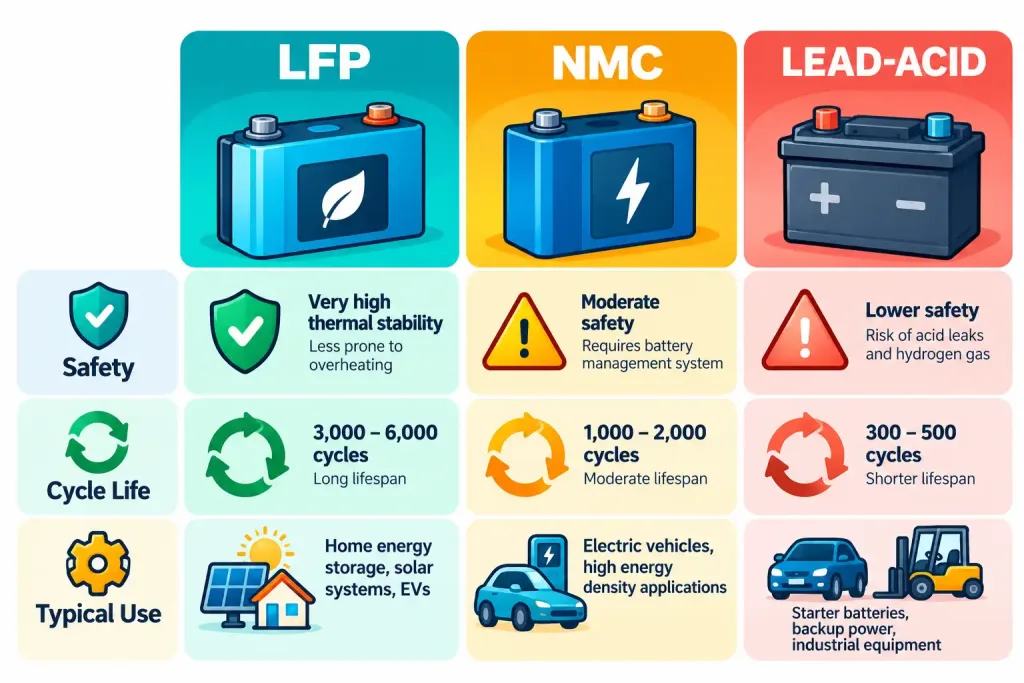
Battery lifespan in practice depends on more than just a maximum cycle count — depth of discharge (how far down you regularly drain it), temperature, and calendar aging (degradation over time regardless of use) all affect how long a battery actually performs well, which is why a single “X cycles” number from marketing material should be treated as a ceiling under ideal conditions, not a guaranteed real-world outcome.
Safety Certifications Worth Actually Checking
Rather than taking a vague “meets safety requirements” claim at face value, look for two specific certifications on any home battery system: UL 9540, which certifies the complete energy storage system, and UL 9540A, a specific fire-safety test for thermal runaway propagation. These are the standards installers and inspectors actually reference, and a reputable product will list its certifications explicitly rather than making a general safety claim.
Cost and the Current State of Incentives
Installed home battery systems commonly run in the five-figure range depending on capacity and installation complexity, and pricing varies enough by region and installer that getting multiple quotes is genuinely worth the time rather than treating any single number as standard.
On incentives specifically: it’s important to get this right rather than rely on older articles, because the landscape changed significantly. The federal residential solar tax credit (Section 25D), which for years let homeowners claim 30% of system costs including battery storage, was eliminated for systems purchased and installed starting in 2026, following the 2025 tax and budget legislation that ended the credit early. If you’re evaluating a system now, don’t assume that 30% federal credit applies — check current eligibility directly with a tax professional or the IRS, and look into your state and local incentives separately, since many of those remain active independent of the federal credit’s status and vary significantly by location.
Making the Decision
Working through capacity, power rating, round-trip efficiency, chemistry, and safety certification in that order gives you a genuinely comparable way to evaluate competing systems, rather than picking based on brand name or a single advertised spec. Get a proper load assessment from an installer rather than relying on a blanket capacity rule, request certification documentation rather than a vague safety claim, and get multiple quotes given how much installation costs can vary by region. Taken together, these five factors are really the whole answer to finding the right solar battery storage system for your home, rather than any single spec on its own.
Frequently Asked Questions
What’s the difference between battery capacity and power rating?
Capacity (kWh) is how much total energy a battery can store and release. Power rating (kW) is how much of that energy it can deliver at any given moment. A battery can have high capacity but a limited power rating, meaning it can’t handle large simultaneous loads even if it holds a lot of total energy. Weighing both together, rather than just one spec, is the core of choosing the right solar battery storage for your home.
Is LFP or NMC lithium better for home solar storage?
LFP (lithium iron phosphate) has become the dominant choice for home storage specifically because of its strong safety profile and long cycle life. NMC offers higher energy density but carries a somewhat higher thermal runaway risk, which is part of why it’s more commonly used in electric vehicles than in stationary home batteries.
Does the federal solar tax credit still apply to battery storage?
Not for homeowner purchases starting in 2026 — the 30% residential credit (Section 25D) was eliminated under 2025 tax legislation. Check current state and local incentives separately, since many remain active, and confirm federal eligibility directly with a tax professional before assuming any credit applies.
What safety certifications should I look for in a home battery?
UL 9540 (certifying the overall energy storage system) and UL 9540A (a specific thermal-runaway fire-safety test) are the two standards actually referenced by installers and inspectors. A reputable product will list these explicitly rather than making a vague “meets safety requirements” claim.