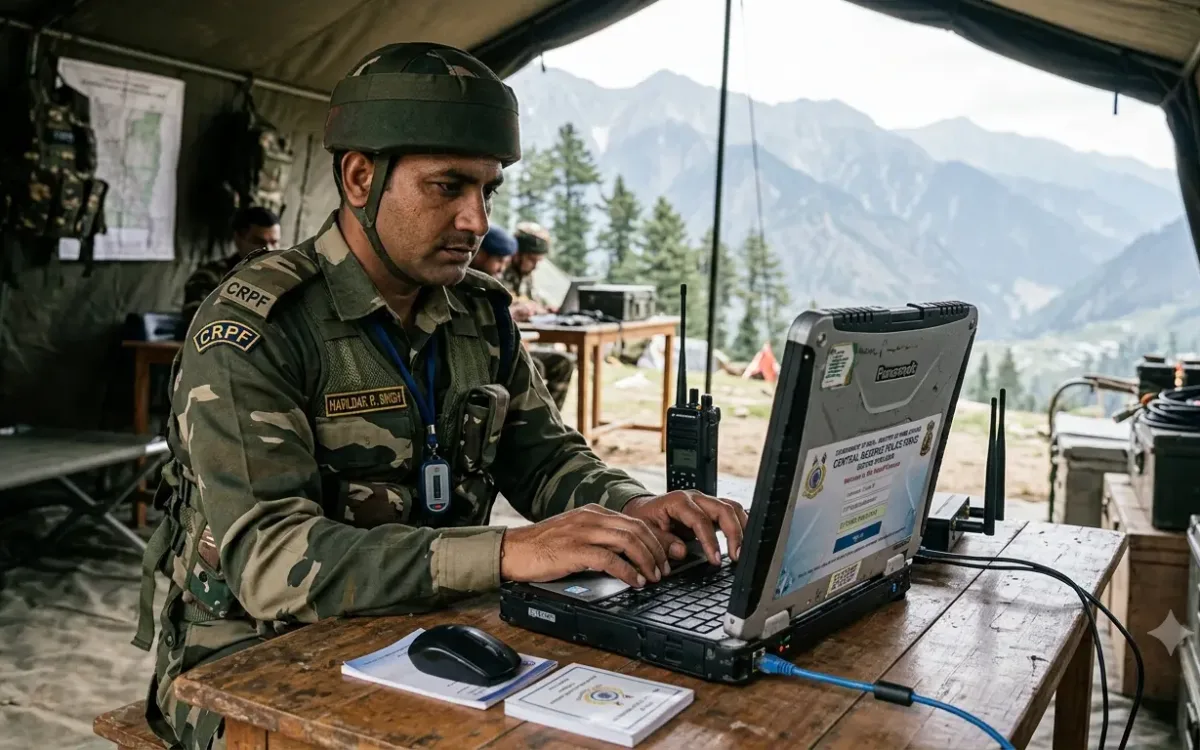
What the CRPF Is and Why Remote Access Matters
The Central Reserve Police Force is India’s largest Central Armed Police Force, operating under the Ministry of Home Affairs. Originally established on 27 July 1939 as the Crown Representative’s Police, it took its current name and form when the CRPF Act was passed on 28 December 1949. Today, the force comprises 246 battalions — including 208 Executive Battalions, 15 Rapid Action Force (RAF) battalions, 10 CoBRA (Commando Battalion for Resolute Action) battalions, and several specialist units — with a total strength exceeding 313,000 active personnel and an annual budget of ₹38,517 crore for 2026–27.
CRPF personnel are deployed across the country for internal-security duties: anti-insurgency and Left-Wing Extremism operations, election-security duty, VIP protection, and disaster response. Officers are routinely posted to temporary camps, training establishments, and administrative attachments across multiple states, often far from a fixed office. That operational spread is the real reason secure remote access matters for a force like this. When personnel are dispersed across postings, files still need to move, reports still need filing, and there still needs to be an auditable record of who accessed what.
Remote access becomes the practical compromise between operating across distance and maintaining a disciplined administrative trail. It is treated as a controlled privilege — not a convenience — which is precisely why the actual technical and procedural details are handled through internal channels rather than published on public blogs.
The NIC VPN Framework: What Is Actually Documented
CRPF’s Web VPN does not exist in isolation. It sits within the broader government remote-access framework run by the National Informatics Centre (NIC), an Indian government body under the Ministry of Electronics and Information Technology (MeitY), established in 1976. NIC operates the backbone IT infrastructure — networks, data centres, and e-governance applications — for central and state government departments across India.
According to NIC’s own published documentation, the NIC VPN Service provides secure remote access to servers and websites hosted in NIC Data Centres. Eligibility is explicitly limited: authorised employees from NIC, central and state government departments, public-sector undertakings, and autonomous bodies who need to administer or manage systems hosted in those data centres. Access is provisioned as a formal administrative act rather than a self-service download. Eligible users register online at vpn.nic.in and must submit their application through their Reporting Officer, Head of Department, or Nodal Officers, along with the concerned NIC Coordinator. Approved users then receive VPN details and a digital certificate, install the certificate and required client software, and connect.
For browser-based access — what government documentation calls WebVPN — the portal is saccess.nic.in. This is the SACCESS application, which provides clientless WebVPN over the internet, allowing authorised users to access internal applications hosted in NIC Data Centres from any internet-connected device via a standard web browser. Multiple officially published government circulars and SOPs confirm this URL and the basic workflow: log in using an official NIC or government email address as the username, then complete a one-time-password (OTP) step before being redirected to the relevant internal service, such as e-Office or SPARROW. The OTP can be delivered by SMS or generated through a mobile authenticator app — the latter being more reliable in areas with poor cellular signal.
The registration process, per documented NIC guidance, typically takes around two working days once an application is submitted through the correct internal channels. Approvals route through reporting and coordinating officers, which means access can be audited end-to-end and revoked when a posting ends or authorisation changes. This role-based, revocable model is the same principle behind access-control systems that protect sensitive data more broadly — and it has a practical consequence worth understanding: when someone is locked out, the real cause is often an authorisation change, not a technical system failure.
What Is Not Verifiable — and Why You Should Be Cautious
A large body of “CRPF VPN login” content circulating online makes confident claims that are either unverifiable or demonstrably wrong. Understanding what falls into this category matters for safety, not just accuracy.
Specific login URLs presented as public entry points for a security force’s VPN should be treated with scepticism. A paramilitary organisation is not incentivised to publish technical detail about its remote entry points; the public record is sparse by design. Personnel with legitimate access already receive the correct address through internal IT channels. Any public page offering a specific “login here” link for a law-enforcement VPN is following exactly the same pattern used by phishing pages — which are designed to harvest credentials from people who don’t know the difference.
Step-by-step credential flows in circulation — typically framed as “use your employee ID, pick a server, click connect” — are generic descriptions dressed as insider knowledge. The actual NIC VPN provisioning process, as documented in official government sources, involves formal application, officer approval, digital certificates, and registered government email credentials. It is not a public download-and-go service.
Migration deadlines deserve particular scrutiny. Circulating articles variously claim that legacy access arrangements “end July 2025” and “end July 2026” — sometimes within the same piece. Contradictory dates across sources that cite no internal directives are a reliable signal of fabricated content. Genuine migration schedules reach personnel through official internal communications, not third-party websites. Similarly, escalation phone numbers and IT email addresses for a security force’s internal IT support should never be sourced from a blog — use only officially communicated channels from your unit or formation.
Precise breach and savings statistics — claims such as “cyber attacks up 20% year-on-year,” “₹5 crore saved annually,” or “15 breaches thwarted” — appear widely in circulating guides without any cited source. They are invented specificity, designed to make an article sound authoritative. No official CRPF or NIC publication has released such figures publicly.
How WebVPN Works: The Concept, Not a Login Guide
At a conceptual level, the technology behind NIC’s WebVPN is not mysterious, and understanding it helps you recognise where fake guides go wrong. The NIC VPN service uses industry-standard encryption protocols — IPSec and SSL — to protect data in transit, as stated in NIC’s own published service descriptions. Understanding the mechanics of secure private networking helps make sense of how these controls function in practice.
When an authorised user connects, the system first verifies their identity through multi-factor authentication: a registered government email address or e-Office ID as the username, a password, and a one-time password delivered via SMS or authenticator app. Once validated, an encrypted tunnel is established between the user’s device and the internal servers hosted in NIC Data Centres. Everything travelling through that tunnel is encrypted, so anyone intercepting it without authorisation sees only unreadable ciphertext. When the session ends, the tunnel closes and no lingering access remains.
This is why remote access over untrusted networks — public Wi-Fi at a transit point, for example — can be made reasonably safe: the encryption protects the traffic regardless of the underlying network quality. It also explains why the emphasis throughout real government documentation is on who is permitted to connect and how their identity is proven, rather than on speed benchmarks or feature lists. The OTP requirement is the single most important security control to understand. It means that even if a password is compromised, access still cannot occur without the second factor tied to a registered identity.
Correcting the Specific Claims Found in Circulating Guides
A few assertions common in popular “CRPF VPN login” articles are worth addressing directly, because they are not merely unverified — they reflect conceptual confusion about what this infrastructure is and does.
Framing a law-enforcement VPN as a tool for “bypassing geo-restrictions” confuses a consumer-VPN marketing pitch with a controlled-access government system. The purpose of NIC WebVPN is authenticated, auditable access to internal government applications — not evading regional content blocks. These are entirely different use cases with different architectures, different oversight requirements, and different risk profiles.
Guidance about using the service on personal devices appears inconsistently across circulating articles — sometimes “yes with IT approval,” sometimes “no personal use.” The safe and accurate position is that device policy for a security force is set internally, typically involves device verification, and is not something a public blog can determine. Whether a personal device may be used at all is a question for official policy, communicated through your unit.
Comparisons to commercial VPN providers largely miss the point. A government WebVPN and a consumer privacy VPN solve fundamentally different problems. One provides controlled access to internal government systems with central oversight and revocability; the other sells individuals general-purpose privacy and content unblocking on the open internet. Evaluating them side by side on price or cipher strength is a category error.
The phrase “military-grade encryption” that appears throughout these guides is marketing language, not a technical specification. Strong encryption standards are real and in use — NIC documentation references IPSec and SSL — but the phrase itself is meaningless as a differentiator. The meaningful security properties in this context are identity verification, multi-factor authentication, certificate-based access provisioning, and end-to-end auditability. Those properties are what make the system trustworthy, not a slogan.
Practical Security Guidance for Government Personnel
For anyone using government remote access legitimately, the following principles hold regardless of which specific system or department is involved.
Always reach internal systems only through officially communicated portals and client software — never through links found on third-party websites or received unexpectedly by message. This discipline sits at the heart of reducing an organisation's cyber-attack surface, and it is the primary defence against phishing pages that mimic government login portals.
Protect your OTP device and never share one-time passwords. Multi-factor authentication only functions as a security control if the second factor stays exclusively with the authorised user. Keep your operating system and any official VPN client software updated — outdated software is a common and well-documented entry point for attackers. Assume that all access is logged and tied to your registered identity; treat that as the accountability feature it is intended to be, not as a surveillance concern. And if you find yourself unexpectedly locked out, contact your unit’s IT coordinator or NIC Coordinator rather than searching online for a workaround — the cause is frequently an authorisation change, not a system outage.
Conclusion
The honest version of a “CRPF VPN login” article is shorter and less dramatic than most of what currently dominates search results, because most of what those articles confidently state is simply not public information — and for good reason. What is documented is the surrounding NIC VPN framework: a structured, approval-based system for secure remote access to government-hosted resources, using registered identities, multi-factor authentication, digital certificates, and formal officer-approval chains. CRPF’s Web VPN sits inside that framework, as do e-services for dozens of other central government bodies.
For anything beyond that general framework — the current portal address, your specific credentials, the client software version, or any migration timeline — the only trustworthy source is official CRPF and NIC communication through your chain of command. Any public page offering a specific login URL and a quick credential flow for a security force’s internal VPN should be treated not as a shortcut, but as a reason for caution. The pattern is indistinguishable from a credential-harvesting phishing page, and that is not a coincidence.
Authorised personnel who need access for the first time, or who have lost access after a posting change, should submit a registration request via eforms.nic.in with the involvement of their Reporting Officer and the relevant NIC Coordinator — the official process documented across multiple government department circulars. That process, and not any public blog, is the legitimate route.