
“Bitcoin and sustainability” usually gets discussed as a contradiction — a famously energy-hungry network sitting awkwardly next to a movement built around reducing waste and reusing resources. That framing isn’t entirely wrong, but it skips past the parts of this relationship that are genuinely interesting and, in a few specific cases, genuinely positive. Here’s what the circular economy actually is, what Bitcoin’s environmental footprint actually looks like with real numbers attached, and the narrow but real ways the two intersect.
What the Circular Economy Actually Means
A circular economy is a model built around keeping resources in use for as long as possible — through reuse, repair, refurbishment, and recycling — rather than the traditional linear model of take raw materials, make a product, use it, then dispose of it. The goal is to minimize waste and the extraction of new raw materials by designing products and systems so that what would otherwise become waste gets fed back into production instead. It’s a framework that applies as naturally to electronics and industrial equipment as it does to packaging or textiles, which matters here because Bitcoin mining is, at its core, an industrial hardware operation.
Bitcoin’s Environmental Footprint, With Actual Numbers
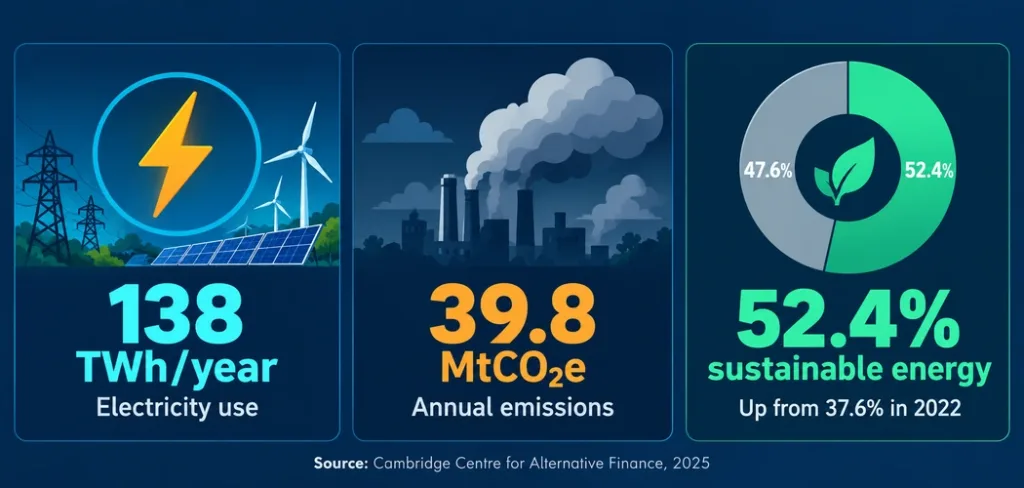
Vague claims that Bitcoin’s footprint “compares favorably” to traditional finance don’t hold up well without data, so here’s what the most recent rigorous estimate actually says. The University of Cambridge’s Centre for Alternative Finance published a report in April 2025, based on a survey of 49 mining firms across 23 countries representing roughly 48% of global mining activity, putting Bitcoin’s annual electricity consumption at approximately 138 terawatt-hours — about 0.5% of global electricity consumption — with associated network-wide emissions estimated at 39.8 million tonnes of CO2-equivalent per year.
The same report found that 52.4% of Bitcoin mining now runs on sustainable energy sources, split between 42.6% renewables (primarily hydropower and wind) and 9.8% nuclear — up meaningfully from a 2022 estimate of 37.6%. That’s a genuine improvement, driven largely by miners relocating to regions with cheap hydro and wind capacity and by a growing subset of operations specifically built around otherwise-wasted energy (more on that below).
It is not, however, the same as saying Bitcoin’s footprint is small or solved — roughly half its energy still comes from fossil sources, and the absolute emissions figure is comparable to a mid-sized country’s annual output. Any claim about Bitcoin’s environmental standing is only honest if it includes both halves of that picture.
Where the Real Circular Economy Connection Exists: Energy
The most legitimate link between Bitcoin and circular-economy principles isn’t abstract — it’s that Bitcoin mining can function as a flexible, interruptible buyer for energy that would otherwise be wasted entirely, which is a genuine resource-efficiency use case rather than marketing language:
- Flared natural gas. Oil and gas production often produces “stranded” associated gas with no pipeline infrastructure to transport it, which operators historically burned off (flaring) because capturing it wasn’t economical. Companies like Crusoe Energy Systems run mobile data centers directly at well sites, using otherwise-flared gas to power Bitcoin mining instead of burning it off for no economic benefit — converting a pure waste stream into both computing capacity and (by burning the gas in a generator rather than an open flare) meaningfully more complete combustion, which reduces methane slip compared to flaring.
- Curtailed renewable capacity. Wind and solar installations frequently generate more power than the local grid can absorb at a given moment, especially in regions with limited transmission capacity, and that excess generation often gets curtailed (deliberately wasted) rather than used. Mining operations that can power down within seconds act as a flexible, interruptible load that can absorb exactly this kind of otherwise-wasted renewable output, giving grid operators and renewable developers a buyer of last resort for power that would otherwise generate no revenue or environmental benefit at all.
- Grid-balancing and demand response. Beyond just absorbing excess supply, some mining operations now participate formally in grid demand-response programs, powering down during peak demand periods in exchange for payment — the mining load becomes a tool for grid stability rather than simply a consumer competing with other demand.
These aren’t hypothetical or PR-only use cases — they represent real, if still comparatively small, segments of the mining industry, and they’re the actual substance behind “Bitcoin can support sustainable energy infrastructure” claims, as opposed to vague assertions about blockchain transparency helping supply chains in general.
The Circular Economy Problem Bitcoin Mining Actually Has: Hardware Waste
Any honest treatment of Bitcoin and the circular economy has to include the uncomfortable part, not just the flattering one. Bitcoin mining runs on ASICs (application-specific integrated circuits) — chips designed to do nothing but compute Bitcoin’s mining algorithm as fast and efficiently as possible. That specialization is exactly what makes them fast, and exactly what makes them circular-economy-unfriendly: once a newer, more efficient ASIC generation makes an older one unprofitable to run, the old hardware can’t be repurposed for anything else the way a general-purpose server or GPU often can.
Research published in the journal Resources, Conservation & Recycling estimates that Bitcoin mining generates up to 30,700 tonnes of electronic waste per year — comparable to the small-IT-equipment waste produced by an entire country like the Netherlands — driven by an average ASIC hardware lifespan of only about 1.29 years before it’s replaced. That’s a genuine circular-economy failure mode specific to this industry, and it’s worth naming directly rather than letting “blockchain enables sustainability” rhetoric paper over it. Some mining operations and manufacturers have begun exploring take-back and component-recycling programs for retired ASICs, but this remains a much less mature practice than the energy-reuse side of the industry.
“Green Bitcoin” and Carbon Offsetting, Honestly
Bitcoin carbon-offset programs and “green” mining claims exist and some are legitimate, but this is an area that rewards skepticism rather than acceptance at face value. A credible claim should specify: which carbon credits are used and under what certification standard, whether the offsets are retired (permanently claimed) rather than double-counted or resold, and whether the underlying renewable-energy claims are based on direct power-purchase agreements or just geographic proximity to a grid with some renewable mix. A business or reader evaluating any specific “carbon-neutral Bitcoin” claim should ask for these specifics rather than accepting the label itself as evidence.
Decentralization, DeFi, and Resource Efficiency: What’s Actually Verifiable
Claims that decentralization and DeFi inherently “enable inclusive participation” and resource efficiency are directionally reasonable but need grounding: decentralized systems remove intermediaries from certain transactions, which can reduce some administrative overhead, and blockchain’s immutable record-keeping genuinely does make supply-chain provenance tracking more auditable in specific deployed systems (several real pilots exist in commodities and agriculture tracing). But “blockchain helps supply chains” is a claim that needs a named example to mean anything — a generic reference to “several successful case studies” with none named is not a basis for a reader to evaluate the claim, and that kind of unsupported generality is worth being skeptical of wherever it appears, in this topic or any other.
The Regulatory Picture, Specifically
Regulatory treatment of crypto’s environmental dimension is an active, evolving area rather than a settled one. The EU’s Markets in Crypto-Assets (MiCA) regulation, which came into force in phases through 2024, requires crypto-asset service providers to disclose information about the environmental impact of the consensus mechanisms they use — a concrete disclosure requirement, not just a general “regulatory landscape” gesture. In the US, environmental disclosure requirements specific to crypto mining remain less developed at the federal level, though some states have considered or enacted measures targeting mining operations’ energy use directly. This is a genuinely unsettled area worth watching rather than a solved regulatory question.
The Bottom Line
The honest version of “Bitcoin and the circular economy” isn’t a blanket claim that Bitcoin is environmentally sound, nor is it a blanket dismissal. It’s a genuinely mixed picture: real progress on the energy side (52.4% sustainable energy sourcing as of the 2025 Cambridge estimate, up from 37.6% in 2022, plus legitimate flared-gas and curtailed-renewable use cases that function as real resource-efficiency wins) sitting alongside a real and under-addressed hardware-waste problem (up to 30,700 tonnes of e-waste annually from short-lived ASIC hardware) that doesn’t get the same attention.
Evaluating any specific claim in this space — “green” mining, carbon-neutral Bitcoin, blockchain-enabled supply chains — on its actual evidence rather than the label attached to it is the only way to tell which claims hold up.
Frequently Asked Questions
Is Bitcoin mining actually becoming more sustainable? On the energy-sourcing side, yes, measurably — the share of mining powered by sustainable energy rose from about 37.6% in 2022 to 52.4% as of a 2025 Cambridge Centre for Alternative Finance estimate. That’s real progress, though it still means roughly half of mining’s energy comes from non-sustainable sources, and it doesn’t address the separate hardware-waste problem.
What’s the real link between Bitcoin mining and reducing energy waste? Mining operations can act as flexible, interruptible buyers for energy that would otherwise be wasted entirely — flared natural gas at oil wells that would otherwise just be burned off with no benefit, and curtailed wind or solar output that exceeds what the local grid can absorb. Companies like Crusoe Energy Systems operate specifically around the flared-gas use case.
Why is Bitcoin mining hardware such a significant source of e-waste? ASIC mining chips are built to do one thing — compute Bitcoin’s mining algorithm — and nothing else, so once a newer, more efficient chip generation makes an older one unprofitable, it typically can’t be repurposed for any other use. With an average device lifespan of only about 1.29 years, this drives rapid hardware turnover and, by one published estimate, up to 30,700 tonnes of e-waste annually.
How should I evaluate a company’s “carbon-neutral” or “green” Bitcoin claim? Ask specifically which carbon credits are used, under what certification standard, whether they’re permanently retired rather than resold or double-counted, and whether renewable-energy claims are backed by actual power-purchase agreements rather than just operating in a region with some renewable capacity on its grid. The label alone isn’t evidence.