Mandarin Chinese has a reputation as one of the hardest languages for English speakers to learn — and that reputation is earned, but not in the way most beginners expect. The real difficulty isn’t some mystical “Chinese is impossible” barrier; it’s that Chinese breaks nearly every assumption English speakers bring from learning French or Spanish. No alphabet. No verb conjugation. A tonal system that changes a word’s entire meaning based on pitch. And a writing system built from thousands of characters rather than 26 letters.
None of that makes it unlearnable — it makes it a language that rewards a different strategy than the one that works for Romance languages. This guide covers what actually works: the real structure of the challenge, the methods backed by how memory and language acquisition actually function, a genuinely honest comparison of the tools available (including Migaku, which the original version of this article focused on exclusively), and a realistic study plan you can actually follow.
Why Chinese Is Different, Not Just “Harder”
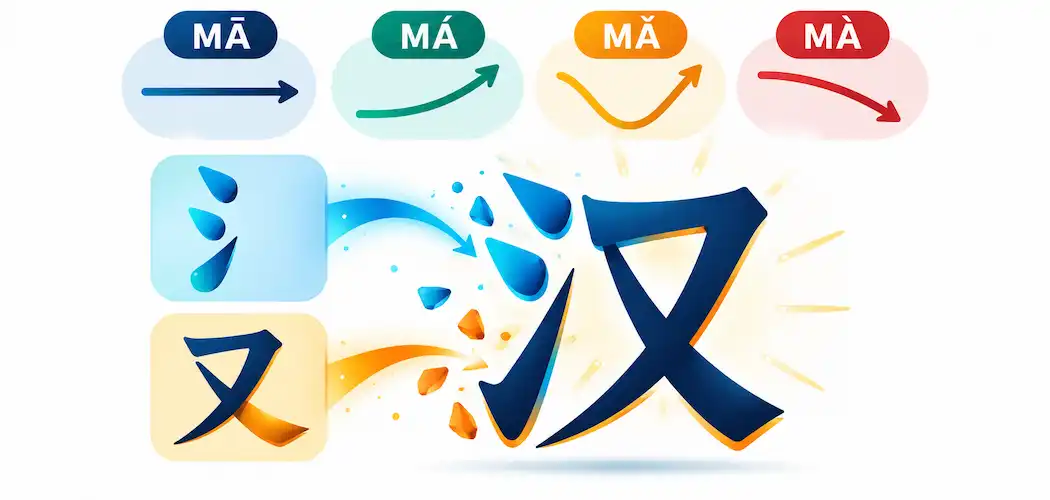
No alphabet, but not random either. Chinese characters (汉字, hànzì) aren’t arbitrary symbols — most are built from combinations of radicals, smaller recurring components that often hint at meaning or pronunciation. Once you recognize that 氵(water radical) tends to show up in words related to liquid — 河 (river), 海 (sea), 汗 (sweat) — characters stop looking like random scribbles and start looking like a system you can learn to read, the same way English speakers learn that “-tion” signals a noun.
Tones carry real meaning, not just emphasis. Mandarin has four main tones plus a neutral tone, and getting them wrong doesn’t just sound like an accent — it can change the word entirely. The classic example: mā (妈, mother), má (麻, hemp/numb), mǎ (马, horse), and mà (骂, to scold) are four completely different words that an English speaker’s ear initially hears as “the same syllable said slightly differently.” Training your ear to hear tone as meaning, not decoration, is one of the genuine early hurdles — and it’s a listening problem before it’s a speaking problem.
Grammar is comparatively simple — this is the good news. Chinese has no verb conjugation, no noun gender, no plural forms to memorize, and a word order that’s closer to English than you’d expect. Time and context, not verb endings, tell you whether something happened yesterday or will happen tomorrow. This is a genuine advantage over, say, learning Russian or German grammar, and it’s worth knowing upfront so the character-and-tone challenge doesn’t make the whole language feel uniformly hard.
Why People Actually Learn Chinese — And Why Your Reason Should Shape Your Plan
Before getting into method, it’s worth being honest that “learn Chinese” means different things depending on why you’re doing it, and the right study plan genuinely differs by goal:
- Business and career. If you’re learning for professional reasons — dealing with Chinese suppliers, clients, or colleagues — you likely need strong listening and speaking first, with reading coming later, and you may never need to handwrite a single character. Business Mandarin also has its own vocabulary set (negotiation language, industry terms) that generic courses barely touch.
- Heritage learners. If you grew up hearing Chinese at home but never formally studied it, you often have a head start on listening comprehension and tone recognition that complete beginners lack, but a real gap in reading/writing and formal vocabulary. Standard “beginner” courses can feel simultaneously too slow (for listening) and too fast (for characters) — a more customized mix of immersion content and targeted character study usually works better than a generic beginner track.
- Travel and short-term practical use. If your goal is navigating a trip rather than deep fluency, a narrower, high-frequency vocabulary set (numbers, directions, food, basic survival phrases) delivers far more practical value per hour studied than working through a full structured course.
- Academic or certification-driven study. If you need an HSK score for university admission or a job requirement, your plan should be built backward from the specific HSK level’s vocabulary list and test format, not a generic “learn Chinese” curriculum.
- General interest / media and culture. If you’re drawn to Chinese cinema, music, or literature, immersion-first study (built around content you’re already motivated to understand) tends to sustain motivation far better than textbook-first study, since the content itself is the reward, not just a study exercise.
None of this changes the underlying mechanics covered below — tones, characters, spaced repetition, and immersion all still apply — but it should shape how you prioritize your limited study time.
Breaking Down the Tone System Properly
It’s worth spending real time on tones specifically, since this is where most self-taught learners develop habits that are hard to correct later.
The five tones, practically described:
- First tone (mā): high and flat, held steady — like holding a single musical note.
- Second tone (má): rising, like the intonation of a surprised “what?” in English.
- Third tone (mǎ): falls then rises — in connected speech, it’s often shortened to just the low dip, which trips up learners who only practiced the full textbook version.
- Fourth tone (mà): a sharp fall, like a firm command — “No!” said with emphasis.
- Neutral tone: short, light, unstressed — carries no independent pitch contour, borrowing its pitch from context.
Why isolated tone drills aren’t enough. Textbook tone charts teach each tone in isolation, but real speech constantly modifies tones based on neighboring syllables — the most well-known example being third-tone sandhi, where two third tones in a row cause the first to shift to something closer to a second tone. This is exactly why pure memorization of “tone rules” without listening to real connected speech leaves learners able to produce textbook-perfect isolated syllables that still sound unnatural, or get misunderstood, in actual conversation.
A practical fix: minimal pair drills plus shadowing. Minimal pairs — word pairs that differ only by tone (mā/má/mǎ/mà) — trained through listening discrimination exercises build the ear’s ability to actually hear tone as meaningful, which has to come before reliable production. Shadowing — listening to a short clip of native audio and immediately repeating it, matching rhythm, pitch, and pacing as closely as possible rather than translating first — trains the muscle memory and pitch control that isolated drilling misses.
Understanding Characters: Radicals, Components, and Phonetic Hints
Roughly 80-90% of modern Chinese characters are what’s called phono-semantic compounds — built from two parts, one hinting at meaning (the semantic component, often a radical) and one hinting at pronunciation (the phonetic component). This single fact changes character learning from “memorize thousands of unrelated pictures” to “learn a few hundred recurring building blocks and recognize how they combine.”
A few genuinely useful examples:
- 女 (woman) appears in 妈 (mother), 姐 (older sister), 好 (good — the idea of a woman with a child, historically) — the semantic component signals category.
- 青 (qīng) as a phonetic component shows up in 清 (qīng, clear), 请 (qǐng, please/invite), and 情 (qíng, feeling) — all pronounced with a similar sound, hinting that the phonetic part is doing real work even though the meanings differ.
- The radical 氵(a compressed form of 水, water) consistently marks water-related meaning: 河 (river), 海 (sea), 汤 (soup), 泪 (tears).
Learning the roughly 200 most common radicals early, rather than treating every character as a brand-new shape to memorize from scratch, is one of the highest-leverage early investments a learner can make — it turns character recognition from rote visual memorization into pattern recognition, the same cognitive shift that makes reading English words faster once you recognize common prefixes and suffixes instead of sounding out every letter.
The HSK System: Knowing What “Fluent” Actually Means
If you’re setting goals, it helps to use a real, standardized reference rather than a vague “I want to be fluent.” The HSK (Hanyu Shuiping Kaoshi) is China’s official standardized Chinese proficiency test, and it’s currently mid-transition to a new structure worth knowing about if you’re planning long-term study:
- HSK 2.0 (the system most learners are still familiar with) has 6 levels, with HSK 6 requiring roughly 5,000 words.
- HSK 3.0, the revised standard, restructures proficiency into 9 levels across three stages — Elementary (1–3), Intermediate (4–6), and Advanced (7–9) — with notably higher vocabulary requirements at every level (HSK 3.0 Level 4, for instance, requires around 2,000 words versus roughly 1,200 under the old HSK 4). HSK 3.0 also makes a speaking component mandatory starting at Level 3, a meaningful change from the older written-only lower levels. Official HSK 3.0 testing is rolling out through 2026, with HSK 2.0 sittings winding down — if you’re planning around a specific certification timeline, check chinesetest.cn directly, since the transition details are still being finalized.
For most self-directed learners not pursuing formal certification, the practical takeaway is simpler: aim for roughly 1,000–1,500 words and basic tone accuracy to handle everyday conversation, and treat 3,000+ words as the point where reading native content (news, novels, subtitles without constant lookups) starts feeling genuinely fluent rather than effortful.
The Method That Actually Works: Comprehensible Input and Immersion
The single most evidence-aligned principle in language acquisition is simple to state and harder to execute: you learn a language primarily by understanding messages in it, not by memorizing rules about it. This is often called comprehensible input — content that’s understandable enough to follow, but still introduces new vocabulary and structures in context.
For Chinese specifically, this means:
- Watching native content with support, not pure immersion from day one. Jumping straight into untranslated Chinese TV is overwhelming for a true beginner — you need content at or just above your current level, with tools that let you look up unfamiliar words without losing the thread of what you’re watching.
- Reading graded or native content, progressively. Starting with beginner-friendly graded readers (content written specifically for learners at a known vocabulary level) and working up to native articles, web novels, or news as your vocabulary grows.
- Letting grammar emerge from exposure, supplemented by targeted explanation. You don’t need to memorize a grammar textbook before you can understand sentences — but when a pattern keeps confusing you, looking up a focused explanation (rather than avoiding grammar study entirely) speeds things up considerably.
The reason this beats rote memorization of vocabulary lists isn’t mystical — it’s that words learned in context, with real sentences and real audio attached, create far stronger and more flexible memory associations than a word sitting alone on a flashcard with just an English translation.
Spaced Repetition: The Science Behind Not Forgetting What You Just Learned
Here’s a genuinely useful piece of cognitive science: the Ebbinghaus forgetting curve, first described in the 1880s, shows that newly learned information decays rapidly without review — often more than half of it is gone within a day. Spaced repetition systems (SRS) counter this by showing you a flashcard right before you’re about to forget it, with the interval between reviews growing longer each time you successfully recall it. This is why serious language learners lean so heavily on SRS flashcard tools rather than one-time vocabulary lists: it’s working with memory’s actual decay pattern instead of against it.
For Chinese specifically, effective SRS flashcards should ideally include:
- The character(s) and pinyin (the romanized pronunciation system)
- Audio from a native speaker (tone accuracy is very hard to learn from text alone)
- A real example sentence, not just an isolated word
- Ideally, an image or context cue rather than only an English translation
Comparing the Real Tools: An Honest Look
The previous version of this article focused exclusively on one tool. Here’s a fuller, more useful picture of what’s actually available, so you can pick what fits your learning style and budget rather than taking one product’s word for it.
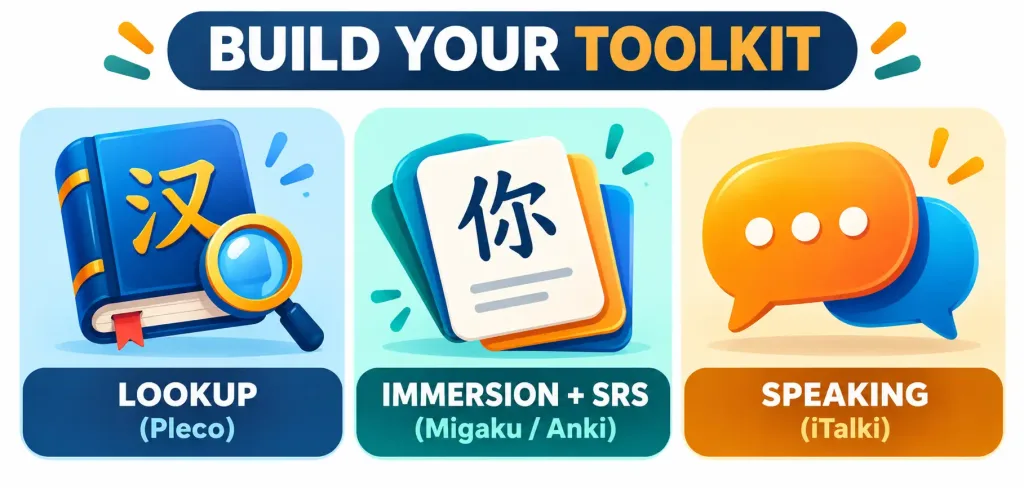
Migaku (migaku.com) is a browser extension and companion app built specifically around the immersion-plus-SRS approach described above — it adds clickable subtitles to video content (letting you look up a word mid-video without pausing your comprehension flow), generates multimedia flashcards automatically from what you look up (pulling in the audio clip, image, and sentence context rather than a bare word-translation pair), and includes tools for interactive reading of web content and web novels with real-time definitions. It’s a genuinely well-built implementation of the immersion method described in this guide, and worth trying if that workflow — learning primarily from real native content with integrated lookup and flashcard generation — appeals to you. As with any paid tool, check current pricing and try the free trial before committing, since subscription terms change.
Other tools worth knowing about, for a complete picture:
- Pleco — the most widely used Chinese dictionary app among serious learners, with excellent character lookup (including handwriting and camera-based recognition), stroke order animations, and a huge example-sentence database. Many learners use Pleco alongside an immersion tool like Migaku rather than instead of one — it’s primarily a reference tool, not a course.
- Anki — the most customizable, free (on desktop/Android) SRS flashcard system, widely used across language-learning communities for building custom Chinese decks. It requires more manual setup than an all-in-one tool but offers unmatched flexibility for learners who want full control over their review process.
- Du Chinese and The Chairman’s Bao — graded-reader platforms offering native Chinese articles leveled by difficulty, with built-in audio and pop-up dictionaries — excellent for the “progressively harder native content” stage of immersion once you’re past pure beginner level.
- HelloChinese and Duolingo — structured, gamified beginner apps that are genuinely useful for getting the absolute basics (pinyin, tone recognition, core vocabulary) before transitioning to immersion-based study. Good starting points, not sufficient on their own to reach fluency.
- iTalki and Preply — platforms connecting learners with native-speaking tutors for live conversation practice, which is close to irreplaceable for developing real speaking fluency and getting live tone correction, something no app can fully substitute for.
- Skritter — a dedicated character-writing practice app, useful specifically if handwriting (now required at earlier HSK 3.0 levels than before) is a priority for you.
The realistic picture: most successful self-directed learners combine 2–3 of these rather than relying on a single app — a dictionary tool (Pleco), an immersion/flashcard workflow (Migaku, or a free Anki setup), and regular speaking practice (a tutor platform or language exchange).
A Realistic Study Plan
Weeks 1–4 (Absolute beginner): Learn pinyin pronunciation thoroughly before anything else — it’s the foundation everything else builds on. Start basic tone-pair drills daily. Begin learning your first 150–300 words through a structured beginner app, focusing on survival vocabulary and greetings.
Months 2–4 (Building core vocabulary): Shift toward SRS flashcards with audio and example sentences for new vocabulary (targeting roughly 500–1,000 words by the end of this period). Start light immersion — short, beginner-friendly videos or graded readers with lookup support, even if you’re only understanding 50–60% without help. Begin basic character recognition for your most frequent 200–300 words.
Months 4–9 (Intermediate transition): Increase immersion time — aim for daily exposure to native or near-native content with vocabulary support. Start a weekly conversation practice habit with a tutor or exchange partner; passive input alone won’t build speaking fluency. Continue SRS daily, now targeting 1,500–3,000 words.
Months 9+ (Toward fluency): Shift the balance toward more native content and less structured study — news articles, podcasts, web novels, TV shows with Chinese (not English) subtitles. Keep SRS going for new vocabulary encountered in real content, rather than studying from pre-made decks. This is also a reasonable point to start considering an HSK level as a concrete goal if formal certification matters for your purposes (study, work, or immigration requirements).
Breaking Down the Four Skills: Listening, Speaking, Reading, Writing
It’s worth treating these as genuinely separate skills that need separate attention, rather than assuming progress in one automatically carries over to the others — a mistake that catches a lot of self-directed learners off guard.
Listening is arguably the skill most learners under-invest in relative to its importance, because it’s the one input-heavy skill that directly builds the other three. Passive listening (podcasts or shows in the background) has real but limited value; active listening — where you’re genuinely working to parse meaning, pausing and replaying difficult sections — builds comprehension far faster. A useful progression: graded-content audio for absolute beginners, slowed native podcasts or shows with Chinese subtitles at intermediate level, and full native-speed unsupported audio as a late-stage goal.
Speaking is the skill that suffers most from app-only study, because no app can fully replace real-time feedback from a human listener. Early speaking practice doesn’t need to be impressive — it needs to be frequent. A 15-minute weekly conversation with a tutor from month one, even at a very basic level, builds real-time production skills that months of silent study can’t substitute for, and it surfaces exactly which sounds and tones you’re actually struggling with (which often differs from what you’d guess from self-study alone).
Reading benefits enormously from graded content at the right level — material that’s roughly 90-95% comprehensible, where you can infer unknown words from context rather than needing to look up every third word. Content that’s too hard (under 80% comprehensible) turns reading into decoding rather than genuine input, which is both exhausting and less effective for actual acquisition.
Writing — meaning composing original Chinese, not just handwriting characters — is often the last skill developed and the one most learners need least, depending on their goals (see the “why people learn Chinese” section above). If it matters for you, starting with short, simple journal-style writing and getting corrections from a tutor or language exchange partner is far more useful than studying grammar rules in isolation.
When Progress Stalls: Getting Past a Plateau
Almost every language learner hits a point — often somewhere in the HSK 3-4 vocabulary range — where progress feels like it’s stopped, even though study hasn’t. A few genuine causes and fixes, rather than just “try harder”:
- Your input has stopped being new. If you’re re-watching the same shows or re-reading the same graded readers, you’ve likely saturated the vocabulary they contain. Deliberately seeking slightly harder, less familiar content restarts real vocabulary growth.
- You’re reviewing old material more than learning new material. A heavy SRS review backlog can crowd out new-word acquisition. It’s worth periodically capping daily reviews and prioritizing fresh input over endlessly reviewing words you already mostly know.
- You’ve neglected one of the four skills. A learner who’s read extensively but barely spoken often feels “stuck” specifically in conversation, even though their overall Chinese ability is actually progressing — the fix is deliberately rebalancing study time, not abandoning the method.
- You need harder listening material, not easier. Counterintuitively, plateaued listening comprehension often improves faster by pushing into content that’s genuinely challenging (80-85% comprehensible) rather than staying comfortable at 95%+, since the brain needs some genuine difficulty to keep building new connections.
Common Mistakes That Slow Learners Down
- Avoiding tones early on “to focus on vocabulary first.” This creates bad pronunciation habits that are genuinely harder to unlearn later than to build correctly from the start. Tone accuracy from day one is worth the extra early effort.
- Studying only from flashcards, with no real input. Vocabulary learned in isolation, without ever encountering it in actual sentences or audio, tends to be fragile — you’ll recognize it on a flashcard but freeze when you hear it in a real conversation.
- Delaying speaking practice until you “feel ready.” Speaking is a skill that only improves with speaking — reading and listening comprehension don’t automatically transfer to fluent output, and most learners who delay speaking practice find it’s the hardest skill to catch up on later.
- Treating characters as an optional extra. Skipping character learning in favor of pinyin-only study might feel faster short-term, but it caps how far you can go with reading native content, and relearning characters after building a large pinyin-only vocabulary is harder than learning them alongside vocabulary from the start.
Simplified vs. Traditional Characters, and Which “Chinese” You’re Actually Learning
One thing beginner resources often gloss over: “Chinese” isn’t a single monolithic target. Two practical distinctions matter early on:
Simplified vs. Traditional characters. Mainland China and Singapore use simplified characters (简体字), introduced in the mid-20th century to improve literacy, while Taiwan, Hong Kong, and Macau primarily use traditional characters (繁體字), which preserve more of the historical character forms. The two systems overlap significantly but aren’t identical — 国 (simplified) versus 國 (traditional) for “country” is a commonly cited example. Most learning tools, including Migaku and Pleco, support both, but it’s worth deciding early which you’re prioritizing based on where you’ll actually use the language (mainland business or travel generally points to simplified; Taiwan-focused interests point to traditional), since mixing both from day one adds unnecessary cognitive load.
Mandarin vs. other Chinese varieties. “Chinese” as most courses teach it means Standard Mandarin (based on the Beijing dialect), which is the official language of mainland China, Taiwan, and Singapore, and the most widely spoken variety globally. But China is linguistically diverse — Cantonese (spoken in Hong Kong, Macau, and much of Guangdong), Shanghainese, Hokkien, and many other varieties are, in practical terms, distinct spoken languages that share a writing system with Mandarin but aren’t mutually intelligible when spoken. If your specific goal involves Hong Kong or a particular regional community, confirm you’re learning the right variety before investing hundreds of hours — “I learned Chinese” sometimes turns out to mean “I learned a variety that isn’t spoken where I need it.”
A Sample Weekly Study Rhythm
Beyond the month-by-month arc above, here’s what a realistic week looks like for a consistent intermediate learner putting in roughly 45-60 minutes a day:
- Monday/Wednesday/Friday: SRS flashcard review (15 min) + immersion content — a video or reading passage with lookup support (25-30 min).
- Tuesday/Thursday: SRS review (15 min) + focused listening practice, ideally slightly above comfortable level (20-25 min) + 10 minutes of shadowing practice using a short clip from that day’s content.
- Saturday: A longer session — 45-60 minutes of a tutor conversation or language exchange call, using vocabulary and structures encountered that week.
- Sunday: Lighter day — passive listening (a podcast or show, even partially understood) during a commute or chore, with no formal study pressure. Consistency matters more than any single day’s intensity, and a deliberate lighter day helps sustain a daily habit rather than burning out.
This rhythm isn’t a rigid prescription — the right balance shifts based on your goals (see above) and which skill currently needs the most attention — but it illustrates the core principle: daily input and review, with weekly dedicated speaking practice, rather than infrequent long study marathons.
The Bottom Line
Chinese isn’t harder than other languages in some abstract sense — it’s different in ways that make rote memorization and translation-heavy study genuinely inefficient, and comprehensible input plus spaced repetition genuinely effective. The right toolkit — a solid dictionary, an immersion/flashcard workflow that fits your style, and real speaking practice — matters more than any single app’s marketing claims. Whether that immersion tool is Migaku, a free Anki setup, or something else entirely, the method underneath it is what actually moves the needle.
Frequently Asked Questions
How long does it realistically take to become conversational in Chinese?
With consistent daily study (45–60 minutes) using an immersion-plus-SRS approach, most learners reach basic conversational ability (roughly HSK 3–4 level, 1,000–2,000 words) within 12–18 months. True fluency takes considerably longer — Chinese is officially classified by the U.S. Foreign Service Institute as one of the most time-intensive languages for English speakers to reach professional proficiency in, typically requiring significantly more study hours than French or Spanish.
Do I need to learn to write Chinese characters by hand, or is typing enough?
It depends on your goals. For reading fluency and everyday typing (which uses pinyin input, not handwriting), character recognition without handwriting mastery is sufficient for most learners. However, HSK 3.0’s updated syllabus now requires handwriting from earlier levels than the previous system did, so if formal certification is a goal, handwriting practice (via a tool like Skritter) matters more than it used to.
Is Migaku worth it, or should I just use free tools?
It depends on how much you value an integrated, low-friction workflow versus assembling free tools yourself. Migaku’s core value is reducing the friction of the immersion method — clickable subtitles and automatic flashcard generation save real time compared to manually looking up words and building cards in Anki. A dedicated, patient learner can replicate much of this with free tools (Anki plus a browser dictionary extension), but it takes more manual setup. Try the free trial and decide based on your own workflow preference.
What’s the single best way to improve my tones?
Focused listening discrimination practice (minimal-pair drills, where you practice distinguishing words that differ only by tone) combined with regular speaking practice where a native speaker or tutor can correct you in real time. Shadowing — repeating native audio immediately after hearing it, matching rhythm and pitch as closely as possible — is also widely used and genuinely effective.